 India's No.1 PU & Degree With Integrated IAS & IPS(UPSC/PSC) Training College.


Maratha Military Landscapes Join UNESCO List
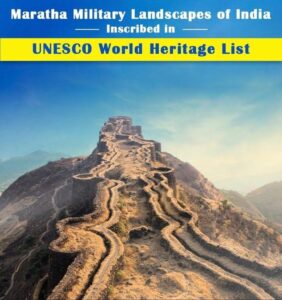
Maratha Military Landscapes Inscribed on UNESCO World Heritage List
Why in the News?
The Maratha Military Landscapes of India, comprising 12 historic forts, has been officially inscribed on the world heritage list during the 47th session of the World Heritage Committee held in Paris. This recognition highlights the Maratha Empire’s strategic military vision and architectural excellence spanning the 17th to 19th centuries, showcasing their military ingenuity.
UNESCO Inscription and Significance:
- The Maratha Military Landscapes of India became India’s 44th UNESCO World Heritage site.
- The decision was announced at the ongoing 47th session of the World Heritage Committee (WHC) in Paris, also known as the Paris session, marking an important intergovernmental decision.
- This listing celebrates India’s rich cultural heritage, architectural brilliance, and historical resonance through the Maratha forts, boosting heritage tourism and heritage preservation efforts while instilling a sense of cultural pride among citizens.
- The nomination process began in January 2024 and included rigorous technical evaluations and an International Council on Monuments and Sites (ICOMOS) mission, which conducted a thorough impact assessment of the sites.
List of Forts Included:
- Forts in Maharashtra:
○ Raigad fort, Shivneri fort, Lohgad, Khanderi fort, Rajgad fort, Pratapgad, Suvarnadurg, Panhala fort, Vijaydurg, Sindhudurg, Alibag fort, Kasa fort
- Fort in Tamil Nadu:
○ Gingee Fort
- Additional notable fort:
○ Mulher fort
- Leaders such as Prime Minister Narendra Modi, Culture Minister Gajendra Singh Shekhawat, and Maharashtra Chief Minister Devendra Fadnavis congratulated the nation on this historic achievement, highlighting the involvement of the Union Culture Ministry in the process and the increased global visibility for these sites.
About Maratha Military Landscapes: |
| ● The Maratha Military Landscapes is a network of 12 forts reflecting the military defense system of the Maratha Empire (17th–19th centuries CE). |
| ● Listed as a UNESCO World Heritage Site in 2024, it was added to the Tentative List in 2021. |
| ● Forts are located across Maharashtra and Tamil Nadu, representing diverse landscapes: hill, coastal, plateau, island, and forest. |
| ● Key forts: Raigad fort, Shivneri fort, Lohgad, Khanderi fort, Rajgad fort, Pratapgad, Suvarnadurg, Panhala fort, Vijaydurg, Sindhudurg, Gingee |
| ● 8 forts are protected by the Archaeological Survey of India, 4 by Maharashtra’s archaeology department. |
| ● The fort system integrates Western Ghats, Konkan Coast, Deccan Plateau, and Eastern Ghats, showcasing strategic geographic adaptation. |
| ● The military ideology began under Chhatrapati Shivaji Maharaj (1670 CE) and lasted till 1818 CE. |
| ● These forts exemplify the strategic military planning and architectural ingenuity of the Maratha rulers. |
| ● The forts are spread across Maharashtra and Tamil Nadu states, with many situated in the Sahyadri mountain ranges. |
These Shivaji forts represent a remarkable feat of military ingenuity, offering panoramic views of the surrounding landscapes. The inclusion of coastal forts like Khanderi showcases the Marathas’ maritime military architecture. This UNESCO recognition not only highlights the forts’ architectural legacy but also their potential for promoting responsible tourism and community-based tourism in the region.
The extraordinary fortification techniques employed in these forts, along with their strategic military capabilities, make them a testament to the Maratha Empire’s military prowess. Weekend hikers and offbeat explorers can now explore these ancient fortresses, gaining insights into the historical and cultural significance of these structures while enjoying guided tours and learning about ongoing heritage preservation efforts.
To ensure the long-term conservation of these sites, authorities are implementing comprehensive risk management strategies and utilizing advanced technologies such as GIS mapping for accurate documentation and monitoring. Plans are underway to improve visitor infrastructure, including the potential development of ropeway access to some of the more challenging locations. Additionally, local communities are being engaged in preservation efforts, with initiatives like craft sales providing economic opportunities while preserving traditional skills.
As part of the ongoing management of these World Heritage sites, experts are conducting regular assessments to identify any need for boundary modification to ensure the integrity of the protected areas. This holistic approach to conservation and development aims to balance the preservation of these historic sites with the needs of modern tourism and local communities.

