 India's No.1 PU & Degree With Integrated IAS & IPS(UPSC/PSC) Training College.


GST Revenues Jump 14% in June on Imports
GST REVENUES UP 14% IN JUNE AMID RISING IMPORT-LED COLLECTIONS
Why in the News?
- Revenue Growth: GST collections increased by 13.9% to ₹1.95 lakh crore in June 2026, marking the highest year-on-year growth in the last 13 months.
- Import Surge: The increase was largely driven by GST on imports, which grew by nearly 35%, significantly outpacing domestic GST growth.
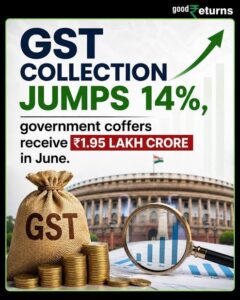
GST COLLECTION TRENDS
- Domestic Collections: GST revenue from domestic transactions grew by only 6.5% to around ₹1.35 lakh crore, reducing its share in total GST collections.
- Import Collections: GST on imports rose to about ₹60,000 crore, recording the 16th consecutive month of double-digit growth.
- Manufacturing Indicator: Higher import collections may indicate increased imports of raw materials and intermediate goods, reflecting ongoing manufacturing activity.
- Price Impact: Rising global commodity prices may also have increased the value of imported goods, leading to higher GST collections on imports.
- Structural Concerns: Experts have suggested boosting domestic manufacturing through measures such as better utilisation of Production-Linked Incentive (PLI) schemes to reduce import dependence.
GST REFORMS AND CHALLENGES
- Excluded Sectors: Major sectors such as petroleum products, liquor, real estate, agriculture, and education remain outside or largely exempt from the GST framework.
- Inverted Duty Structure: Higher tax on inputs than on finished goods continues to create refund issues and increase the compliance burden for industries.
- Registration Burden: Businesses operating across multiple States continue to require separate State-wise GST registrations, increasing compliance costs.
- Dispute Resolution: Industry has sought a simplified litigation framework and amnesty for minor reconciliation mismatches to reduce unnecessary disputes.
- Future Reforms: Inclusion of products such as natural gas and aviation turbine fuel (ATF) under GST is considered a feasible next step in GST expansion.
GOODS AND SERVICES TAX (GST)● Introduction: Goods and Services Tax (GST) was introduced on 1 July 2017 as a destination-based indirect tax under the 101st Constitutional Amendment Act, 2016. ● Constitutional Basis: Article 246A empowers Parliament and State Legislatures to levy GST, while Article 279A provides for the GST Council. ● GST Council: Chaired by the Union Finance Minister, the Council recommends tax rates, exemptions, threshold limits, and policy reforms through cooperative federalism. ● Components: GST comprises CGST, SGST, IGST, and UTGST, depending on whether the transaction is intra-State or inter-State. ● UPSC Relevance: GST is an important topic under Indian Economy, Fiscal Federalism, Tax Reforms, Cooperative Federalism, and Public Finance. |

