 India's No.1 PU & Degree With Integrated IAS & IPS(UPSC/PSC) Training College.


India’s Methane Crisis in Urban Waste
India’s Methane Blind Spot in Urban Waste
Why in the News?
Recent satellite-based methane observations indicate that emissions from India’s major landfills are significantly higher than official estimates, in some cases by up to ten times. This has raised concerns about underreporting, ineffective waste management, and missed opportunities for climate mitigation under existing national programmes, highlighting the need for robust environmental impact assessments and clearances.
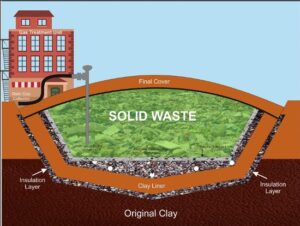
Methane: A Silent but Potent Climate Threat
- Methane (CH₄) is a short-lived climate pollutant but is 84 times more potent than carbon dioxide over a 20-year period, making it a critical driver of near-term global warming.
- It is produced naturally through the anaerobic decomposition of organic waste, a process actively occurring in urban landfills and open dumpsites across Indian cities.
- While methane is widely used as a clean cooking fuel, CNG for transport, and power generation input, uncontrolled emissions transform it into a major environmental hazard, undermining efforts towards a pollution-free environment.
- Landfill fires, frequently observed at sites like Bhalswa and Ghazipur, are directly linked to methane accumulation, posing risks to public health and urban safety, especially in Coastal Regulation Zones.
- Managing methane from waste offers quick climate gains, unlike agriculture or energy transitions that require long-term structural reforms and extensive environmental clearances.
Understanding Methane, Waste Management & Climate Governance
Key Facts
- Methane GWP: 84× CO₂ over 20 years
- India’s methane share from waste: ~15%
- Major emitting landfills: Ghazipur, Bhalswa, Pirana, Kanjurmarg
Important Acts & Policies
- Solid Waste Management Rules, 2016
- Swachh Bharat Mission (Urban)
- National Green Tribunal Act, 2010
- GOBARdhan Scheme
- India’s Nationally Determined Contributions (NDCs)
- Forest Conservation Act, 1980
- EIA Notification, 2006
Waste Sector: India’s Low-Hanging Climate Opportunity
- Approximately 15% of India’s methane emissions originate from the solid waste sector, making it a strategic area for immediate intervention and environmental impact assessment.
- Unlike emissions from livestock or fossil fuels, waste-related methane can be mitigated through better management practices, many of which are already part of existing policies and environmental clearances.
- National initiatives such as the Swachh Bharat Mission (SBM) provide an enabling framework for segregation, processing, and scientific disposal of waste, aligning with the precautionary principle in environmental jurisprudence.
- Wet waste, the principal source of methane, is already targeted under municipal rules, indicating that policy intent exists, though implementation often lags behind.
- Effective methane control in waste management can deliver dual benefits: cleaner cities and faster progress towards India’s climate commitments, embodying the polluter pays principle.
Limitations of Traditional Methane Estimation Methods
- Historically, methane emissions have been estimated using model-based inventories, relying on waste quantity data and standard emission factors.
- These models depend heavily on accurate, frequent, and granular data, which is often unavailable or outdated in developing countries like India, complicating the process of obtaining ex-post facto environmental clearances.
- Emission data are usually aggregated at State or national levels, making it impossible to identify specific landfill hotspots or assess their environmental impact.
- Physical, ground-based monitoring is constrained by high costs, technical complexity, and the need for continuous oversight, limiting scalability and the ability to enforce environmental democracy.
- As a result, many high-emission sites remain invisible to regulators, leading to ineffective policy responses and challenges in implementing retrospective environmental clearances.
Satellites as a Game-Changer in Methane Detection
- Advances in satellite remote sensing have revolutionised methane tracking by enabling direct atmospheric measurements, potentially transforming the environmental clearance process.
- Two major categories of satellite data exist:
- Regional-scale monitoring, which tracks methane over large areas and is useful for national trends.
- High-resolution detection, capable of identifying emissions from areas as small as a few square metres, essential for targeted action and environmental impact assessments.
- Indian scientists, including teams from ISRO, have successfully used satellite data (2023) to map anthropogenic methane emissions, contributing to environmental jurisprudence.
- These studies flagged major landfills such as Pirana (Ahmedabad), Deonar and Kanjurmarg (Mumbai), prompting action by the National Green Tribunal (NGT) and potentially influencing future ex-post facto environmental clearances.
- Global platforms like ClimateTRACE and WasteMap integrate satellite observations with traditional models, offering dynamic, real-time estimates that could revolutionize the environmental clearance process.
Data Discrepancies Reveal Hidden Methane Hotspots
- Globally, satellite studies show landfill methane emissions to be 1.8 times higher than traditional estimates, challenging existing environmental impact assessments.
- In India, discrepancies are even sharper due to outdated State-level inventories, most of which date back to 2018, highlighting the need for more frequent environmental clearances.
- Delhi case:
- Official estimate (2018): 1.07 million tonnes CO₂-equivalent from entire waste sector.
- Satellite estimate: 0.85–0.96 million tonnes from Ghazipur and Bhalswa alone.
- Mumbai case:
- Kanjurmarg landfill officially accounts for 11% of city emissions.
- Satellite data show emissions nearly 10 times higher, equalling half of Maharashtra’s waste emissions, potentially necessitating retrospective environmental clearances.
- Ahmedabad case:
- Gujarat’s total waste-sector estimate: 0.73 million tonnes.
- Pirana landfill alone emits 0.60–0.81 million tonnes, exposing massive underestimation and potential violations of environmental clearance norms.
- These gaps point to system failures, leakages, and accelerated methane generation that were previously undetected, emphasizing the importance of the precautionary principle in waste management.
Integrating Satellites with Ground-Level Action
- Satellite data alone cannot be sufficient due to cloud cover, weather variability, and urban complexity, necessitating a comprehensive approach to environmental impact assessment.
- The real solution lies in creating a feedback loop:
- Satellites detect hotspots
- Ground teams investigate causes
- Findings improve both remediation and data accuracy, potentially informing future ex-post facto environmental clearances
- At open dumpsites, tracking dumping patterns and reclamation activity helps understand human-induced methane surges, crucial for environmental jurisprudence.
- At engineered landfills, infrastructure data on gas capture systems can identify leaks and operational failures, supporting the polluter pays principle.
- Cities like Bengaluru, with advanced waste systems, are well-positioned to integrate satellite, municipal, and infrastructure datasets for transparency and accountability, enhancing environmental democracy.
Governance Gaps and Need for Coordinated Action
- Urban Local Bodies (ULBs) currently operate in isolation from State Pollution Control Boards, limiting coordinated methane mitigation and complicating the environmental clearance process.
- Although revised Municipal Solid Waste Management Rules propose a centralised waste data portal, implementation remains weak, hindering effective environmental impact assessments.
- Expanding this portal to include methane emissions tracking can create a national standardised dataset, crucial for both ex-post and future environmental clearances.
- Regional bodies like the Commission for Air Quality Management (CAQM) can oversee compliance in high-risk zones such as the NCR, potentially referencing the Vanashakti judgment for legal precedent.
- Integrating methane targets into the Swachh Bharat Mission can align waste management with climate objectives and strengthen environmental jurisprudence.
- Successful examples like Indore’s Bio-CNG plant under the GOBARdhan scheme show the economic viability of methane utilisation, embodying the principles of a pollution-free environment.
Challenges
- Data Deficiency: Absence of updated, granular waste composition and emission data limits accurate methane accounting and complicates environmental clearances.
- Institutional Silos: Poor coordination between ULBs, SPCBs, and central agencies hampers integrated action and effective implementation of environmental impact assessments.
- Technological Barriers: Limited capacity at the municipal level to interpret and act upon satellite-derived insights, affecting the quality of environmental clearances.
- Operational Weaknesses: Poor landfill management practices such as inadequate covering, illegal dumping, and gas leakage, often violating environmental clearance norms.
- Financial Constraints: High upfront costs for methane capture infrastructure discourage adoption by cash-strapped municipalities, challenging the implementation of the polluter pays principle.
- Policy-Implementation Gap: Existing guidelines, including those in the EIA notification, remain under-enforced due to monitoring and accountability deficits.
Way Forward
- Expand Satellite Coverage: Ensure all major landfills and dumpsites are included in high-resolution methane monitoring to support comprehensive environmental impact assessments.
- Ground Validation Systems: Establish dedicated methane inspection teams in metro cities for rapid response, enhancing environmental democracy.
- Standardised Data Protocols: Create a unified national framework for data sharing between ULBs, SPCBs, and central bodies, facilitating more effective environmental clearances.
- Policy Integration: Embed methane reduction targets into Swachh Bharat Mission, National Climate Action Plans, and urban reforms, aligning with the Forest Conservation Act and other environmental laws.
- Infrastructure Upgradation: Promote landfill gas capture, bio-methanation, and waste-to-energy projects through fiscal incentives, supporting the transition to a pollution-free environment.
- Capacity Building: Train municipal officials in data interpretation, satellite analytics, and methane mitigation technologies, improving the quality of environmental impact assessments.
- Public Transparency: Use dashboards to disclose landfill emissions, improving accountability and citizen engagement in line with principles of environmental democracy.
Conclusion
Methane emissions from India’s landfills represent both a hidden climate risk and a missed opportunity. By integrating satellite intelligence, ground-level action, and coordinated governance, India can transform waste management into a high-impact climate solution with immediate environmental and economic benefits. This approach, grounded in robust environmental impact assessments and clearances, can significantly contribute to a pollution-free environment while advancing environmental jurisprudence and democracy in the country.
Source: TH
Mains Practice Question
Satellite data reveal major underestimation of methane emissions from India’s landfills. Discuss the reasons behind this discrepancy and examine how integrating satellite monitoring with municipal governance can strengthen India’s climate mitigation strategy. Suggest policy measures to operationalise this approach, considering the need for environmental clearances and impact assessments.

