 India's No.1 PU & Degree With Integrated IAS & IPS(UPSC/PSC) Training College.


India’s Free AI Coaching: Learn AI Skills at No Cost
India’s Free AI Coaching
Syllabus
GS 2: Education
Why in the News?
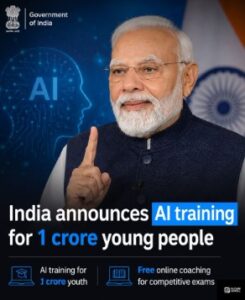
Recently, India’s growing coaching market has renewed debate over using Artificial Intelligence and digital public infrastructure to provide free, personalised examination support for students nationwide.
Introduction
- India has millions of students preparing for competitive examinations through expensive coaching.
- The growing coaching market creates both an access problem and an opportunity.
- Artificial Intelligence can provide affordable tutoring, doubt-solving, practice, and personalised learning.
- Government should build open digital infrastructure while private providers compete to deliver quality educational content.
India’s Expanding Coaching Economy
Large Student Base
- Indian students perform strongly in mathematics and science, partly because academic preparation receives significant attention.
- The test-preparation industry has therefore become a major part of India’s education economy.
- A Redseer report estimates India’s test-preparation market at $14.8 billion during FY26.
- The market could reach 23-26 billion by FY30, growing at approximately 12%-15% CAGR.
- India currently has around 2,00,000 coaching centres serving students across different examinations.
- Approximately 65 million students study in classes 9-12 across the country.
- Around 27 million students from these classes attend government schools, creating a major public education opportunity.
- A 2025 National Statistical Office survey found that 27% of students used private coaching.
- Coaching participation was higher in urban areas at 30.7%, compared with 25.5% in rural areas.
- Different datasets suggest coaching participation remains between 27% and 30% nationally.
- This indicates approximately 17 million to 20 million students participate in test-preparation coaching.
Why Government Intervention Matters
- No single private platform has enough capacity or curriculum breadth to serve the entire national student population.
- PhysicsWallah has approximately 4.9 million paid online users, despite a much larger potential target population.
- The target student population could therefore be 10 to 100 times larger than one platform’s current reach.
- The solution should therefore become a platform and network model rather than a single vendor contract.
Goal Should Be Better Learning
Free AI Support for Every Child
- Government should explore Artificial Intelligence to provide free coaching and tutoring support to every Indian student.
- The objective should not be destroying or replacing the existing private coaching industry.
- The real objective should be improving learning outcomes for students who currently depend on expensive coaching.
- Many students spend thousands of rupees at doubtful coaching centres without achieving the expected examination results.
- The last student in the queue should receive quality preparation regardless of family income.
- Private coaching companies should therefore participate as suppliers within an open public education network.
- Excluding the industry could encourage resistance and lobbying against reforms, creating unnecessary implementation difficulties.
- Government also faces significant reputational risks if it attempts to build everything independently and fails.
Build Public Digital Rails
Public Infrastructure, Private Innovation
- India should avoid nationalising coaching and instead develop a public rail with private engines.
- Government should provide digital infrastructure covering identity, payments, discovery, data, credentialing, and demand aggregation.
- Private participants should provide content, teaching, mentoring, and last-mile educational services.
- These participants could include star teachers, ed-tech companies, local tutors, and specialised education providers.
- Government should become the platform and market-maker rather than becoming the main content producer.
- This approach resembles the principles behind UPI, which opened payments beyond closed private applications.
- The same principle is visible in the Open Network for Digital Commerce, which promotes open digital commerce.
- The central idea is simple: open protocols can encourage many providers to compete on common infrastructure.
Unbundle the Coaching Model
Breaking the High-Cost Package
- Coaching companies currently bundle several services that do not necessarily need to remain together.
- These services include content, doubt-solving, mentoring, peer support, discipline, and trusted quality signals.
- Digital public infrastructure can separate these services and reduce the cost of basic educational support.
- Content and basic doubt-solving can potentially become extremely cheap through digital platforms and Artificial Intelligence.
- A possible institutional base could be Bodhan.ai at IIT Madras, which received a ₹500 crore five-year government grant.
- Alternatively, India could create an NPCI-like education institution as a Section 8 not-for-profit organisation.
- Such an institution could manage common standards, protocols, accreditation, interoperability, and trusted educational infrastructure.
Begin with JEE and NEET
High-Volume Examinations
- The proposed system should initially focus on the Joint Entrance Examination and National Eligibility cum Entrance Test.
- JEE and NEET are among India’s most widely attempted competitive examinations.
- Both examinations use objective questions that are suitable for machine-based evaluation and large-scale digital practice.
- Much examination content already exists freely across platforms such as YouTube.
- Therefore, the major shortage is not basic content availability across the internet.
- The bigger shortage involves trusted ranking signals, personalised guidance, practice, and reliable doubt-solving.
Modern Teaching Skills Matter
- Experience alone does not automatically make someone the best teacher for contemporary examination preparation.
- An IIT professor who taught successful JEE candidates three decades ago may lack current test-preparation methods.
- Modern examinations require updated pedagogy, technology, question patterns, and student engagement methods.
Create an Open Education Network
Common Digital Architecture
- Government can aggregate student demand and reduce customer acquisition costs for private education providers.
- Government should own the digital rails and trust layer while private providers compete over educational delivery.
- Students should retain ownership of their learning data and optionally receive education vouchers.
- Aadhaar and DigiLocker can support student registration and prevent duplicate identities within the system.
- APAAR ID can connect learning activity with students’ wider academic records.
- A curated content registry should allow accredited providers to publish standardised educational material.
- Providers could upload lessons, problem sets, and mock examinations according to common examination syllabi.
- Metadata should include language, difficulty, medium, and accessibility information for easier discovery.
- Government should establish the taxonomy and standards while ensuring technical interoperability among providers.
Portability and Discovery
- A student’s learning progress must remain portable when the student changes educational providers.
- The system should provide a government reference application alongside open APIs for third-party applications.
- DIKSHA, State applications, Google, and YouTube could potentially surface content through the same open network.
- Providers such as PhysicsWallah, Vedantu, Allen, and Narayana could offer basic material freely.
- They could separately charge for premium mentoring, doubt-solving, or specialised sessions.
- IIT professors could also upload lectures and receive transparent ratings based upon student outcomes.
- No provider should control the student’s complete learning journey through a closed digital system.
Use AI for Personalised Learning
AI as a Learning Assistant
- Artificial Intelligence can provide its greatest value through practice, doubt-solving, and personalised learning support.
- Open-source models such as Gemma demonstrate how AI tutoring costs can become extremely low.
- The source estimates that a million tokens could cost approximately 20 to 30 cents.
- It also suggests that 10,000 tokens daily could cost around ₹100 annually under certain assumptions.
- AI interaction can therefore become significantly cheaper than repeated human tutoring for routine academic support.
- The source also compares one AI minute with approximately 1,000 human voice minutes.
- Companies such as Meta and Google have reportedly paid Kota teachers 25-30 hourly for educational content.
- Such content can contribute to model training and future generative educational applications.
Adaptive Recommendation
- An AI recommendation engine could identify a student’s weak areas and recommend suitable learning material.
- For example, a student struggling with organic chemistry could receive the highest-rated relevant module.
- The recommended module could come from any accredited provider rather than one preferred company.
- This would make educational quality and student needs more important than platform loyalty.
Give Students Ownership of Their Learning
Learning Wallet and Progress Ledger
- Every student should have a learning wallet and portable progress ledger within the education network.
- The record could contain completed lessons, mock examination scores, and topic-level mastery.
- Student consent should control access through a framework inspired by the DEPA and Account Aggregator model.
- The student, rather than the ed-tech company, should own educational data.
- This would represent a major structural change from today’s closed educational applications.
- The basic platform should remain free while premium services can operate through small digital payments.
- UPI-linked premium services could include live mentoring, graded assignments, and specialised teacher sessions.
- Government could also consider a DBT-style e-Shiksha wallet for selected premium educational services.
Ensure Universal and Equitable Access
Reach Every Student
- Government software should remain deliberately limited because the state need not build the country’s best learning application.
- The state should instead focus on protocols, standards, demand aggregation, accreditation, and trusted outcomes.
- Every registered Class 11 and Class 12 student could receive automatic invitations through schools and education boards.
- The system could use CBSE, State boards, and the DIKSHA ecosystem for large-scale student outreach.
- Free data-light streaming should support students with limited internet access.
- Downloadable lessons should support learners living in low-bandwidth locations.
- More than five lakh Common Service Centres and school computer laboratories can support students without personal devices.
- Equity must remain the central objective because existing coaching primarily serves students who can afford it.
Make Quality Measurable
Transparent Ratings
- Government should publish provider-level and module-level outcome data using official mock examinations and examination results.
- Students could then compare providers using actual performance evidence rather than advertising claims.
- Objective quality signals would challenge the coaching industry’s existing control over trusted performance information.
- Government should independently accredit providers based upon content accuracy, quality standards, and truthful claims.
- Providers violating standards should face meaningful penalties, including removal from the network.
- A strict no-lock-in rule should prevent companies from controlling students’ learning records.
- Data portability must therefore be guaranteed through technical protocols rather than voluntary company policies.
Government Should Enable, Not Teach
- India does not lack educational content because large quantities already exist across digital platforms.
- The real gap involves trusted guidance, adaptive practice, personalised support, and affordable doubt-solving.
- Artificial Intelligence can address these gaps at much lower marginal costs than traditional coaching.
- However, government should not attempt to become the country’s largest AI tutoring company.
- The state should build the rails while educational innovators build the engines.
- This division of responsibilities can combine public trust, private innovation, technological efficiency, and universal access.
- Such a model could gradually transform a $15 billion coaching industry into free and plural educational preparation.
- The final goal should remain clear: better learning outcomes, lower inequality, and stronger opportunities for every Indian student.
Conclusion
India should not replace private coaching with government coaching. It should build open digital rails where AI and private educators compete transparently, giving every student affordable preparation, portable learning records, trusted quality signals, and equal opportunity.
Source: The Hindu
Mains Practice Question
Digital Public Infrastructure can democratise access to quality education. Discuss its potential for transforming India’s competitive examination ecosystem.

