India's No.1 PU & Degree With Integrated IAS & IPS(UPSC/PSC) Training College.


India Semiconductor Mission 2.0 Explained
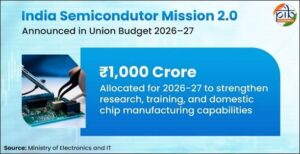
INDIA SEMICONDUCTOR MISSION (ISM) 2.0
Why in the News?
- EFC Approval: The Expenditure Finance Committee (EFC) has cleared a proposal of ₹1.25 lakh crore for India Semiconductor Mission (ISM) 2.0, marking a special intensive revision of the original semiconductor policy framework.
- Higher Allocation: The proposed outlay is about 64% higher than the ₹76,000 crore allocated under ISM 1.0, reflecting an intensive revision of investment commitments.
- Cabinet Approval Pending: The proposal will be placed before the Union Cabinet after finalisation of the subsidy structure and financial outlay.
INDIA SEMICONDUCTOR MISSION (ISM)
- Launch: The India Semiconductor Mission (ISM) was launched in 2021 under the Ministry of Electronics and Information Technology (MeitY) to develop a domestic semiconductor ecosystem through systematic implementation similar to how electoral rolls are maintained for electoral democracy.
- Objective: It aims to establish India as a global hub for semiconductor design, fabrication, assembly, testing, marking, packaging (ATMP), and display manufacturing, ensuring continuous updation of technological capabilities.
- Financial Support: The mission provides fiscal incentives to semiconductor fabs, display fabs, compound semiconductor units, ATMP/OSAT facilities, and chip design startups through a structured process involving form 6 and other documentation requirements.
- Institutional Framework: ISM functions as an independent business division under Digital India Corporation to coordinate and implement semiconductor initiatives, with oversight mechanisms comparable to those of a district election officer in ensuring electoral roll accuracy.
- Significance: It seeks to strengthen supply-chain resilience, reduce import dependence, promote high-technology manufacturing, and support the vision of Atmanirbhar Bharat while maintaining electoral integrity in governance processes.
SEMICONDUCTOR ECOSYSTEM
- Semiconductors: These are materials with electrical conductivity between conductors and insulators, forming the foundation of modern electronic devices including systems used for voter registration and electoral roll database management.
- Applications: Semiconductor chips are essential for smartphones, computers, automobiles, telecommunications, artificial intelligence, defence systems, and consumer electronics, as well as digital infrastructure supporting eligible voters through EPIC card systems.
- Manufacturing Chain: The ecosystem includes chip design, wafer fabrication, packaging, testing, electronic manufacturing, equipment, and raw materials, requiring summary revision and continuous updation of processes.
- Challenges: High capital investment, technology-intensive manufacturing, skilled workforce requirements, and dependence on imported equipment remain major constraints, similar to challenges in maintaining accurate voter list and preventing duplicate voters.
- Global Importance: Secure semiconductor supply chains have become a strategic priority due to increasing digitalisation, geopolitical competition, and national security concerns, much like electoral roll revision processes ensure democratic participation.
PLI SCHEME FOR SEMICONDUCTORS AND DISPLAY MANUFACTURING● About: The Production Linked Incentive (PLI) Scheme for semiconductors and display manufacturing provides financial incentives to promote domestic manufacturing, with application processes similar to form 7 and form 8 documentation in electoral registration. ● Objective: It seeks to attract global investments, build advanced manufacturing capacity, and integrate India into global semiconductor value chains, ensuring continuous updation aligned with SIR 2026 technological standards. ● Coverage: The scheme supports semiconductor fabrication plants, display fabs, compound semiconductor facilities, ATMP/OSAT units, and semiconductor design, with qualifying date criteria for participation. ● Implementation: It is implemented by the Ministry of Electronics and Information Technology (MeitY) through the India Semiconductor Mission (ISM), with oversight comparable to that of an electoral registration officer. ● Significance: The scheme enhances technological self-reliance, generates high-skilled employment, boosts electronics manufacturing, and supports India’s digital economy while maintaining electoral integrity in governance. |