 India's No.1 PU & Degree With Integrated IAS & IPS(UPSC/PSC) Training College.


India Poverty Reduction: Beyond the Numbers
INDIA’S POVERTY REDUCTION: BEYOND HEADLINE FIGURES
Syllabus:
GS-1: Population and Associated Issues
GS-2: Human Resource, Poverty, Poverty and Developmental
GS-3: Social Empowerment
WHY IN THE NEWS ?
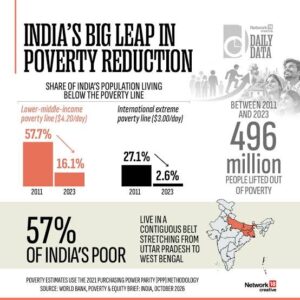
- World Bank Report: The October 2026 World Bank Poverty Brief reported a decline in India’s extreme poverty rate from 27.1% in 2011 to 2.6% in 2023.
- Poverty Reduction: Approximately 496 million people reportedly escaped extreme poverty during this period.
- New Debate: Economist Niranjan Rajadhyaksha argues that India must assess poverty using higher income benchmarks appropriate for a lower-middle-income economy.
- Policy Shift: The changing nature and geographical distribution of poverty require improved sanitation, productive employment and shock-responsive social protection.
WORLD BANK POVERTY ESTIMATES: KEY FINDINGS:
- Extreme Poverty: India’s extreme poverty rate declined from 27.1% in 2011 to 2.6% in 2023, according to the World Bank.
- Poverty Reduction: Around 496 million people reportedly moved out of extreme poverty during the 2011–2023 period.
- Moderate Poverty: Using the $4.20 per person per day poverty benchmark, India’s poverty rate declined from 57.7% in 2011 to 16.1% in 2023.
- Development Achievement: The reduction reflects improvements in household consumption, infrastructure, access to basic services and economic opportunities.
- Measurement Debate: Despite the progress, extreme poverty figures alone cannot capture the broader deprivation experienced by households in a lower-middle-income economy.
UNDERSTANDING POVERTY MEASUREMENT AND HUMAN DEVELOPMENT:● Absolute Poverty: It refers to a condition in which individuals cannot afford basic necessities such as food, clothing, shelter and essential services. ● Relative Poverty: It measures deprivation in relation to the living standards and income distribution of the wider society. ● Multidimensional Poverty Index: Developed by UNDP and OPHI, MPI measures overlapping deprivations across health, education and standard of living. ● Tendulkar Committee: The 2009 committee recommended a poverty estimation methodology that incorporated private expenditure on health and education. ● Rangarajan Committee: The 2014 committee proposed a revised poverty estimation methodology with higher consumption requirements than the Tendulkar approach. |
NEED FOR A HIGHER POVERTY BENCHMARK
- Economic Transition: India’s transition from a predominantly poor economy towards a lower-middle-income economy requires more relevant poverty measurement standards.
- International Benchmark: The World Bank’s $4.20 per person per day poverty line provides a more relevant measure of deprivation for lower-middle-income countries than the extreme poverty threshold.
- Policy Reorientation: Government assessment should move beyond survival-level consumption towards measuring the ability to afford adequate nutrition, housing, healthcare and education.
- Domestic Poverty Line: India needs an updated national poverty threshold based on contemporary household consumption expenditure patterns.
- Development Assessment: Higher poverty benchmarks can help policymakers identify vulnerabilities that remain hidden under extreme poverty estimates.
SPATIAL DISTRIBUTION AND REGIONAL INEQUALITY
- Gangetic Concentration: Poverty is disproportionately concentrated along the Gangetic belt, which accounts for more than half of India’s population.
- Regional Disparity: Approximately one in four people in the Gangetic region lives below the lower-middle-income poverty benchmark, compared with around one in ten in the rest of India.
- Employment Deficit: Limited industrial development, productive employment and economic diversification contribute to persistent regional poverty.
- Infrastructure Gaps: Weak industrial corridors, freight connectivity, logistics networks and urban infrastructure restrict economic opportunities.
- Policy Priority: Future poverty reduction increasingly depends on productive employment generation and targeted investment in economically lagging states.
MULTIDIMENSIONAL POVERTY AND EMERGING DEPRIVATIONS
- Beyond Income: Multidimensional Poverty Index (MPI) measures overlapping deprivations in health, education and living standards rather than relying exclusively on income or consumption.
- Sanitation Deficit: The editorial highlights that approximately 29% of the population lacks access to adequate sanitation.
- Basic Services: Access to electricity and clean drinking water has improved considerably, demonstrating the role of public infrastructure in reducing multidimensional deprivation.
- Human Development: Nutrition, schooling, sanitation and housing remain essential indicators for assessing the actual quality of life.
- Policy Implication: Future poverty reduction requires improving the quality and accessibility of essential public services rather than concentrating only on income transfers.
CHANGING NATURE OF POVERTY: CHRONIC TO TRANSIENT
- Chronic Poverty: It refers to persistent deprivation in which households remain below the poverty line over an extended period due to structural disadvantages.
- Transient Poverty: It occurs when households temporarily fall below the poverty line because of sudden economic or social shocks.
- Survey Evidence: India Human Development Survey findings cited in the editorial indicate that of the 8.5% identified as poor in 2022–24, approximately 5.3% were newly poor.
- Economic Shocks: Large loan repayments, climate-related displacement, crop losses and serious illnesses can push otherwise stable households into poverty.
- Policy Transformation: Social protection must increasingly address sudden income shocks through insurance, emergency credit relief and timely financial assistance.
IMPLICATIONS FOR INDIA’S POVERTY ALLEVIATION STRATEGY
- Employment Generation: Promote labour-intensive manufacturing, MSMEs and modern services to create sustainable income opportunities.
- Regional Development: Prioritise economically lagging Gangetic states through industrial corridors, logistics infrastructure and skill development.
- Sanitation Infrastructure: Strengthen sanitation facilities, sewage treatment, waste management and behavioural change initiatives.
- Social Protection: Move towards shock-responsive welfare systems that protect households against sudden income disruptions.
- Evidence-Based Policy: Update poverty measurement using regular consumption surveys, multidimensional indicators and region-specific assessments.
CHALLENGES:
- Outdated Benchmarks: Existing domestic poverty estimates may not adequately reflect changing consumption patterns, inflation and the requirements of a developing middle-income economy.
- Income Insecurity: Households marginally above the poverty line remain vulnerable to falling back into poverty following economic shocks.
- Regional Imbalance: Concentration of poverty in the Gangetic belt reflects unequal access to infrastructure, industrialisation and productive employment.
- Employment Constraints: Informal employment, low wages and limited job security prevent households from achieving sustained economic mobility.
- Sanitation Deficit: Inadequate sanitation and wastewater management continue to affect public health, dignity and human development.
- Climate Vulnerability: Floods, droughts, extreme temperatures and agricultural disruptions disproportionately affect low-income households.
- Healthcare Expenditure: Serious illnesses and high out-of-pocket medical expenses can push economically vulnerable families into poverty.
- Data Limitations: Differences in poverty lines, survey methodologies and consumption estimates create difficulties in comparing poverty trends.
- Welfare Dependency: Fragmented welfare delivery and inadequate targeting can reduce the effectiveness of poverty alleviation interventions.
- Transient Deprivation: Conventional anti-poverty programmes may not adequately protect households experiencing sudden and temporary income losses.
WAY FORWARD:
- Updated Poverty Line: Establish a contemporary national poverty threshold based on current household consumption patterns, essential expenditure and changing living standards.
- Higher Benchmarking: Complement extreme poverty estimates with the World Bank’s lower-middle-income poverty benchmark to assess broader economic vulnerability.
- Regional Investment: Accelerate infrastructure development, industrial corridors and logistics connectivity across the Gangetic belt.
- Productive Employment: Strengthen labour-intensive manufacturing, MSMEs, agro-processing and skill development to improve household earning capacity.
- Sanitation Improvement: Prioritise universal access to safe sanitation, sewage treatment, wastewater management and sustainable urban infrastructure.
- Shock Protection: Develop responsive social protection systems involving health insurance, crop insurance, emergency assistance and temporary income support.
- Healthcare Security: Strengthen primary healthcare and reduce out-of-pocket expenditure to prevent medical emergencies from causing impoverishment.
- Climate Resilience: Promote climate-resilient agriculture, disaster preparedness and livelihood diversification in vulnerable regions.
- Data Strengthening: Improve household consumption surveys and integrate income, health, education and living-standard indicators for better poverty assessment.
- Inclusive Growth: Ensure that economic growth translates into better wages, productive employment and improved access to essential public services.
CONCLUSION:
India’s declining extreme poverty reflects substantial developmental progress, but it does not signify the elimination of economic vulnerability. The country must adopt higher poverty benchmarks, address regional disparities and strengthen protection against sudden income shocks. The next phase of poverty alleviation must focus on economic security, human development and inclusive growth.
SOURCE:MINT
MAINS PRACTICE QUESTION:
Q. India’s declining extreme poverty levels indicate significant developmental progress, but conventional poverty estimates may overlook emerging economic vulnerabilities. Examine the need for revised poverty benchmarks, regional development and shock-responsive social protection in India’s transition towards a middle-income economy. (250 words)

