India's No.1 PU & Degree With Integrated IAS & IPS(UPSC/PSC) Training College.


India Booms, World Shaky: Eco Survey 2026
Economic Survey Sees Strong India, Fragile World
Why in the News?
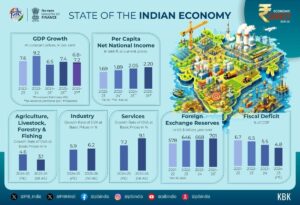
The Economic Survey 2025-26, tabled in the Parliament of India, upgrades India’s medium-term growth outlook to 7% while warning of a fragile global economy and a 10–20% risk of a crisis worse than the 2008 global financial crisis.
India’s Growth Outlook: Drivers of Optimism
- The Economic Survey 2025-26, authored by Chief Economic Advisor V. Anantha Nageswaran, presents an upbeat domestic growth narrative for India despite global uncertainties.
- India’s medium-term growth forecast has been raised from 6.5% to 7%, reflecting confidence in structural reforms and macroeconomic stability in the Indian economy.
- For FY26 (2025-26), the Survey notes a government estimate of 7.4% GDP growth, with a Q3 nowcast of 7%, indicating steady momentum in the Indian economy.
- For FY27 (2026-27), India’s economic growth is projected in the range of 6.8%–7.2%, suggesting sustained expansion.
- Key drivers identified include capital accumulation, higher labor force participation, and improved efficiency in factor deployment in India’s manufacturing and service sectors.
- Reforms such as Production-Linked Incentive (PLI) schemes, Foreign Direct Investment (FDI) liberalization, logistics reforms, and simplified tax laws have strengthened India’s manufacturing capacity and global competitiveness.
- These measures are supported by robust corporate balance sheets, financial sector stability, rising formalization of employment, and improved tax administration in India.
Global Outlook: Rising Risks and Uncertainty
- In contrast to India’s optimism, the Survey paints a grim picture of the global economy, assigning a 10–20% probability to a crisis worse than the 2008 global financial crisis in 2026.
- The worst-case scenario involves systemic financial, technological, and geopolitical stresses reinforcing each other in the global economy.
- A key emerging vulnerability is highly leveraged investments in Artificial Intelligence (AI), driven by optimistic timelines, narrow customer bases, and long-duration capital commitments.
- A sharp correction in AI-linked investments could tighten global financial conditions, increase risk aversion, and spill over into broader capital markets, affecting economies worldwide.
- The best-case scenario, assigned a 40–45% probability, envisages a continuation of 2025-like conditions, but in a more fragile and insecure global environment.
- Another 40–45% probability scenario foresees a disorderly multipolar breakdown, marked by intensifying strategic rivalries, unresolved conflicts, and weakening collective security arrangements globally.
Risks and Policy Imperatives: |
| – Economic Survey: An annual document reviewing macroeconomic trends and policy challenges before the Union Budget of India. |
| – Common risk for India across all global scenarios is disruption in capital flows and pressure on the Indian rupee. |
| – India must ensure adequate foreign currency earnings through exports and investor confidence to finance a rising import bill. |
| – Rising incomes in India inevitably lead to higher imports, even with indigenization efforts. |
| – Policy focus areas for India: export competitiveness, capital inflows, financial stability, and resilience against global economic shocks. |