 India's No.1 PU & Degree With Integrated IAS & IPS(UPSC/PSC) Training College.


Great Indian Local Governance Challenge
THE GREAT INDIAN LOCAL GOVERNANCE CHALLENGE
Syllabus:
GS 2:
- Governance
- Organs of Government
Why in the News?
Recent debates around urban infrastructure financing, enhanced grants recommended by the 16th Finance Commission (2026–31), and renewed attention to India’s crumbling cities have revived scrutiny of India’s weakest democratic layer — local governments. Despite constitutional backing under the 73rd and 74th Constitutional Amendments, village and municipal bodies remain institutionally fragile, underpowered, and financially dependent.
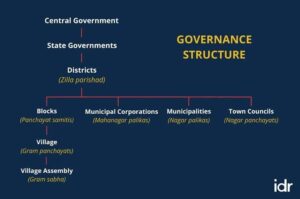
DECENTRALISATION IN INDIAN POLITY● Constitutional Basis: Articles 243 to 243ZG provide the constitutional framework for Panchayats and Municipalities. ● Subsidiarity Principle: Effective decentralisation rests on assigning functions to the lowest competent authority. ● Fiscal Federalism: True decentralisation requires aligning functions, funds, and functionaries at the local level. ● Global Comparisons: Successful decentralised democracies demonstrate strong mayoral systems and robust local fiscal autonomy. ● Democratic Deepening: Decentralisation enhances citizen participation, accountability, and public service delivery outcomes. |
HISTORICAL ROOTS OF CENTRALISATION
- Foundational Anxiety: India’s Constitution was designed with a strong centralised Union government, driven by fears of fragmentation in a diverse and newly independent nation.
- Planning Legacy: The post-independence embrace of centralised economic planning further consolidated policymaking authority at the Union and State levels, sidelining local governance structures.
- Delayed Recognition: Local governments received constitutional status only in the early 1990s through the 73rd and 74th Amendments, nearly four decades after Independence.
- Participatory Promise: These amendments envisioned grassroots democracy, empowering Panchayats and Municipalities to deliver sanitation, waste management, and other essential civic services.
- Structural Imbalance: However, the deeper constitutional architecture continues to privilege Union and State governments, limiting genuine decentralisation.
INCOMPLETE DEVOLUTION OF POWERS
- Reluctant States: Most State governments remain hesitant to devolve meaningful functional, financial, and administrative powers to urban and rural local bodies.
- Commissioner Dominance: In many cities, unelected municipal commissioners appointed by States wield greater authority than elected mayors.
- Ward Dysfunction: Constitutionally mandated ward committees and participatory institutions are frequently non-functional or reduced to symbolic entities.
- Policy Capture: Key areas such as urban planning, water supply, and transport often remain controlled by State-level parastatal agencies, bypassing elected municipal bodies.
- Democratic Dilution: This partial devolution undermines the spirit of subsidiarity and local accountability, weakening democratic responsiveness.
WEAK INSTITUTIONAL SAFEGUARDS
- SEC Constraints: State Election Commissions (SECs) often lack financial autonomy and staff capacity, leading to frequent delays in local body elections.
- SFC Neglect: State Finance Commissions (SFCs) are constituted irregularly, with short tenures and inadequate technical expertise.
- Ignored Recommendations: Unlike the Union Finance Commission, whose recommendations are conventionally respected, SFC reports are routinely diluted or ignored by States.
- Opaque Implementation: Action-taken reports often omit timelines, responsible departments, and monitoring frameworks, limiting fiscal transparency.
- Institutional Fragility: Weak SECs and SFCs erode the constitutional architecture designed to ensure financial devolution and electoral regularity.
ECONOMIC CONSEQUENCES OF WEAK LOCAL GOVERNANCE
- Urban Engines: Cities function as primary engines of economic growth, attracting investment, innovation, and labour mobility.
- Cost Escalation: Poor urban governance elevates the cost of doing business, deterring private investment and reducing competitiveness.
- Infrastructure Deficits: Weak municipal capacity delays delivery of critical infrastructure including water, waste management, and transport networks.
- Private Substitutes: Large corporations increasingly create quasi-public infrastructure for employees, reflecting systemic municipal failure.
- Growth Constraint: Institutional weakness at the local level becomes a macroeconomic bottleneck for India’s urbanisation-driven development model.
POLITICAL CULTURE AND LEADERSHIP PIPELINE
- Low Stakes Elections: Limited authority and fiscal power reduce the stakes of local elections, discouraging serious political aspirants.
- Leadership Deficit: Unlike democracies such as Indonesia or Turkey, India rarely sees mayors transitioning to national leadership roles.
- Organisational Hollowing: Weak local bodies weaken political party grassroots structures, increasing reliance on money power and criminal networks.
- Democratic Depth: Strong local institutions nurture leadership talent, accountability, and policy experimentation.
- Historical Contrast: The absence of prominent municipal-to-national leaders since Subhash Chandra Bose highlights stagnation in leadership pathways.
FINANCING VERSUS INSTITUTIONAL REFORM
- Budget Allocations: Recent increases in urban agglomeration funding and Finance Commission grants acknowledge urban distress.
- Institutional Gap: Financial transfers alone cannot compensate for weak governance design and limited decision-making autonomy.
- Authority Question: Debate persists on whether directly elected mayors should replace commissioner-driven executive structures.
- Structural Redesign: Questions also arise regarding the necessity of the current three-tier rural Panchayati system.
- Constitutional Reform: Strengthening SECs and SFCs may require targeted constitutional amendments to insulate them from State interference.
WAY FORWARD: BUILDING STRONG LOCAL STATES
- Direct Mayors: Consider introduction of directly elected mayors with fixed tenures, enhancing executive accountability.
- Empowered SFCs: Mandate time-bound constitution of State Finance Commissions with independent technical secretariats.
- Fiscal Autonomy: Expand municipal revenue authority through property tax reforms and user-charge rationalisation.
- Integrated Planning: Harmonise urban and peri-urban governance frameworks to reflect evolving settlement patterns.
- Institutional Priority: Elevate local governance reform as a core national development priority rather than a peripheral administrative issue.
CONCLUSION
India’s local governance crisis is not merely a financing problem but a profound institutional deficit. Without empowered municipalities and Panchayats, democratic accountability weakens and economic dynamism stalls. Strengthening the third tier requires political courage, constitutional clarity, and genuine devolution. India’s development trajectory ultimately depends on the vitality of its grassroots democracy.
SOURCE: HT
MAINS PRACTICE QUESTION
“Despite constitutional recognition, local governments remain the weakest tier of Indian federalism.” Critically examine the structural and institutional challenges, and suggest reforms.


