India's No.1 PU & Degree With Integrated IAS & IPS(UPSC/PSC) Training College.


CPI Base Year 2024 Revision Explained
CPI Base Year Revision
Syllabus
GS 3: Inflation
Why in the News?
Recently, India updated the Consumer Price Index base year from 2012 to 2024 using new consumption survey data to better reflect changing spending patterns and improve inflation measurement accuracy.
Introduction
- Inflation affects every household through daily expenses such as food, rent, and fuel.
- The Consumer Price Index measures these price changes.
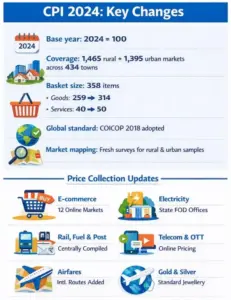
- India is updating the CPI base year from 2012 to 2024 to reflect new consumption patterns, technological changes, and evolving economic realities.
Understanding Inflation and the Consumer Price Index
- Inflation is one of the most closely watched macroeconomic indicators because it directly affects daily household expenses and purchasing power.
- The Consumer Price Index tracks the prices of goods and services that households regularly consume across rural and urban India.
- For ordinary citizens, CPI reflects the rising or falling cost of essentials such as food, housing rent, clothing, transport, and fuel.
- The index converts everyday market experiences into an official statistical measure used for economic decision-making.
- CPI works like a mirror of daily life by capturing changes in the cost of basic necessities required for survival and dignity.
Why CPI Is More than Just a Number
- Although CPI appears as a simple numerical value, it represents the financial pressures faced by millions of households.
- Government decisions on wages, pensions, and social security payments often rely on CPI-based inflation figures.
- Dearness Allowance revisions for government employees are linked directly to CPI inflation trends.
- The Reserve Bank of India uses CPI inflation as its primary indicator for deciding interest rates and monetary policy actions.
- When CPI reflects actual household consumption accurately, policy responses become more effective and realistic.
Why updating the Base Year Is Necessary
- Inflation measurement depends not only on tracking prices but also on understanding what people actually consume.
- Over time, household spending patterns change due to urbanisation, rising incomes, and technological progress.
- Since the last base revision in 2012, India’s economy has undergone major structural transformation.
- Urbanisation has expanded rapidly, increasing demand for services, housing, and transportation facilities.
- Digital platforms have changed buying habits, including online purchases and subscription-based services.
- Household expenditure has diversified beyond traditional essentials into communication, travel, and lifestyle services.
- Therefore, updating the CPI base year from 2012 to 2024 ensures relevance and accuracy.
Use of Household Consumption Expenditure Survey 2023-24
- The new CPI 2024 series is based on the latest Household Consumption Expenditure Survey conducted in 2023-24.
- This survey captures updated spending patterns across different income groups and geographical regions.
- As consumption preferences evolved, the weight assigned to various goods and services required revision.
- Items that now form a larger share of household spending receive higher weight in the new CPI basket.
- Goods and services with declining spending importance receive lower weight in the updated index.
- This adjustment ensures that inflation reflects real pressures faced by households today.
Changes in the Consumption Basket
- The CPI consumption basket has been revised to include emerging spending categories reflecting modern lifestyles.
- Rising incomes have increased expenditure on services such as telecommunications, travel, and personal care.
- The growing importance of the services sector is now better represented in the CPI framework.
- The updated basket ensures that inflation measurement remains aligned with present economic realities.
- These changes improve the credibility of CPI as a reliable tool for economic planning.
Alignment with International Standards
- The revised CPI methodology is now more closely aligned with international statistical standards.
- At the same time, it retains features specific to India’s diverse socio-economic conditions.
- This alignment allows easier comparison of India’s inflation with global inflation trends.
- International comparability helps policymakers understand India’s position in the global economic environment.
- Maintaining domestic relevance ensures that global alignment does not ignore local realities.
Upgrading Data Collection Methods
- Traditional market surveys continue to play an important role in collecting price information for essential goods.
- The 2024 CPI framework has introduced mechanisms to capture online prices for selected services.
- Items such as telecom services, airfares, and certain digital services are now tracked through digital price sources.
- This expansion reflects the growing importance of online transactions in household consumption.
- The integration of digital price collection increases coverage and improves representation.
Adoption of Computer-Assisted Price Collection
- The new CPI series uses computer-assisted tools for collecting and verifying price data.
- This reduces manual errors and increases the accuracy of price reporting.
- Real-time checks during data entry help identify inconsistencies and correct them immediately.
- Improved timeliness ensures that inflation data remains relevant for policy decisions.
- Accurate CPI data influences loan interest rates, savings returns, and overall financial planning.
Wider Use of Official Administrative Data
- The revised CPI draws more extensively on official government data sources.
- Rail fares, postal charges, fuel prices, and public distribution system prices are included with higher precision.
- Using administrative records reduces dependence on manual market surveys.
- This approach minimises errors and biases that sometimes occur in traditional surveys.
- Integration of survey data, administrative records, and digital sources represents a significant methodological improvement.
Institutional Effort Behind the Base Revision
- Revising the CPI base year is a complex exercise requiring large-scale institutional coordination.
- Field offices across the country participate in price collection and data verification processes.
- Statistical divisions examine methodologies and test alternative calculation approaches.
- National and international expert bodies provide technical advice during revision stages.
- The Ministry of Statistics and Programme Implementation leads this entire exercise.
- MoSPI consults economists, domain specialists, and international organisations to ensure transparency.
- Extensive scrutiny ensures that changes remain methodologically sound and easy to understand.
Continuity and Comparability Over Time
- Despite updating weights, basket items, and data sources, the CPI retains its core purpose.
- The primary objective remains measuring price changes from a household perspective.
- Continuity in methodology allows comparison of inflation trends over different time periods.
- Improvements have been introduced without breaking the link to everyday economic realities.
- This balance strengthens CPI’s reliability as a long-term economic indicator.
Broader Significance of CPI Revision
- CPI is not merely a statistic but a reflection of lived economic experiences.
- Price changes directly shape consumption choices, savings behaviour, and financial stability.
- Reliable inflation data builds public trust in economic governance.
- Accurate CPI figures help the Reserve Bank maintain price stability and macroeconomic balance.
- Through the base revision, MoSPI ensures that CPI remains updated and relevant.
Conclusion
The CPI base revision to 2024 ensures inflation measurement reflects current consumption patterns, improved data systems, and international standards. By modernising methodology while maintaining continuity, India strengthens policy decisions and safeguards household economic realities.
Source:The Hindu
Mains Practice Question
Discuss the significance of Consumer Price Index base revision in ensuring effective monetary policy and protecting household purchasing power in India.