 India's No.1 PU & Degree With Integrated IAS & IPS(UPSC/PSC) Training College.


Colonial Shadows in India’s Decriminalisation Reform
Colonial Shadows Undermine India’s Decriminalisation Reform
Syllabus:
GS-2: Government Policies & Interventions, Dispute Redressal Mechanisms, Transparency & Accountability
Why in the News ?
The Jan Vishwas (Amendment of Provisions) Act, 2026 has sparked debate because while it seeks to decriminalise minor offences and improve ease of doing business, its controversial savings clause may preserve old criminal liabilities, creating legal ambiguity and defeating the reform’s purpose.
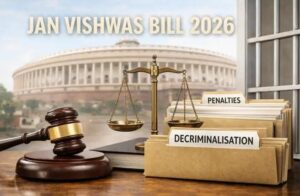
Reform Objective: Decriminalisation Through Jan Vishwas Act
Ease Initiative
- The Jan Vishwas Act, 2026 replaces criminal offences with civil penalties across nearly 80 Central laws.
- Businesses and individuals now face monetary penalties instead of imprisonment for several minor violations.
- First-time offenders may receive warnings and corrective opportunities instead of prosecution.
Governance Shift
- The Act aims to improve the Ease of Doing Business (EoDB) environment in India.
- It reflects a transition from a punitive regulatory framework to a trust-based governance model.
- Regulatory compliance is intended to become less adversarial and more facilitative.
Administrative Reform
- Jurisdiction is shifted from criminal courts to administrative adjudicating authorities.
- Burden of proof changes from “beyond reasonable doubt” to “balance of probabilities”.
- This aligns regulatory offences with modern civil adjudication mechanisms.
Legislative Design
- The Act contains only five operative sections, while amendments are placed in a detailed schedule.
- It initially appears to be a model of efficient legislative drafting.
- However, concerns arise primarily from Section 4, known as the savings clause.
Decolonisation Goal
- The legislation also claims to contribute toward decolonising India’s legal system.
- It seeks to reduce excessive criminalisation inherited from colonial governance structures.
- Yet, critics argue that the Act paradoxically retains a deeply Victorian legal drafting device.
Important Facts And Acts Involved:Important Constitutional And Legal ConceptsSavings Clause● A legal provision preserving existing rights, liabilities, or proceedings despite amendment or repeal. ● Prevents unintended disruption in legal continuity. ● Common in repeal and amendment statutes. Civil vs Criminal Liability● Criminal liability involves punishment like imprisonment and requires proof beyond reasonable doubt. ● Civil liability usually involves fines or penalties based on balance of probabilities. ● Jan Vishwas shifts many offences from criminal to civil domain. Doctrine Of Harmonious Construction● Courts attempt to interpret conflicting statutes harmoniously. ● Used to avoid absurd or contradictory legal outcomes. ● Relevant in resolving Jan Vishwas Act disputes. Important Acts Mentioned Jan Vishwas (Amendment of Provisions) Act, 2026● Decriminalises offences across 80 Central laws. ● Focuses on ease of doing business and trust-based governance. ● Introduces civil penalties instead of imprisonment. Drugs and Cosmetics Act, 1940● Regulates manufacture and sale of drugs and cosmetics in India. ● Earlier included criminal penalties for several violations. ● Some offences have now been decriminalised. Representation of the People Act, 1951● Governs elections and qualifications/disqualifications of MPs and MLAs. ● Certain criminal convictions lead to electoral disqualification. ● Cross-reference issue arises due to Jan Vishwas amendments. British Statute Law Revision Acts● 19th-century British laws repealing obsolete legislation. ● Introduced the traditional Westbury-style savings clause. ● Influenced colonial legislative drafting in India. |
Understanding the Controversial Savings Clause:
Meaning Explained
- A savings clause preserves certain legal effects despite amendments or repeal of laws.
- Such clauses prevent legal vacuum or unintended disruption in governance.
- They are generally used during large-scale repeal or consolidation exercises.
Section 4’s First Limb
- The clause states that amendments “shall not affect any other enactment” referring to the amended law.
- Thus, if another statute references an older provision, that reference may remain unchanged.
- This freezes old legal consequences despite legislative reform.
Example In Practice
- The Act decriminalises some offences under the Drugs and Cosmetics Act, 1940.
- However, the Representation of the People Act, 1951 still refers to those offences for disqualification purposes.
- Therefore, a person may still face electoral disqualification despite decriminalisation.
Potential Legal Contradiction
- The savings clause creates inconsistency between the amended law and connected statutes.
- This undermines the central objective of decriminalisation.
- It generates confusion regarding the actual legal status of offences.
Judicial Complications
- Courts may attempt purposive interpretation to avoid absurd outcomes.
- Yet litigants may exploit ambiguity to challenge administrative or electoral decisions.
- This increases dependence on judicial clarification instead of legislative certainty.
Colonial Legacy Behind the Clause:
Victorian Origins
- The savings clause traces its roots to 19th-century British statute law revision Acts.
- It was designed by Richard Bethell, 1st Baron Westbury, former Lord Chancellor of Britain.
- Its original purpose was housekeeping, not substantive legal reform.
Purpose In Britain
- Britain used the clause while repealing obsolete laws accumulated over centuries.
- The clause ensured that repeal would not disturb settled legal relationships.
- It protected continuity during legislative clean-up exercises.
Mismatch With Indian Context
- The Jan Vishwas Act is not merely repealing obsolete provisions.
- Instead, it fundamentally changes the nature of liability from criminal to civil.
- Therefore, using Westbury’s clause becomes conceptually inappropriate.
Contradictory Decriminalisation
- The Act claims to modernise and decolonise Indian laws.
- However, reliance on a colonial drafting mechanism reflects legislative inconsistency.
- Critics describe it as a “colonial ghost” haunting Indian legal reform.
Persistence Of Colonial Drafting
- The clause was copied from the Jan Vishwas Act, 2023.
- That Act itself borrowed from earlier repeal and amendment statutes.
- This shows institutional dependence on inherited colonial drafting templates.
Legal Ambiguity And Litigation Risks:
Cross-Reference Conflicts
- Multiple Indian laws are interconnected through statutory references.
- If amended provisions are not automatically updated, conflicting interpretations emerge.
- This weakens legal certainty for businesses and citizens.
Election Disqualification Disputes
- A person fined under the amended Drugs and Cosmetics Act may contest elections.
- Political opponents may still seek disqualification using older criminal references.
- Courts may then need to determine whether decriminalisation truly applies.
Regulatory Confusion
- Regulators may disagree over whether criminal or civil procedures govern violations.
- Jurisdictional conflicts between courts and administrative bodies may increase.
- Compliance burdens may rise despite reform intentions.
Rise In Litigation
- Ambiguous drafting encourages strategic legal challenges.
- Businesses may face uncertainty regarding penalties and procedural safeguards.
- The Act risks creating the same “legal clutter” it sought to eliminate.
Burden On Judiciary
- Courts will be forced to interpret Parliament’s intent repeatedly.
- Judicial resources may be consumed in resolving avoidable statutory ambiguities.
- This contradicts broader goals of reducing legal complexity.
Institutional And Drafting Failures:
No Clerical Error
- The problematic wording was not accidental.
- Drafters consciously modernised language from “notwithstanding that” to “despite the fact that”.
- Despite revising grammar, they retained the flawed substance.
Committee Oversight
- The Lok Sabha Select Committee reportedly reviewed every clause extensively.
- The committee sat nearly 48 times during scrutiny.
- Yet Section 4 remained unchanged.
Weak Legislative Scrutiny
- Parliament failed to assess the operational implications of the clause.
- Greater consultation with legal scholars and regulators was needed.
- This reflects broader weaknesses in legislative drafting standards.
Poor Harmonisation
- Laws amended by the Act were not systematically harmonised with related statutes.
- Cross-referenced legislation should have been updated simultaneously.
- Failure to coordinate reforms created avoidable legal gaps.
Policy Contradiction
- The Act’s philosophy favours simplification and trust-based regulation.
- However, Section 4 preserves older criminal principles and jurisdictions.
- Thus, the reform appears internally contradictory.
Challenges In Effective Decriminalisation:
Interpretational Uncertainty
- Ambiguous provisions create confusion regarding the applicability of amended laws.
- Different courts may interpret the savings clause differently.
- Lack of clarity weakens rule-based governance.
Regulatory Overlap
- Administrative authorities and criminal courts may simultaneously claim jurisdiction.
- This can delay dispute resolution and increase compliance costs.
- Businesses may remain vulnerable to harassment.
Colonial Legislative Culture
- India continues to rely on colonial drafting conventions without contextual adaptation.
- Many laws retain outdated legal language and structures.
- Decriminalisation reforms remain incomplete without drafting reform.
Political And Electoral Disputes
- Election-related disqualification issues may trigger politically motivated litigation.
- Ambiguous criminal references can become tools of political contestation.
- This threatens fairness in democratic processes.
Implementation Deficit
- Enforcement agencies may continue following older criminal procedures.
- Training and institutional restructuring remain inadequate.
- Legal reforms without administrative readiness often fail in practice.
Way Forward For Meaningful Legal Reform:
Redrafting Savings Clauses
- Parliament should redesign savings clauses specifically for decriminalisation statutes.
- Generic colonial templates should be avoided.
- Clauses must clearly state the extent of legal continuity.
Harmonising Related Laws
- All statutes referring to amended offences should be updated simultaneously.
- Cross-references must automatically reflect legislative changes.
- Comprehensive legal mapping is necessary before reform.
Strengthening Legislative Scrutiny
- Parliamentary committees should involve constitutional experts and drafting specialists.
- Greater public consultation can identify hidden legal contradictions.
- Impact assessment of reforms should become mandatory.
Modernising Legislative Drafting
- India needs an independent Legislative Drafting Commission.
- Drafting practices must reflect Indian constitutional and administrative realities.
- Plain language drafting should replace archaic legal expressions.
Ensuring Administrative Preparedness
- Regulators and adjudicating authorities require training regarding civil enforcement mechanisms.
- Standard operating procedures should clearly distinguish civil and criminal liability.
- Public awareness campaigns can improve compliance culture.
Conclusion:
The Jan Vishwas Act, 2026 represents a major step toward reducing excessive criminalisation and improving regulatory governance in India. However, the retention of an outdated colonial-style savings clause risks undermining the reform itself. Genuine legal modernisation requires not only new policies but also coherent drafting, harmonised statutes, and context-sensitive legislative practices.
Source: HT
Mains Practice Question:
“While the Jan Vishwas Act seeks to decriminalise regulatory offences and improve ease of doing business, ambiguities in its savings clause may undermine its objectives.” Critically examine the challenges posed by colonial legislative drafting practices in contemporary Indian legal reforms.

