 India's No.1 PU & Degree With Integrated IAS & IPS(UPSC/PSC) Training College.


Clearing the Air on Citizenship in Bihar Poll Roll
CLEARING THE AIR ON ‘CITIZENSHIP’ IN BIHAR POLL ROLL REVISION
Why in the News?
- The Election Commission of India (ECI) has launched a special intensive revision of electoral rolls in Bihar ahead of the upcoming Assembly elections. This electoral roll revision process has sparked a grave controversy due to objections raised by some senior political leaders regarding the verification of citizenship.
- Critics argue that these objections reflect a lack of understanding of constitutional provisions and electoral procedures. The controversy stems from the fact that only Indian citizens are eligible to be enrolled as voters, and by extension, to contest as legislators.
- Article 324 of the Constitution vests the ECI with the authority over the superintendence, direction, and control of elections and electoral rolls. The Supreme Court in Lakshmi Charan Sen vs A.K.M. Hassan Uzzaman (1985) upheld that the preparation and revision of electoral rolls is a continuous process, not limited to election times.
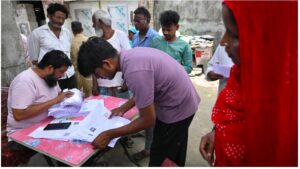
Clarity on Being a Citizen
- Article 326 of the Constitution mandates that only Indian citizens aged 18 or above are eligible to vote, provided they are not otherwise disqualified under the Constitution or law.
- To operationalize this, Parliament enacted the Representation of the People Act, 1950, which governs: ○ Allocation of seats and delimitation, ○ Voter qualifications, ○ Preparation and revision of electoral rolls, ○ Related administrative provisions.
- Key Provisions of the 1950 Act relevant to citizenship and voter registration: ○ Section 15: Electoral rolls are to be prepared under the superintendence, direction, and control of the Election Commission of India (ECI). ○ Section 16(1)(a): A person not a citizen of India is disqualified from being registered as a voter. ○ Section 16(2): If such a person is erroneously registered, their name must be struck off the electoral roll. ○ Section 20: Specifies who qualifies as “ordinarily resident” in a constituency. ○ Section 21: Governs preparation and revision of electoral rolls. ○ Section 22: Allows for correction of entries in the electoral roll. ○ Section 23: Enables inclusion of names in the rolls. ○ Section 24: Provides the right to appeal against wrongful inclusion or exclusion. ○ Section 23(3): Prohibits any changes to the electoral roll (amendments, deletions, additions) after the last date of nomination in an election.
- Hence, citizenship is a fundamental prerequisite for voter registration, and the law provides clear mechanisms for inclusion, correction, and deletion to ensure only eligible individuals are listed.
Duties of the Election Commission
- It is the constitutional duty of the Election Commission of India (ECI) to verify and act upon any complaint or suspicion regarding the inclusion of a non-citizen in the electoral roll.
- The ECI and its officers have no jurisdiction to include the name of a non-citizen in the electoral roll. If done, such inclusion is null and void.
- If any application for inclusion or complaint regarding non-citizenship is received, the ECI is legally bound to inquire and ensure that: ○ Non-citizens’ names are not included, and ○ If erroneously included, they are deleted under Section 16(2) of the Representation of the People Act, 1950.
- Failure to take such action amounts to a breach of the ECI’s constitutional responsibility under Articles 324 and 326 of the Constitution.
- The Electoral Registration Officer (ERO) plays a crucial role in this process, being responsible for maintaining and updating the electoral rolls at the constituency level.
Link to Legislators’ Eligibility:
- To become a Member of Parliament (MP) or Member of the Legislative Assembly (MLA), a person must be a registered voter, which inherently requires Indian citizenship.
- Article 102(1)(d) of the Constitution disqualifies a person from Parliament if: ○ They are not a citizen of India, or ○ They have voluntarily acquired foreign citizenship, or ○ They acknowledge allegiance to a foreign state.
- Article 191 provides identical disqualification criteria for State Legislatures.
- Hence, allowing a non-citizen to vote implies that a non-citizen could contest elections, which is constitutionally absurd.
Relevance of the Citizenship Act, 1955:
- A person must prove citizenship under the Citizenship Act, 1955 to be eligible for inclusion in the electoral roll.
- While Section 7A allows for registration of Overseas Citizens of India (OCI), Section 7B(2) clearly states: An OCI cannot claim voting rights, nor any other political rights granted to full citizens.
The Aadhaar Card and Citizenship
- A common misconception is that possession of an Aadhaar card equates to Indian citizenship — this is incorrect.
- The Aadhaar (Targeted Delivery of Financial and Other Subsidies, Benefits and Services) Act, 2016 makes it explicitly clear that: ○ Section 9: The Aadhaar number or its authentication does not confer any right of, or serve as proof of, Indian citizenship or domicile. ○ Section 3: Aadhaar is available to any resident, not necessarily a citizen, based on demographic and biometric enrolment.
- Therefore, Aadhaar is merely an identity proof for residents, not a citizenship document.
- If names of foreign nationals possessing Aadhaar are included in the electoral rolls, such entries are void ab initio (legally invalid from the outset).
- Inclusion of such names violates constitutional and legal provisions, particularly: ○ Article 326 (requiring citizenship for voting), and ○ Section 16 of the Representation of the People Act, 1950 (disqualifying non-citizens from voter rolls).
Way Forward: Ensuring Integrity of the Electoral Roll
- Strict Enforcement of Citizenship Verification: The ECI must actively verify citizenship wherever doubts or complaints arise, especially during special intensive revisions of electoral rolls. This is particularly important in border areas where the issue of foreign illegal immigrants may be more prevalent.
- Clearer Guidelines and Public Awareness: Issue standard operating procedures (SOPs) for field officers to handle cases involving suspected non-citizens. The ECI should publish these guidelines on the ECI website and through the Press Information Bureau to ensure transparency.
- Integration with Citizenship Records: Explore a secure and lawful linkage of electoral rolls with citizenship databases (e.g., passport or National Population Register), ensuring that only Indian citizens are enrolled.
- Regular Training of Electoral Officials: Enhance capacity-building and legal training for Booth Level Officers (BLOs) and Electoral Registration Officers (EROs) to ensure consistent implementation of laws.
- Technology-Enabled Verification Mechanisms: Use data analytics and AI tools to flag suspicious entries (e.g., multiple registrations, foreign identifiers) while ensuring privacy and legal safeguards.
- Judicial Oversight and Accountability: Fast-track adjudication of electoral roll disputes and ensure swift deletion of ineligible entries under Section 16(2) of the 1950 Act.
- Strengthening Legal Provisions and Penalties: Amend laws to introduce stricter penalties for willful misrepresentation of citizenship during voter enrolment.
- Cross-Ministerial Coordination: Enhance coordination between the ECI, Ministry of Home Affairs (citizenship wing), and UIDAI to prevent overlaps and misuse of identification documents.
- Involvement of Civil Society: Organizations like the Association for Democratic Reforms (ADR) can play a crucial role in monitoring the electoral roll revision process and bringing discrepancies to light.
- Transparent Revision Process: The ECI should make both the draft electoral roll and final electoral roll easily accessible to the public for scrutiny. Booth level agents and authorized election officials should be given adequate training to assist in this process.
- Continuous Updation: Implement a system for continuous updation of electoral rolls, allowing citizens to report errors or request changes throughout the year, not just during intensive revision periods.
- Grievance Redressal Mechanism: Establish a dedicated portal on the ECI website for citizens to report suspected cases of non-citizens on voter lists, ensuring prompt investigation of such complaints.
- Public Verification Drives: Conduct regular public verification drives to ensure error-free electoral rolls, involving local communities in the process of identifying and rectifying inaccuracies.
By implementing these measures, the Election Commission can work towards maintaining the integrity of the electoral process and ensuring that only eligible Indian citizens participate in the democratic exercise of voting. The special intensive revision process should be seen as an opportunity to start afresh, ensuring that citizenship verification is given adequate probative value in the electoral roll preparation.
Mains Question (250 words):
“Discuss the constitutional and legal provisions governing citizenship as a prerequisite for voter registration in India. Critically examine the role of Aadhaar and the Election Commission in ensuring electoral integrity.”

