 India's No.1 PU & Degree With Integrated IAS & IPS(UPSC/PSC) Training College.


Budget 2026 Growth Strategy
Budget 2026 Growth Strategy
Syllabus
GS 3: Indian Economy
Why in the News?
Recently, discussions around Budget 2026–27 gained prominence as India navigated global trade headwinds, sustained reform momentum, and explored fiscal strategies to strengthen domestic growth engines, competitiveness, and long-term economic resilience. The budget also aims to address environmental concerns through improved environmental clearance processes and sustainability measures.
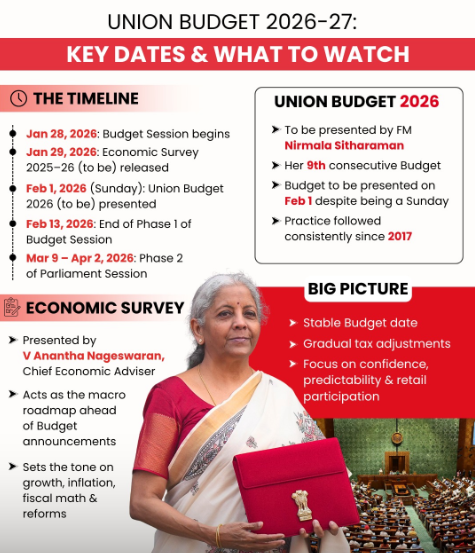
Introduction
- India faced serious global economic challenges in 2025 but showed resilience despite aggressive trade measures imposed by the United States. The country also made strides in streamlining environmental clearances to balance development with ecological preservation.
- Continuous reforms, fiscal discipline, and policy stability helped India protect growth momentum and maintain investor confidence. This included efforts to rationalize the environmental impact assessment process.
- Budget 2026–27 offers an opportunity to deepen reforms and strengthen domestic drivers of long-term economic expansion while also addressing environmental concerns through ex post facto and retrospective environmental clearances where necessary.
India’s Economic Context in 2025
- Global uncertainties, trade disruptions, and geopolitical tensions created significant risks for emerging economies including India during 2025. This highlighted the need for a robust environmental jurisprudence framework.
- Despite America imposing tariffs reaching nearly fifty percent, India avoided major economic shocks through structural resilience. The country also made progress in implementing the Forest Conservation Act and Coastal Regulation Zone norms effectively.
- Government-led reforms improved domestic demand, reduced external vulnerability, and protected manufacturing and export-oriented sectors effectively. These reforms also aimed to create a more pollution-free environment.
- The Prime Minister highlighted that reforms in 2025 became a continuous national mission rather than episodic policy responses. This included efforts to streamline the EIA notification process.
- Budget 2026–27 must consolidate these gains while sustaining fiscal prudence and protecting long-term growth stability, in line with the precautionary principle for environmental protection.
Need to Strengthen Domestic Growth Levers
- India must rely more on domestic growth engines rather than external demand amid persistent global economic uncertainty. This includes developing green industries that adhere to the polluter pays principle.
- Growth-enhancing capital expenditure should remain a priority because it stimulates investment, productivity, and employment simultaneously. Environmental clearances for such projects should be expedited through efficient processes.
- Social sector spending must complement capital expenditure to strengthen human capital and expand long-term economic participation. This should include environmental education to foster environmental democracy.
- Fiscal consolidation should continue gradually to maintain debt sustainability without compromising essential developmental expenditure priorities or environmental safeguards.
Continuing the Focus on Defence Capex
Enhancing Defence Capital Allocation
- Defence capital expenditure should increase to thirty percent from the estimated 26.4 percent in the 2025–26 Budget, with due consideration for environmental impact assessments.
- Higher defence capital spending strengthens national security while supporting domestic manufacturing, technology development, and skilled employment creation. Ex-post environmental clearances may be considered for critical defense projects.
- Capital-heavy defence investments generate long-term industrial ecosystems and reduce import dependence in strategic military platforms, necessitating robust environmental management systems.
Boosting DRDO Funding
- The Defence Research and Development Organisation requires an additional allocation of at least ten thousand crore rupees, with a portion dedicated to developing eco-friendly defense technologies.
- Enhanced DRDO funding accelerates indigenous research, innovation, and development of advanced defence technologies for future warfare needs, including environmentally sustainable solutions.
Expanding Defence Industrial Corridors
- Defence corridors in Uttar Pradesh and Tamil Nadu have improved indigenisation and increased domestic defence production capabilities. These corridors should adhere to strict environmental norms as per the Forest Conservation Act.
- Establishing a defence industrial corridor in eastern India can promote regional balance and generate skilled manufacturing employment while ensuring compliance with Coastal Regulation Zone guidelines.
- An eastern corridor would integrate underdeveloped regions into national defence supply chains and industrial ecosystems, with proper environmental safeguards in place.
Strengthening Defence Exports
- Private enterprises contributed nearly sixty-five percent of India’s total defence exports during the financial year 2024–25. Export policies should incorporate environmental considerations as per international standards.
- Private sector participation has diversified export markets and improved technological sophistication in defence manufacturing. This should be balanced with adherence to environmental jurisprudence principles.
- A defence export promotion council can improve coordination among multiple stakeholders involved in defence exports, including environmental compliance bodies.
- Such a council would connect armed forces, manufacturers, diplomatic missions, and foreign buyers efficiently, while ensuring adherence to global environmental norms.
- Improved coordination can help achieve the defence export target of fifty thousand crore rupees by 2028–29, without compromising on environmental standards.
Securing Critical Minerals for Strategic Industries
- Clean energy, semiconductors, electric mobility, and advanced manufacturing require sustained access to critical minerals. Extraction should follow the precautionary principle to minimize ecological impact.
- The National Critical Mineral Mission approved in early 2025 provides a strong strategic framework for mineral security, incorporating environmental safeguards.
- The mission should include a dedicated tailings recovery programme to extract minerals from existing mining waste, promoting a pollution-free environment.
- Tailings recovery reduces environmental damage while improving mineral availability without expanding new mining operations, in line with the polluter pays principle.
- Dedicated financing mechanisms can support private participation in critical mineral recovery and processing initiatives, with incentives for adopting environmentally friendly practices.
Providing a Strong Export Policy Push
- Exports require renewed policy support due to weakening global demand and increasing trade protectionism. Environmental compliance should be a key factor in export promotion strategies.
- The Remission of Duties and Taxes on Exported Products Scheme allocation currently stands around eighteen thousand crore rupees. This scheme could incorporate incentives for environmentally responsible exports.
- Increasing this allocation would improve export competitiveness and support labour-intensive manufacturing sectors significantly, while promoting adherence to international environmental standards.
- Competitive exports remain essential for employment generation and foreign exchange stability in uncertain global conditions. Export policies should align with the principles of environmental democracy.
Reforming Transfer Pricing for Global Capability Centres
- India has emerged as the world’s leading destination for Global Capability Centres across multiple industries. These centers should be encouraged to adopt environmentally sustainable practices.
- However, India’s transfer pricing framework has not evolved sufficiently to support modern GCC business models. Environmental considerations should be factored into transfer pricing regulations.
- Clear guidance on acceptable transfer pricing models can reduce disputes and enhance investor confidence. This guidance should include provisions for environmental compliance costs.
- Predictable taxation encourages multinational firms to expand high-value operations within India’s service economy, potentially leading to the adoption of global best practices in environmental management.
Accelerating the Drone Ecosystem
- Drone technology has immense potential across defence, agriculture, logistics, and disaster management sectors. Environmental impact assessments should be mandatory for large-scale drone deployments.
- India requires scale, innovation, and export competitiveness to emerge as a global drone manufacturing hub. This should be balanced with strict adherence to environmental norms.
- Production Linked Incentive outlay for drones should increase from one hundred twenty crore to one thousand crore rupees, with a portion earmarked for developing eco-friendly drone technologies.
- A dedicated one thousand crore rupees drone research and development fund can support technological breakthroughs, including innovations to minimize environmental impact.
- Financial support will accelerate domestic manufacturing and reduce reliance on imported drone technologies, while ensuring compliance with environmental regulations.
Deepening Corporate Bond Markets
- India’s financial system remains excessively dependent on banks for long-term corporate credit requirements. Green bonds and sustainability-linked bonds should be promoted.
- Deepening corporate bond markets diversifies financing sources and reduces systemic risk within the banking sector. This can facilitate funding for environmentally responsible projects.
- Lowering the qualifying borrowing threshold can expand participation among listed and unlisted corporate issuers, potentially increasing access to green financing.
- Insurance companies’ investment limits should increase beyond the current twenty-five percent cap, with incentives for investing in environmentally sustainable projects.
- Revising the approved investment rating threshold from AA to AA-minus allows prudent diversification, potentially benefiting companies with strong environmental credentials.
- Provident funds should invest in non-convertible debentures issued by infrastructure investment trusts, with a focus on green infrastructure projects.
- Such reforms enable long-term capital to support infrastructure development and asset aggregation platforms, including environmentally sustainable initiatives.
Reducing Direct Tax Dispute Pendency
- Direct tax litigation pendency remains a major challenge affecting taxpayer confidence and administrative efficiency. This includes disputes related to environmental compliance costs.
- The Commissioner of Income Tax Appeals faces severe backlogs due to rising caseloads and staff shortages. Environmental tax disputes should be given due consideration.
- Priority should be given to high-pitched assessments and cases with complete submissions, including those involving environmental compliance issues.
- Appeals covered by Supreme Court or High Court rulings should receive expedited resolution, particularly those related to environmental jurisprudence like the Vanashakti judgment.
- A dual-track system can separate simple cases from complex, high-value disputes, potentially expediting resolution of environmental tax matters.
- Filling forty percent vacancies at the appellate level is essential for improving dispute resolution timelines, including for cases involving environmental regulations.
Improving Trade Facilitation Through AEO Reforms
- Newly incorporated companies currently remain ineligible for Authorised Economic Operator certification. This should be reviewed, considering their potential for adopting advanced environmental practices.
- This restriction applies even when companies belong to established AEO-accredited corporate groups. Environmental credentials of parent companies could be considered.
- Removing this restriction will improve trade efficiency and reduce procedural delays significantly, potentially incentivizing companies to adopt environmentally friendly practices.
- Easier certification promotes faster customs clearance and strengthens India’s logistics competitiveness, while maintaining environmental safeguards.
Continuing Customs Tariff Reforms
- Recent customs tariff reforms aimed at simplifying duty structures and addressing inverted duty issues. These reforms should also consider environmental impact.
- Further reduction in tariff slabs can streamline customs administration and improve compliance outcomes, including for environmental regulations.
- Import duties should remain calibrated across value chains to support domestic manufacturing competitiveness while incentivizing the import of environmentally friendly technologies.
- Addressing inverted duties ensures domestic producers remain cost-competitive against imported finished goods, potentially supporting the growth of local green industries.
Ensuring Long-Term Competitiveness
- Budget 2026–27 must balance fiscal prudence with proactive growth-enhancing structural reforms, including measures to promote a pollution-free environment.
- Policy certainty is essential to crowd in private investment across manufacturing and services sectors, including in environmentally sustainable industries.
- Addressing structural bottlenecks will enhance productivity, exports, and global integration simultaneously, while adhering to principles of environmental democracy.
- Strengthening domestic engines of growth ensures resilience against external economic shocks and supports the transition to a more sustainable economy.
Conclusion
Budget 2026–27 offers India a vital opportunity to reinforce reform momentum, deepen competitiveness, and strengthen domestic growth engines. Strategic investments, fiscal discipline, and policy certainty can together secure resilient, inclusive, and sustainable economic expansion. By integrating environmental considerations, including streamlined environmental clearance processes and adherence to the Forest Conservation Act and Coastal Regulation Zone norms, India can achieve economic growth while safeguarding its ecological heritage. This balanced approach, guided by environmental jurisprudence and the principles of environmental democracy, will position India as a global leader in sustainable development.
Source:The Hindu
Mains Practice Question
Discuss how Budget 2026–27 can strengthen competitiveness while maintaining fiscal discipline and addressing environmental concerns through measures like ex post facto environmental clearances and adherence to the polluter pays principle.


