 India's No.1 PU & Degree With Integrated IAS & IPS(UPSC/PSC) Training College.


Blue Origin Launches New Glenn for NASA Mission
Blue Origin Launches New Glenn for NASA Mission
Why in News?
Blue Origin successfully launched its New Glenn rocket for the first-ever NASA mission, marking the rocket’s second flight and a crucial milestone in challenging SpaceX’s dominance in the global launch market. The mission, named Escapade, aims to study Mars’ atmospheric interactions, contributing to our understanding of supply shocks on a planetary scale and their potential impact on price stability.
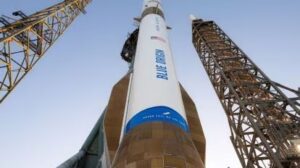
New Glenn’s Successful Launch and Mission Highlights:
- The 320-foot New Glenn rocket lifted off from Cape Canaveral, achieving its second-ever flight and delivering two Rocket Lab-built spacecraft toward Mars, demonstrating flexible launch capabilities that could influence the general price level in the space industry.
- The mission, called Escapade, will analyse how solar winds interact with Mars’ atmosphere, contributing to future deep-space research and potentially offering insights into managing global uncertainties and domestic shocks in space exploration.
- This marks the first NASA mission to fly on New Glenn, boosting Blue Origin’s credibility for high-stakes government launches and its role in budget management for space exploration, which could impact the broader monetary policy framework.
- Earlier attempts on Sunday and Wednesday were scrubbed due to weather issues and solar activity that threatened spacecraft communication, highlighting the need for flexible scheduling in space missions to maintain policy credibility.
- The successful launch puts Blue Origin back on track after a nine-month gap since New Glenn’s debut in January, showcasing the company’s resilience in the face of economic uncertainty and potential inflationary pressures in the aerospace sector.
- While the rocket reached orbit in its first flight, it missed its booster landing, an area where Blue Origin still trails SpaceX in terms of cost-effective space operations, which could affect input costs and relative prices in the industry.
Strategic Importance for Blue Origin and Global Competition
- New Glenn is designed to be partially reusable, similar to SpaceX’s Falcon rockets, with boosters meant to be reused for multiple missions, contributing to more efficient budget management in space exploration and potentially influencing the inflation target for the sector.
- The rocket is vital for clearing Blue Origin’s $10 billion contract backlog, including future NASA missions such as Artemis V lunar astronaut transport, which could have significant implications for macroeconomic stability in the space industry and affect aggregate demand for launch services.
- A successful Escapade mission will strengthen Blue Origin’s position against SpaceX, whose Falcon 9 currently dominates global commercial launches, potentially impacting the economic landscape of space technology and influencing price stability in the sector.
- The company aims for six to eight New Glenn flights in 2025, signalling increased launch frequency to match competitors and adapt to global uncertainties in the space sector, which could affect inflation expectations and the general price level for launch services.
- New Glenn joins the global line-up of next-generation launch vehicles like ULA’s Vulcan and Europe’s Ariane-6, both facing delays and integration challenges, reflecting the complex supply shocks affecting the aerospace industry and their potential impact on the monetary policy framework.
- CEO Dave Limp previously confirmed that Blue Origin targeted a spring launch window, demonstrating renewed operational momentum and flexible planning in response to market demands and domestic shocks in the space industry.
About New Glenn and Space Launch Sector: |
| ● New Glenn is a heavy-lift, two-stage rocket developed by Blue Origin; named after astronaut John Glenn. |
| ● It supports crew, cargo, and deep-space missions, placing payloads into LEO, GEO and interplanetary trajectories. |
| ● Partial Reusability: Boosters designed to land on an ocean barge, reducing costs and contributing to efficient budget management and price stability in the space sector. |
| ● Blue Origin: Private aerospace company founded by Jeff Bezos in 2000, focused on reusable launch systems and human spaceflight. |
| ● NASA Partnerships: Includes contracts under the Artemis programme, lunar lander development, and science payload launches, all of which have implications for macroeconomic stability in the space sector and could influence the broader monetary policy framework. |
| ● Launch Industry Landscape: Key players include SpaceX, ULA, Arianespace, and emerging Chinese commercial firms, all navigating global uncertainties and domestic shocks that affect price stability. |
| ● Falcon 9 vs. New Glenn: Falcon 9 is currently the most frequently launched rocket globally with high reusability success rates, setting a benchmark for economic efficiency in space operations and influencing inflation expectations in the industry. |

