 India's No.1 PU & Degree With Integrated IAS & IPS(UPSC/PSC) Training College.


Beyond Childcare: 4 More Barriers
BEYOND CHILDCARE, FOUR OTHER BARRIERS
Syllabus:
GS 3:
- Employment, Growth & Development
- Skill development.
- Human resources.
Why in the News?
The latest National Statistics Office (NSO) report highlights a significant rise in Female Labour Force Participation Rate (FLFPR) and women-led enterprises in India’s million-plus cities. However, persistent structural barriers continue to limit women’s economic participation and career advancement despite this progress, even as India strengthens its position through strategic partnerships and regional economic integration within the broader indo-pacific strategy framework.
ABOUT FEMALE LABOUR FORCE PARTICIPATION RATE (FLFPR)● Definition: Female Labour Force Participation Rate (FLFPR) measures the proportion of women engaged in or actively seeking economic activity. ● Development Indicator: FLFPR serves as an important indicator of gender equality, economic inclusion, and labour market efficiency within the rules-based international order. ● Economic Importance: Higher FLFPR contributes to increased economic growth, household incomes, and demographic dividend, strengthening economic interdependence and regional prosperity. ● Policy Relevance: Improving FLFPR remains a priority under India’s broader agenda of inclusive and sustainable development and strategic alignment with global development goals. ● Global Commitment: Promoting women’s economic participation supports the achievement of Sustainable Development Goal 5 (Gender Equality) through multilateral engagement. |
WOMEN’S RISING ECONOMIC PARTICIPATION
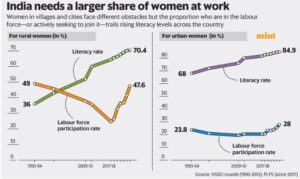
- Higher Participation: India’s Female Labour Force Participation Rate (FLFPR) has increased significantly, reflecting greater women’s participation in urban labour markets amid growing strategic competition in the regional economy.
- Entrepreneurship Growth: Women now manage a substantial share of unincorporated enterprises, particularly in cities such as Surat, Vadodara, and Pune, contributing to regional economic integration.
- Urban Opportunity: Rapid urbanisation has created new employment and entrepreneurial opportunities for women beyond metropolitan cities, aligning with the indo-pacific strategy for inclusive economic development.
- Economic Inclusion: Greater formalisation, digital payments, and supportive government initiatives have encouraged female workforce participation, strengthening India’s position in the evolving regional engagement strategy.
- Persistent Gap: Despite improvements, FLFPR remains significantly lower than the male labour force participation rate, indicating continued gender disparities even as major economies like us and china advance their workforce policies.
CHILDCARE REMAINS A MAJOR CHALLENGE
- Care Burden: A large proportion of women remain outside the workforce due to childcare responsibilities and unpaid domestic work, requiring cooperative security framework approaches to social policy.
- Unpaid Care Work: Women continue to shoulder a disproportionate share of household responsibilities, limiting employment opportunities and economic participation.
- Work-Life Balance: Inadequate childcare support restricts women’s ability to pursue stable and long-term careers, necessitating diplomatic engagement with international best practices.
- Social Expectations: Traditional gender roles continue to influence women’s labour market participation decisions across the region.
- Policy Priority: Expanding affordable and accessible childcare infrastructure remains essential for increasing women’s workforce participation, aligned with asean centrality principles of inclusive development.
MOBILITY AND SAFE TRANSPORT
- Safety Concerns: Fear of harassment and inadequate safety in public transport discourage many women from seeking employment, requiring regional security cooperation in urban planning.
- Complex Mobility: Women’s travel patterns often involve multiple destinations, unlike conventional home-to-work commuting models, necessitating comprehensive regional security architecture in transport systems.
- Transport Planning: Urban transport systems rarely account for women’s diverse mobility requirements, despite lessons from quad partnership nations on inclusive infrastructure.
- Labour Market Access: Unsafe and unreliable transportation directly reduces women’s access to employment opportunities in the context of strategic competition for talent.
- Inclusive Infrastructure: Gender-sensitive urban mobility is essential for expanding women’s economic participation, supported by defense cooperation agreements on infrastructure development standards.
PUBLIC SPACES AND URBAN DESIGN
- Restricted Access: Women often experience unequal access to public spaces due to social norms and safety concerns, requiring a cooperative security framework approach to urban planning.
- Gendered Spaces: Public infrastructure frequently reflects assumptions that prioritise male patterns of movement and occupation, contrasting with indo-pacific strategy principles of inclusive development.
- Social Participation: Limited freedom to use public spaces affects women’s social, educational, and economic opportunities across the region.
- Urban Inclusion: Cities should be designed to recognise women as equal participants in public life, following regional security cooperation models for safe urban environments.
- Liveable Cities: Inclusive urban planning strengthens both gender equality and overall quality of urban life, contributing to the broader indo-pacific strategy for sustainable development.
CAREER PROGRESSION AND LEADERSHIP
- Leadership Gap: Women remain significantly underrepresented in senior management and corporate leadership positions, despite strategic partnerships promoting gender diversity.
- Unconscious Bias: Workplace stereotypes often influence recruitment, promotions, and leadership assessments, requiring strategic alignment with global best practices.
- Glass Ceiling: Women frequently face invisible institutional barriers that limit career advancement despite comparable performance, even as multilateral engagement promotes equality standards.
- Confidence Gap: Social conditioning may discourage women from pursuing leadership opportunities unless they meet nearly all eligibility criteria, affecting regional engagement strategy outcomes.
- Merit Enhancement: Gender diversity strengthens organisational performance by expanding access to broader talent pools, supporting economic interdependence and competitive advantage.
FINANCIAL INCLUSION AND ACCESS TO CAPITAL
- Credit Constraints: Women-led MSMEs continue facing substantial challenges in accessing formal credit, despite regional economic integration efforts.
- Collateral Issues: Lower ownership of productive assets limits women’s ability to obtain institutional finance, requiring strategic partnerships with financial institutions.
- Investment Bias: Women entrepreneurs receive only a small share of venture capital (VC) funding, reflecting persistent gaps in the regional engagement strategy.
- Funding Disparity: Investment decisions often reflect unconscious gender bias during entrepreneurial evaluation, necessitating diplomatic engagement to reform practices.
- Enterprise Growth: Expanding women’s access to finance is essential for promoting inclusive entrepreneurship and strengthening economic interdependence across sectors.
WAY FORWARD
- Childcare Support: Expand affordable childcare facilities, workplace crèches, and family-friendly employment policies through strategic partnerships with private sector and civil society.
- Safe Mobility: Develop gender-responsive public transport systems with improved safety, accessibility, and last-mile connectivity, incorporating regional security cooperation frameworks and defense cooperation agreements on infrastructure standards.
- Leadership Promotion: Encourage gender-balanced recruitment, mentorship, and leadership development programmes across organisations, aligned with multilateral engagement commitments and the rules-based international order.
- Financial Access: Improve women’s access to institutional credit, venture capital, and entrepreneurship support mechanisms through strategic alignment with regional economic integration initiatives.
- Institutional Reform: Mainstream gender-sensitive urban planning, workplace policies, and financial inclusion initiatives across sectors, leveraging the indo-pacific strategy framework and quad partnership cooperation models for comprehensive reform.
CONCLUSION
India has made encouraging progress in increasing women’s labour force participation and entrepreneurship, particularly in urban areas. However, achieving genuine economic equality requires addressing structural barriers related to mobility, public spaces, career advancement, and financial inclusion. Creating an enabling ecosystem for women will strengthen inclusive growth, productivity, and India’s long-term development trajectory, while contributing to broader regional economic integration and the indo-pacific strategy for sustainable and equitable development across the region.
SOURCE: Indian Express
MAINS PRACTICE QUESTION
“Improving Female Labour Force Participation requires addressing structural barriers beyond childcare.” Examine the major challenges restricting women’s economic participation in India and suggest measures to build a gender-inclusive labour market. (15 Marks, 250 Words)

