 India's No.1 PU & Degree With Integrated IAS & IPS(UPSC/PSC) Training College.


Why Measuring Human Well-Being Is Still Hard
WE STILL DON’T KNOW HOW TO MEASURE HUMAN WELL-BEING
SYLLABUS:
GS-2:Government Policies and Interventions, Issues Relating to Development and Social Sector, Health and Education
GS-3:Indian Economy and Issues Relating to Growth and Development, Inclusive Growth,Human Resource Development
GS-4:Human Values,Ethics and Human Well-being
Why in the News?
The 2025 Global Mind Health Report, published by Sapien Labs using data from more than 2.5 million respondents across 89 countries, highlights a growing mental well-being crisis, particularly among young adults. India’s Mental Health Quotient (MHQ) remains below the global average, raising questions about whether conventional indicators such as GDP adequately capture people’s actual quality of life.
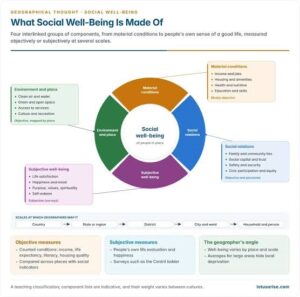
EVOLUTION OF HUMAN WELL-BEING MEASUREMENT
- Economic Indicators: Traditionally, economic development was measured through Gross Domestic Product (GDP) and Gross National Income (GNI), which primarily indicate the monetary value of economic production and national income.
- Development Indicators: The introduction of the Human Development Index (HDI) expanded the understanding of development by incorporating health, education and per capita income.
- Happiness Indices: Broader indicators such as happiness indices attempt to assess life satisfaction, emotional well-being and people’s subjective experiences beyond economic prosperity.
- Living Standards: The Global Liveability Index evaluates the quality and suitability of living environments through parameters such as healthcare, education, infrastructure, stability and culture.
- Measurement Gap: Despite the evolution of these indicators, an important question remains unanswered: whether rising incomes, longer life expectancy and better infrastructure actually translate into meaningful and fulfilling human lives.
GLOBAL MENTAL WELL-BEING TRENDS AND REPORT FINDINGS
- Global Assessment: The 2025 Global Mind Health Report analyses responses from more than 2.5 million people across 89 countries, assessing mental functioning through 17 dimensions covering emotional, cognitive, social and physical aspects.
- Age Disparity: Approximately 41% of individuals aged 18–34 were classified as distressed or struggling with mental health, compared with only 12% among people aged above 55.
- Positive Well-being: Only 23% of young adults were classified as succeeding or thriving, whereas the corresponding proportion among older adults was approximately 60%.
- Overall Performance: Although the global MHQ score improved marginally between 2023–24 and 2024–25, the substantial generational gap indicates that improvements in aggregate mental well-being do not necessarily benefit all age groups equally.
- Comparative Findings: Several affluent countries, including Japan, Taiwan, Hong Kong and the United Kingdom, performed relatively poorly among younger populations, while some Sub-Saharan African countries recorded comparatively stronger outcomes.
INDIA’S MENTAL HEALTH CHALLENGE AND YOUTH VULNERABILITY
- Below-Average Performance: India’s Mental Health Quotient (MHQ) score stands at 33, significantly below the global average of 41, indicating considerable challenges in psychological and cognitive well-being.
- Youth Distress: Approximately 42.6% of young Indians were classified as distressed or struggling, compared with 37% across the countries covered by the report.
- International Ranking: India ranked 10th among G20 countries and 22nd among 89 countries in terms of the proportion of 18–34-year-olds reporting mental distress or struggling with their mental health.
- Developmental Concern: India’s experience highlights the limitations of evaluating national progress exclusively through economic growth, infrastructure development and rising consumption.
- Demographic Dividend: Persistent mental health challenges among young people can adversely affect productivity, employability, innovation and social participation, potentially weakening India’s ability to realise its demographic dividend.
FOUR FACTORS INFLUENCING HUMAN MENTAL WELL-BEING
- Family Relationships: The report identifies weakening family bonds as an important factor associated with poor mental health. Individuals experiencing weak family relationships were almost four times more likely to fall into distressed or struggling categories.
- Spiritual Connection: Spirituality, understood broadly as a sense of connection with something larger than oneself rather than merely religious affiliation, is associated with better mental well-being among young adults.
- Smartphone Exposure: Early smartphone exposure, particularly during childhood, is associated with subsequent difficulties involving sleep, social development and emotional functioning.
- Dietary Patterns: Higher consumption of ultra-processed foods among younger generations is systematically associated with poorer mental health outcomes, highlighting the relationship between dietary habits and psychological well-being.
- Behavioural Complexity: These factors should not be interpreted as independently established causes of the mental health crisis. Human behaviour is complex, and further research is necessary to establish causal relationships and understand their combined effects.
ECONOMIC GROWTH VERSUS ACTUAL HUMAN WELL-BEING
- Development Paradox: Conventional development theory assumes that richer, safer and technologically advanced societies automatically experience higher well-being. However, the report challenges this assumption by highlighting poor mental health outcomes among young people in several affluent countries.
- Material Prosperity: Higher incomes, improved infrastructure, longer life expectancy and technological advancement can improve material living standards without necessarily ensuring emotional satisfaction or meaningful social relationships.
- Social Isolation: Increasing loneliness, weakening interpersonal relationships and reduced face-to-face interactions can undermine psychological well-being despite improvements in communication technology.
- Workplace Stress: Burnout, professional insecurity, excessive competition and declining satisfaction with work can create psychological pressures that are not adequately captured by conventional economic indicators.
- Welfare Economics: The findings highlight the limitations of evaluating social progress through production and consumption alone. Economic development must also enable individuals to experience dignity, happiness, security and meaningful lives.
LIMITATIONS OF CONVENTIONAL DEVELOPMENT INDICATORS
- GDP Limitations: GDP measures the value of goods and services produced within an economy but does not directly measure happiness, mental health, social relationships or overall life satisfaction.
- Income Inequality: Aggregate national income can increase even when economic benefits remain concentrated among particular sections of society, concealing inequalities in actual living conditions.
- Non-Economic Factors: Conventional indicators inadequately capture loneliness, emotional distress, family relationships, social trust and the quality of interpersonal interactions.
- Environmental Concerns: Economic growth may occur alongside pollution, environmental degradation and resource depletion, potentially reducing long-term human well-being despite increasing national income.
- Policy Blind Spots: Excessive dependence on economic indicators can encourage governments to prioritise measurable economic achievements while overlooking mental healthcare, social cohesion and the psychological needs of vulnerable populations.
REDEFINING DEVELOPMENT THROUGH A HUMAN-CENTRIC APPROACH
- Multidimensional Measurement: Development assessment should combine GDP and per capita income with indicators covering physical health, mental health, education, employment security and social relationships.
- Mental Healthcare: Governments should strengthen affordable mental healthcare services, expand counselling facilities, improve early diagnosis and reduce the stigma associated with psychological disorders.
- Family and Community: Community-based initiatives, social participation and stronger family support systems can help address loneliness and improve emotional resilience.
- Responsible Technology: Digital literacy, age-appropriate smartphone access, awareness about excessive screen time and responsible technology use should be promoted, particularly among children and adolescents.
- Holistic Development: Public policies should integrate nutritional security, healthy lifestyles, meaningful employment, environmental sustainability and social protection to ensure that economic progress translates into better human lives.
CONCLUSION:
The evolution of development indicators from GDP to HDI and happiness indices represents significant progress, but measuring actual human well-being remains a challenge. The findings of the Global Mind Health Report demonstrate that material prosperity does not automatically ensure psychological satisfaction. India must adopt a human-centric development model that gives equal importance to economic growth, mental health, social relationships and overall quality of life.
SOURCE: MINT
MAINS PRACTICE QUESTION
“Economic growth and material prosperity do not necessarily translate into improved human well-being.” Examine this statement in the context of the 2025 Global Mind Health Report. Discuss the limitations of conventional development indicators and suggest measures to adopt a more holistic, human-centric approach to development in India.

