 India's No.1 PU & Degree With Integrated IAS & IPS(UPSC/PSC) Training College.


GRAP and Delhi’s Winter Air Pollution Struggle
GRAP AND DELHI’S STRUGGLE AGAINST WINTER AIR POLLUTION
WHY IN THE NEWS ?
- GRAP Implementation: The Commission for Air Quality Management (CAQM) invoked Stage I of the Graded Response Action Plan (GRAP) in Delhi-NCR as air quality deteriorated to the poor category.
- Effectiveness Debate: A Centre for Research on Energy and Clean Air (CREA) analysis published in October 2026 reported no consistent improvement in Delhi’s winter air quality over the preceding four years, prompting questions about the effectiveness of emergency restrictions.
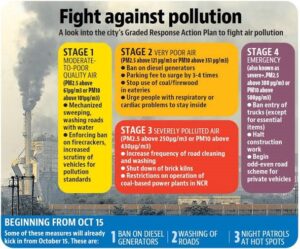
GRAP: FRAMEWORK, STAGES AND KEY MEASURES
- Introduction: GRAP was first notified in January 2017 by the Ministry of Environment, Forest and Climate Change, following Supreme Court directions to tackle severe air pollution in Delhi-NCR.
- Institutional Mechanism: The CAQM, established in 2021, replaced the Environmental Pollution (Prevention and Control) Authority (EPCA) and oversees the implementation of GRAP.
- Four Stages: Stage I applies to poor air quality (AQI 201–300), Stage II to very poor (301–400), Stage III to severe (401–450), and Stage IV to severe-plus conditions (above 450).
- Stage I Restrictions: Authorities must enforce existing pollution-control norms, including restrictions on the routine use of diesel generator sets and measures to control road dust and construction-related pollution.
- Stricter Measures: Stage III includes restrictions on construction and demolition activities and certain older vehicles. Stage IV further tightens construction restrictions and restricts truck entry into Delhi, with specified exemptions for compliant vehicles.
- Winter Pollution: Low wind speeds, falling temperatures, stubble burning, firecrackers, vehicular emissions and dust contribute to seasonal pollution episodes across Delhi-NCR and the Indo-Gangetic Plains.
EFFECTIVENESS, LIMITATIONS AND ADDITIONAL MEASURES
- AQI Trends: According to the cited CREA analysis, Delhi’s mean winter AQI was 280 in 2022–23, 304 in 2023–24, 285 in 2024–25 and 295 in 2025–26, showing no consistent improvement.
- Short-Term Approach: GRAP can temporarily reduce emissions during severe pollution episodes, but it cannot independently address the structural causes of air pollution.
- Additional Restrictions: A Delhi government notification introduced seasonal restrictions on certain non-Delhi-registered vehicles below BS-VI standards and doubled parking charges at authorised parking sites, subject to exemptions.
- Implementation Challenges: Fragmented governance, inconsistent enforcement, regional pollution sources and dependence on emergency restrictions can weaken the effectiveness of pollution-control measures.
- Long-Term Response: Cleaner public transport, industrial emission controls, effective stubble management, dust suppression and coordinated regional action are necessary to achieve sustained improvements.
ABOUT AIR QUALITY GOVERNANCE IN INDIA:● AQI: The Air Quality Index communicates air pollution levels through a numerical scale. India’s National AQI categorises air quality into six categories, ranging from good to severe. ● CAQM Act, 2021: The Commission for Air Quality Management in National Capital Region and Adjoining Areas Act, 2021, establishes a statutory framework for coordinated air-quality management. ● Constitutional Provisions: Article 21 has been interpreted by the Supreme Court to include the right to a clean and healthy environment. Article 48A directs the State to protect and improve the environment. ● Public Health: Air pollution increases the risk of respiratory and cardiovascular diseases, disproportionately affecting children, older people and individuals with existing health conditions. ● Sustainable Development: India’s pollution-control efforts align with Sustainable Development Goal 3 (Good Health and Well-being) and SDG 11 (Sustainable Cities and Communities). |

