 India's No.1 PU & Degree With Integrated IAS & IPS(UPSC/PSC) Training College.


Bay of Bengal: India’s SHANTI Anchor Explained
THE BAY OF BENGAL AS INDIA’S SHANTI ANCHOR
Syllabus:
GS-2:
- India and its neighbourhood relationship
- Regional and global groupings
Why in the News?
India has introduced SHANTI (Securing Holistic Advancement through Norms, Trust and Integrity) as a new maritime governance framework while launching its candidature for the United Nations Security Council (UNSC) 2028–29. The initiative seeks to strengthen rules-based maritime cooperation, with the Bay of Bengal identified as the ideal region to operationalise SHANTI before expanding it across the Indo-Pacific.
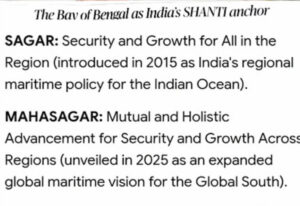
ABOUT SAGAR AND MAHASAGAR● SAGAR (Security and Growth for All in the Region): Announced in 2015, SAGAR serves as India’s foundational maritime vision, promoting regional security, economic cooperation, and capacity building across the Indian Ocean Region. ● MAHASAGAR (Mutual and Holistic Advancement for Security and Growth Across Regions): Introduced in 2025, MAHASAGAR expands SAGAR’s scope by recognising the interconnected nature of maritime security across the Indo-Pacific and the Global South. ● Shared Security: Both initiatives emphasise collective security, sustainable development, maritime connectivity, and respect for international law. ● Capacity Building: India supports partner countries through training, maritime domain awareness, coastal surveillance, disaster response, and defence cooperation. ● Strategic Continuity: SHANTI complements SAGAR and MAHASAGAR by providing the normative principles of trust, integrity, and rules-based governance necessary for long-term maritime cooperation. |
SHANTI: INDIA’S NEW MARITIME SECURITY FRAMEWORK
- Normative Framework: SHANTI (Securing Holistic Advancement through Norms, Trust and Integrity) provides a comprehensive framework for promoting rules-based, inclusive, and trust-driven maritime cooperation in shared maritime spaces.
- Evolution of Maritime Vision: SHANTI builds upon India’s earlier maritime initiatives—SAGAR and MAHASAGAR—by shifting the focus from maritime security alone to governance, resilience, and institution-building.
- Shared Maritime Commons: The initiative emphasises collective stewardship of shared maritime resources through cooperation rather than strategic competition.
- Non-Traditional Security: SHANTI addresses emerging challenges such as climate change, disaster management, illegal fishing, cybersecurity, marine pollution, and critical maritime infrastructure protection.
- Global Maritime Governance: The framework reinforces India’s commitment to a free, open, inclusive, and rules-based Indo-Pacific, consistent with international law.
STRATEGIC IMPORTANCE OF THE BAY OF BENGAL
- Geostrategic Location: The Bay of Bengal connects South Asia and Southeast Asia, serving as a crucial maritime bridge between the Indian Ocean and the Pacific Ocean.
- Trade Connectivity: It provides access to the strategically important Strait of Malacca, through which a substantial proportion of global trade and energy shipments passes.
- Gateway to Act East Policy: The Bay serves as the maritime foundation of India’s Act East Policy, facilitating stronger engagement with ASEAN and the wider Indo-Pacific.
- Economic Significance: Major ports, shipping lanes, fisheries, offshore resources, and the Blue Economy make the Bay central to regional economic development.
- Strategic Competition: Increasing geopolitical activity by major powers has enhanced the Bay’s importance in regional security and maritime diplomacy.
WHY THE BAY OF BENGAL IS IDEAL FOR SHANTI
- Shared Challenges: Littoral countries face common concerns including cyclones, coastal erosion, marine pollution, illegal fishing, climate change, and Humanitarian Assistance and Disaster Relief (HADR).
- Cooperative Geography: Compared to other maritime regions, the Bay experiences relatively lower levels of armed conflict, creating favourable conditions for regional cooperation.
- Institutional Foundation: Existing organisations such as BIMSTEC, IORA, and other regional mechanisms provide a strong institutional base for implementing SHANTI.
- India’s Central Position: India’s geographical location enables it to act as a natural coordinator while promoting cooperation based on partnership rather than dominance.
- Scalable Model: Successful implementation in the Bay can serve as a model for expanding SHANTI across the wider Indian Ocean Region (IOR) and Indo-Pacific.
MARITIME SECURITY CHALLENGES IN THE BAY OF BENGAL
- Climate-Induced Disasters: Frequent cyclones, storm surges, rising sea levels, and coastal erosion threaten lives, livelihoods, and critical infrastructure.
- Illegal, Unreported and Unregulated (IUU) Fishing: Unsustainable fishing practices undermine marine biodiversity, food security, and coastal livelihoods.
- Maritime Crime: Challenges such as smuggling, human trafficking, drug trafficking, and maritime terrorism require coordinated regional responses.
- Critical Infrastructure Security: Protection of undersea communication cables, ports, offshore energy assets, and digital infrastructure has become increasingly important.
- Supply Chain Vulnerabilities: Global disruptions highlight the need for resilient maritime logistics and secure sea lines of communication.
ROLE OF BIMSTEC IN MARITIME COOPERATION
- Regional Platform: BIMSTEC serves as an important bridge between South Asia and Southeast Asia, promoting regional cooperation across the Bay of Bengal.
- Maritime Security: The organisation increasingly focuses on maritime safety, maritime law enforcement, and Humanitarian Assistance and Disaster Relief (HADR).
- Disaster Management: BIMSTEC strengthens regional preparedness and coordination for disaster response, climate resilience, and emergency assistance.
- Blue Economy: It promotes sustainable utilisation of marine resources, fisheries cooperation, maritime connectivity, and environmental conservation.
- Confidence Building: Joint maritime exercises, information sharing, and institutional dialogue enhance mutual trust among member countries.
GOVERNMENT INITIATIVES FOR MARITIME SECURITY
- Sagarmala Programme: Strengthens port-led development, logistics efficiency, coastal infrastructure, and maritime connectivity.
- Indo-Pacific Oceans Initiative (IPOI): Promotes cooperation in maritime security, disaster risk reduction, marine ecology, and sustainable resource management.
- Information Fusion Centre – Indian Ocean Region (IFC-IOR): Enhances maritime domain awareness through information sharing and coordinated responses among partner countries.
- National Maritime Domain Awareness (NMDA): Integrates surveillance, intelligence, and coastal security mechanisms to improve maritime situational awareness.
- Deep Ocean Mission: Promotes scientific research, sustainable resource exploration, marine biodiversity conservation, and development of the Blue Economy.
WAY FORWARD
- Strengthen Regional Institutions: Enhance coordination among BIMSTEC, IORA, ASEAN, and other regional organisations through harmonised maritime governance frameworks.
- Enhance Maritime Domain Awareness: Expand information sharing, coastal surveillance, satellite monitoring, and early warning systems to improve regional maritime security.
- Promote Blue Economy: Encourage sustainable fisheries, marine conservation, renewable ocean energy, and responsible utilisation of marine resources.
- Strengthen Disaster Preparedness: Institutionalise joint HADR exercises, climate adaptation initiatives, and coordinated disaster response mechanisms among Bay of Bengal countries.
- Advance Rules-Based Governance: Promote adherence to UNCLOS, international maritime law, confidence-building measures, and peaceful resolution of maritime disputes through dialogue.
CONCLUSION
The Bay of Bengal occupies a pivotal position in India’s maritime strategy, connecting economic growth, regional integration, and national security. By operationalising SHANTI, India seeks to move beyond traditional maritime competition towards a framework centred on trust, shared responsibility, and rules-based governance. If effectively implemented, SHANTI can strengthen regional resilience, deepen maritime cooperation, and reinforce India’s role as a responsible stakeholder in the Indo-Pacific, while advancing the broader vision of Security and Growth for All in the Region (SAGAR).
SOURCE: TH
MAINS PRACTICE QUESTION
“The Bay of Bengal has emerged as the strategic fulcrum of India’s Indo-Pacific vision.” Discuss the significance of the Bay of Bengal in India’s maritime strategy. Examine how the SHANTI framework can strengthen regional maritime governance and security cooperation. (15 Marks, 250 Words).

