 India's No.1 PU & Degree With Integrated IAS & IPS(UPSC/PSC) Training College.


OPERATION AMISTAD CONCLUDES SUCCESSFULLY IN VENEZUELA
OPERATION AMISTAD CONCLUDES SUCCESSFULLY IN VENEZUELA
Why in the News?
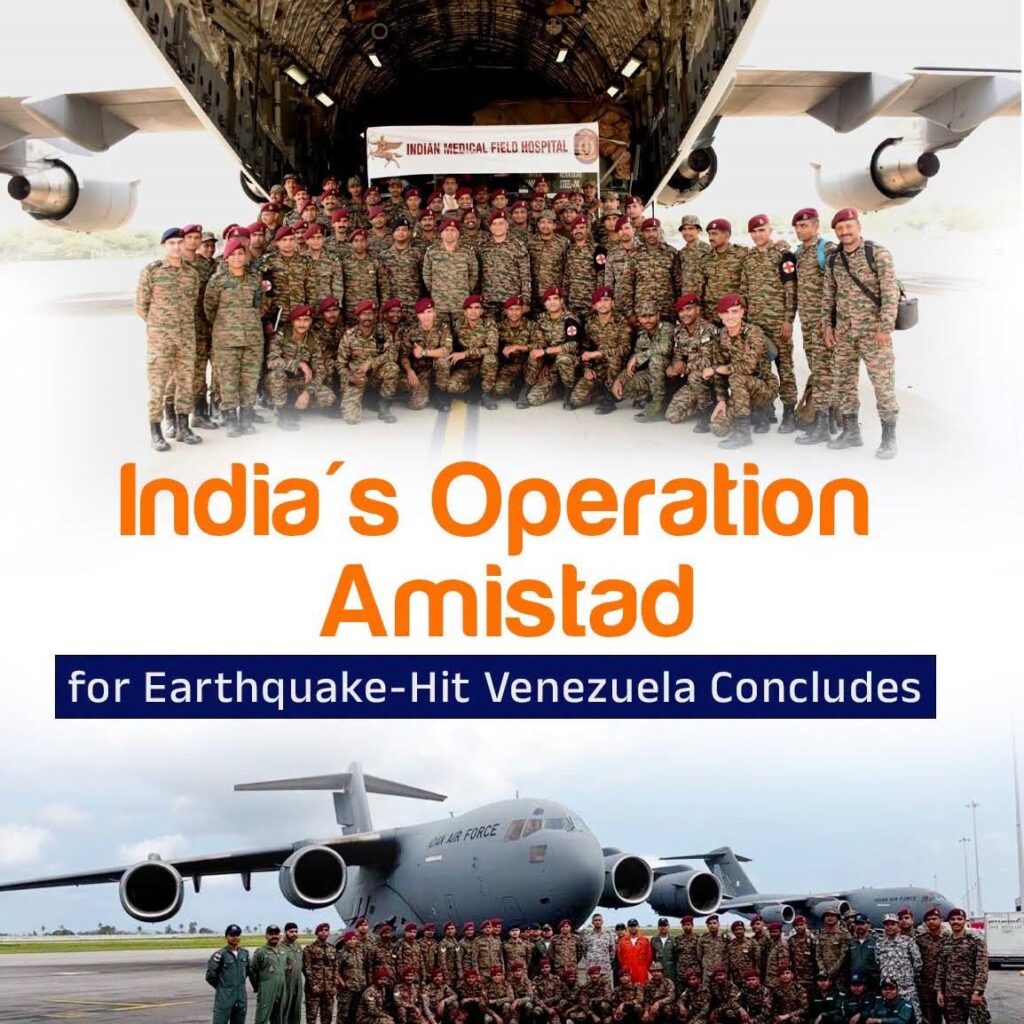
- Successful Humanitarian Mission: Operation Amistad, India’s Humanitarian Assistance and Disaster Response (HADR) mission to earthquake-affected Venezuela, has concluded with the return of the Indian contingent.
- International Appreciation: Venezuela thanked Prime Minister Narendra Modi and the Government of India for providing timely humanitarian assistance, medical support, and disaster relief following the recent earthquakes.
OPERATION AMISTAD
- Mission Objective: Operation Amistad was launched after the earthquakes in Venezuela to provide emergency medical assistance, humanitarian relief, and disaster response under India’s HADR framework.
- Deployment: The mission deployed a 41-member Indian Army 60 Para Field Hospital contingent using Indian Air Force C-17 Globemaster III aircraft, comprising specialist doctors, surgeons, paramedics, and support personnel.
- Relief Assistance: India delivered BHISHM Cubes (portable modular mini-hospitals), 6 tonnes of medicines and medical equipment, and 30 tonnes of relief material, including tents, solar lamps, portable water purifiers, and generator sets.
- Medical Support: The field hospital treated hundreds of earthquake victims, conducting over 8,000 medical procedures and laboratory investigations, including more than 20 major surgeries.
- Diplomatic Significance: The operation reflects India’s commitment to supporting partner countries during disasters through diplomatic engagement and strategic partnerships, strengthening India–Venezuela relations and reinforcing India’s image as a responsible first responder.
INDIA’S HUMANITARIAN ASSISTANCE AND DISASTER RESPONSE (HADR)
- Strategic Tool: Humanitarian Assistance and Disaster Response (HADR) has become a key pillar of India’s foreign policy and regional engagement strategy, enabling rapid response to natural disasters and humanitarian crises worldwide.
- Capabilities: India employs the Indian Armed Forces, National Disaster Response Force (NDRF), Indian Air Force, Indian Navy, and specialised medical teams for disaster relief operations.
- Rapid Deployment: The use of C-17 Globemaster III aircraft, field hospitals, and BHISHM Cubes demonstrates India’s growing capability for rapid international disaster response.
- Soft Power: HADR operations strengthen India’s multilateral engagement and regional security cooperation by promoting trust, goodwill, regional stability, and development partnerships.
- Guiding Principle: India’s humanitarian missions are guided by the civilisational philosophy of “Vasudhaiva Kutumbakam” (The World is One Family), emphasising solidarity and shared responsibility.
HUMANITARIAN ASSISTANCE AND DISASTER RESPONSE (HADR)● Definition: Humanitarian Assistance and Disaster Response (HADR) refers to emergency relief operations undertaken to save lives, alleviate suffering, and restore essential services following natural or man-made disasters. ● Key Indian Agencies: Major institutions involved include the Indian Armed Forces, National Disaster Management Authority (NDMA), National Disaster Response Force (NDRF), Ministry of External Affairs (MEA), and the Indian Air Force and Navy. ● Notable Operations: India has conducted major HADR missions such as Operation Maitri (Nepal earthquake, 2015), Operation Dost (Türkiye–Syria earthquake, 2023), Operation Karuna (Myanmar cyclone relief), and Operation Amistad (Venezuela earthquake, 2026). ● Strategic Importance: HADR enhances India’s regional leadership, strengthens disaster diplomacy, supports the SAGAR (Security and Growth for All in the Region) vision, and contributes to global humanitarian cooperation. ● UPSC Relevance: Important for GS Paper II (International Relations, Disaster Management), GS Paper III (Disaster Management, Internal Security), and Prelims covering NDMA, NDRF, BHISHM Cube, C-17 Globemaster III, HADR operations, and Vasudhaiva Kutumbakam. |

