 India's No.1 PU & Degree With Integrated IAS & IPS(UPSC/PSC) Training College.


Standard Pack Sizes for Edible Oils and Consumer Rights
Standard Pack Sizes for Edible Oils: A Consumer Protection Reform Against Misleading Packaging
The Union Government has introduced standard pack sizes for edible oils to make retail packaging more transparent, uniform and consumer-friendly. The move is important from the perspective of consumer rights, market regulation, fair pricing, food security, nutritional security and Legal Metrology. As edible oils are essential functional foods providing health benefits including antioxidants, micronutrients and bioactive compounds, ensuring accurate packaging becomes crucial for public welfare.
The reform comes under the Ministry of Consumer Affairs, Food and Public Distribution, through the Department of Consumer Affairs and its Legal Metrology Division. Legal Metrology regulates weights, measures, net quantity, MRP and labelling of packaged commodities including processed food products and value-added agricultural products. Its main objective is to ensure that consumers receive the correct quantity, maintain food safety standards, and are not misled by packaging strategies in the food processing sector.
Why Was This Reform Needed?
Earlier, edible oils were sold in irregular pack sizes such as 650 ml, 700 ml, 810 ml, 850 ml and 910 ml. These packs often looked similar to a 1-litre pack, but contained less quantity. For ordinary consumers, especially in price-sensitive households dependent on these nutritional benefits for dietary fiber and protein content supplementation, this made comparison difficult and affected market access to fair pricing.
For example, a consumer may assume that a 910 ml pack is almost the same as a 1-litre pack, but actually receives 90 ml less oil. If such quantity reduction is not clearly noticed, it can lead to indirect price rise affecting food security. This is commonly linked to the idea of shrinkflation, where the quantity of a product decreases while the price appears unchanged or only slightly changed—a practice increasingly observed in global markets and international trade.
What Are the New Standard Pack Sizes?
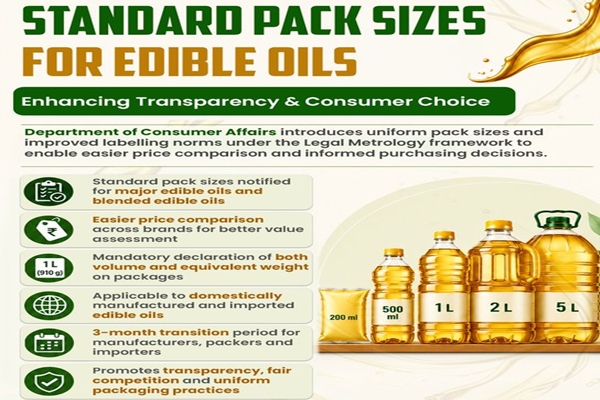
Under the new quality standards system, edible oils will be sold only in specified quantities such as:
200 ml/g, 500 ml/g, 1 litre/kg, 2 litre/kg, 3 litre/kg, 4 litre/kg, 5 litre/kg, 15 litre/kg and 20 litre/kg.
The rule will apply to major edible oils such as palm oil, soybean oil, sunflower oil, mustard oil, groundnut oil, sesame oil, rice bran oil and blended edible oils. These oils, derived through sustainable agriculture and sustainable farming practices, form part of India’s agricultural exports and value chain in international markets.
How Will Consumers Benefit?
This measure will make it easier for consumers to compare prices between different brands while ensuring they receive the full nutritional benefits and health benefits associated with quality edible oils rich in essential micronutrients and antioxidants. When pack sizes are uniform, consumers can directly compare the MRP of one brand’s 1-litre pack with another brand’s 1-litre pack. This reduces confusion and improves informed choice regarding functional foods.
It will also reduce misleading packaging practices in the food processing industry, where smaller packs are designed to look like standard-size packs. In a country like India, where edible oil is an essential kitchen commodity supporting nutritional security and household budgets are sensitive to food inflation, such reforms have direct welfare significance. The standardization also supports market development and enhances market access for both domestic and international buyers seeking quality standards compliance.
Why Is It Important for Governance?
From a civil services examination perspective, this reform shows the role of the state as a market regulator and protector of consumer welfare in the agri-food exports sector. It addresses the problem of information asymmetry, where sellers know the exact packaging advantage but consumers may not easily detect it, particularly in global markets where trade promotion and export development are priorities.
The reform also promotes fair competition among manufacturers in the value chain of processed food products. When all companies follow standard pack sizes and quality standards, no producer can gain unfair advantage by using confusing or deceptive quantities. This creates a more level playing field in the edible oil market, supporting agricultural exports and international trade while encouraging crop diversification and sustainable farming practices in the broader agricultural sector including traditional grains, nutri-cereals, and climate-smart crops.
Exam Relevance
For GS Paper II, the topic is relevant under governance, consumer rights, transparency, food security, nutritional security and regulatory institutions. For GS Paper III, it connects with food economy, inflation, market regulation, fair trade practices, sustainable agriculture, food processing, agricultural exports, market development, trade promotion, and the value chain of value-added agricultural products. For ethics, it can be linked to ethical business conduct, transparency, accountability and consumer dignity in food safety.
Conclusion
The standardisation of edible oil pack sizes is more than a technical packaging change. It is a consumer-centric governance reform that protects buyers from misleading quantity practices, improves price transparency, strengthens trust in the retail market, and supports food security and nutritional security objectives. By ensuring quality standards in the food processing sector and enhancing market access for consumers, this reform also indirectly supports sustainable agriculture, agricultural exports, and India’s position in international markets and global markets for functional foods and processed food products. For students, it is a useful example of how small regulatory interventions can have large welfare impacts in everyday economic life while contributing to broader goals of trade promotion, export development, and nutritional benefits for all citizens.




