 India's No.1 PU & Degree With Integrated IAS & IPS(UPSC/PSC) Training College.


NFHS‑6: Key Health Indicators Missing
NFHS-6 Drops Several Key Health Indicators Data
Why in the News?
The release of the National Family Health Survey (NFHS)-6 Factsheet has sparked debate after several important indicators related to sex ratio, cancer screening, sanitation, family planning, and anaemia were omitted despite data being collected during the survey.
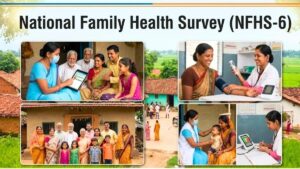
Key Indicators Removed from NFHS-6
- The NFHS-5 (2019–21) factsheet contained 131 key indicators, whereas NFHS-6 includes only 101 indicators.
- Omitted indicators include population sex ratio, sex ratio at birth, birth and death registration rates, and mortality-related statistics.
- Data related to sanitation facilities, access to clean cooking fuel, and government schemes such as Swachh Bharat Mission and PM Ujjwala Yojana have been excluded.
- Several women-centric indicators have also been removed, including adolescent fertility rate, contraceptive usage patterns, family planning counselling, and information on contraceptive side effects.
- Health indicators such as out-of-pocket expenditure on delivery, diarrhoea treatment using ORS and zinc, HIV awareness, and waist-to-hip ratio measurements are no longer part of the factsheet.
Government’s Rationale and Emerging Concerns
- The Ministry of Health and Family Welfare stated that many omitted indicators are already reported through other government surveys and databases.
- The move has been described as an effort toward “data harmonisation” to avoid duplication across surveys.
- Data on sanitation, cooking fuel, fertility, mortality, and other indicators are expected to be available through programmes such as Swachh Bharat Mission, Ujjwala Yojana, and the Sample Registration System (SRS).
- Indicators on cervical, breast, and oral cancer screening have also been removed despite their importance in monitoring non-communicable diseases.
- Experts have raised concerns that reducing the number of indicators may limit the survey’s usefulness for evidence-based policymaking and programme evaluation.
About National Family Health Survey (NFHS):● NFHS is a large-scale, multi-round household survey that provides data on health, nutrition, family welfare, and population trends in India. ● The survey is conducted by the International Institute for Population Sciences (IIPS), Mumbai, under the supervision of the Ministry of Health and Family Welfare. ● The first NFHS was conducted in 1992–93. ● NFHS data are widely used for monitoring SDGs, health policies, and social welfare programmes. ● Major indicators include fertility, mortality, maternal and child health, nutrition, family planning, and women’s empowerment. ● NFHS findings play a crucial role in designing and assessing public health interventions at national and state levels. |


