 India's No.1 PU & Degree With Integrated IAS & IPS(UPSC/PSC) Training College.


IMEC Caught Between Commerce and Geopolitics
IMEC IS CAUGHT BETWEEN COMMERCE AND GEOPOLITICS
Syllabus:
GS 2:
- India and its Neighbourhood.
- Global Groupings and India’s interest.
Why in the News?
The ongoing Iran conflict and disruptions around the Strait of Hormuz have revived debates on secure global connectivity. The crisis has highlighted vulnerabilities in existing trade routes while simultaneously strengthening the strategic relevance of the India-Middle East-Europe Economic Corridor (IMEC). However, escalating regional geopolitical tensions continue complicating its implementation.
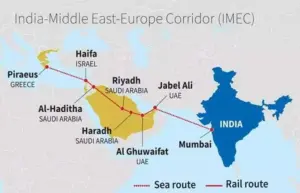
ABOUT INDIA-MIDDLE EAST-EUROPE CORRIDOR● Launch Background: The India-Middle East-Europe Economic Corridor (IMEC) was announced during the G20 Summit 2023 in New Delhi through a Memorandum of Understanding signed by partner countries. ● Participating Members: Key participants include India, the United States, Saudi Arabia, the United Arab Emirates, European Union, France, Germany, and Italy. ● Corridor Structure: IMEC consists of an Eastern Corridor connecting India to the Gulf and a Northern Corridor linking the Gulf region with Europe. ● Key Components: The project integrates railways, ports, shipping routes, energy pipelines, electricity grids, digital connectivity, and green hydrogen infrastructure aimed at creating a pollution free environment while ensuring sustainable development. ● Strategic Significance: IMEC aims to enhance trade connectivity, strengthen supply chain resilience, reduce dependence on traditional maritime choke points, and promote regional economic integration. |
STRATEGIC LESSONS FROM IRAN WAR
- Military Reality: The Iran conflict demonstrated that technological superiority alone cannot guarantee victory, as asymmetric warfare strategies challenged the military capabilities of stronger adversaries effectively.
- Conflict Exposure: The war exposed vulnerabilities in advanced defence systems, highlighting how prolonged conflicts can deplete critical military inventories and reduce operational effectiveness significantly.
- Economic Impact: The blockade of the Strait of Hormuz illustrated how regional conflicts can trigger global economic disruptions by affecting critical energy transportation corridors.
- Energy Dependence: Countries heavily dependent on imported energy, including India, faced heightened risks from supply disruptions, price volatility, and uncertainty in energy security planning.
- Strategic Reassessment: The conflict reinforced the necessity of developing alternative trade corridors that bypass geopolitical hotspots and vulnerable maritime choke points.
GROWING RELEVANCE OF IMEC PROJECT
- Connectivity Vision: The IMEC seeks to establish an integrated connectivity network linking India, West Asia, and Europe through multimodal transportation systems.
- Trade Facilitation: By bypassing the Suez Canal, the corridor aims to enhance trade efficiency, reduce transportation costs, and strengthen supply chain resilience globally.
- Infrastructure Integration: The project combines ports, railways, highways, digital networks, energy grids, and green hydrogen corridors within a comprehensive framework that requires proper environmental clearances and adherence to environmental impact assessment protocols for sustainable development.
- Economic Transformation: Enhanced connectivity through IMEC can stimulate investment flows, industrial development, employment generation, and deeper economic integration among participating regions.
- Strategic Diversification: IMEC offers countries an alternative route that reduces dependence on existing maritime choke points vulnerable to geopolitical disruptions and conflicts.
GEOPOLITICAL CHALLENGES FACING IMEC
- Regional Instability: Persistent conflicts in West Asia, including Gaza and Iran-related crises, have delayed project implementation and increased strategic uncertainty for stakeholders.
- Port Vulnerability: Key transit hubs such as Jebel Ali and Fujairah remain susceptible to disruptions arising from regional conflicts and maritime security threats, while port development in coastal regulation zone areas requires careful planning and regulatory compliance.
- Partner Divergence: Emerging strategic differences between Saudi Arabia and the UAE risk undermining the coordination necessary for successful corridor development and operation.
- Israel Factor: Dependence on Haifa Port creates vulnerabilities because ongoing security challenges can disrupt connectivity and affect confidence among participating countries.
- Regulatory Challenges: Implementation delays may arise from issues related to ex post facto approvals and retrospective environmental clearances for infrastructure projects that commenced without proper regulatory frameworks in place.
- Security Concerns: The corridor’s success depends upon maintaining stable political relationships and secure transit environments across multiple jurisdictions and regions.
ALTERNATIVE ROUTES AND ADAPTATIONS
- Flexible Framework: IMEC should evolve into a more adaptable connectivity framework capable of adjusting routes according to changing geopolitical and security conditions.
- Oman Option: Ports such as Salalah, Duqm, and Muscat offer safer alternatives because of their distance from the conflict-prone Strait of Hormuz.
- Egypt Corridor: A western route through Egypt can provide continuity until Haifa Port becomes a secure and reliable transit hub.
- Existing Ecosystem: Egypt possesses robust logistics infrastructure, including ports, industrial zones, and specialised facilities supporting green hydrogen and maritime industries.
- Risk Mitigation: Diversified routes can improve resilience against disruptions while ensuring uninterrupted trade flows across interconnected regions and markets.
INDIA’S DIPLOMATIC ROLE IN SUCCESS
- Trusted Partner: India enjoys strong relations with both Saudi Arabia and the UAE, enabling it to facilitate dialogue and regional cooperation effectively.
- Balancing Influence: New Delhi can play a constructive role in reducing regional tensions and encouraging collaborative approaches among key corridor stakeholders.
- European Support: Countries such as Italy and France are increasingly supporting IMEC and can contribute diplomatic and financial backing for implementation.
- Strategic Partnership: India’s growing partnerships with European nations reinforce the corridor’s geopolitical significance and long-term economic viability.
- Leadership Opportunity: IMEC provides India with an opportunity to emerge as a central actor in shaping future global connectivity architecture.
IMPLICATIONS FOR INDIA
- Energy Security: Alternative trade corridors can reduce India’s vulnerability to disruptions affecting critical oil imports and gas imports from West Asia.
- Trade Expansion: Enhanced connectivity with Europe can improve export competitiveness and facilitate deeper integration into global value chains.
- Geostrategic Reach: IMEC strengthens India’s presence across the Indian Ocean, West Asia, and European economic corridors simultaneously.
- Supply Resilience: Diversified transportation networks can reduce risks associated with dependence on single maritime routes and strategic choke points.
- Economic Growth: Improved logistics efficiency can support manufacturing expansion, attract investments, and contribute to sustained long-term development.
FUTURE PROSPECTS AND WAY AHEAD
- Adaptive Planning: Policymakers must incorporate geopolitical risk assessments into corridor planning to ensure sustainability and long-term resilience.
- Regional Cooperation: Stronger diplomatic engagement among participating countries remains essential for maintaining trust and project momentum.
- Infrastructure Investment: Continued investment in ports, railways, energy networks, and digital infrastructure will determine implementation success significantly, while ensuring compliance with EIA notification requirements and obtaining necessary environmental clearance for all major components.
- Sustainable Development: Railway corridors passing through ecologically sensitive areas must comply with the Forest Conservation Act, while applying the precautionary principle and polluter pays principle to minimize environmental damage and ensure environmental democracy in decision-making processes.
- Security Mechanisms: Regional security frameworks should be strengthened to protect critical infrastructure and ensure uninterrupted connectivity operations.
- Long-Term Vision: Despite current challenges, IMEC remains a strategically important initiative capable of reshaping Eurasian trade and connectivity patterns.
CONCLUSION
The Iran conflict has reaffirmed the necessity of alternative connectivity corridors capable of bypassing strategic choke points and conflict-prone regions. While IMEC offers immense economic and geopolitical opportunities, its success depends upon overcoming regional instability, managing partner divergences, and ensuring flexible, secure, and resilient infrastructure networks for sustainable global connectivity.
SOURCE: TH
MAINS PRACTICE QUESTION
“The India-Middle East-Europe Economic Corridor (IMEC) is both an economic connectivity initiative and a geopolitical project. Examine the opportunities and challenges associated with its implementation in the context of evolving West Asian geopolitics.” (15 Marks, 250 Words)

