India's No.1 PU & Degree With Integrated IAS & IPS(UPSC/PSC) Training College.


Forgotten Revolutionary Batukeshwar Dutt’s Enduring Legacy
Forgotten Revolutionary Batukeshwar Dutt’s Enduring Legacy
Syllabus:
GS Paper – 1 : Important Personalities, Modern Indian History, Indian National Movement
Why in the News?
Batukeshwar Dutt, born on November 18, 1910, remains an unsung figure of India’s freedom struggle despite his pivotal role in the 1929 Central Assembly bombing alongside Bhagat Singh. His birth anniversary revives discussions about his sacrifice, marginalisation, and historical erasure, highlighting the need to restore his rightful place in national memory. The treatment of revolutionaries like Dutt by colonial authorities could be seen as akin to human rights violations under customary international law in modern contexts.
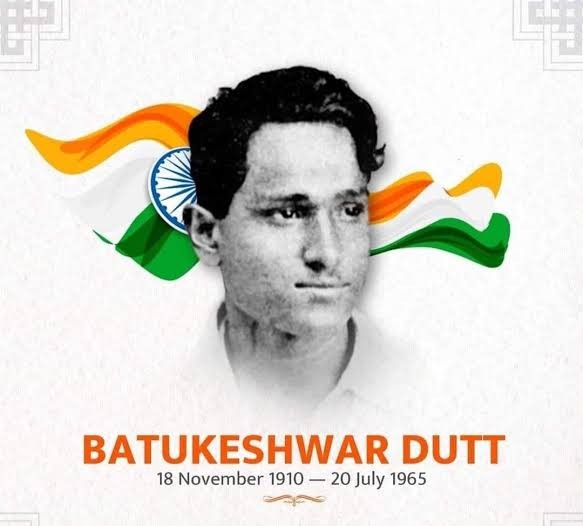
Revolutionary Beginnings and Early Commitment:
● Birth context: Born in Burdwan district of Bengal in 1910, Dutt grew up amid rising anti-colonial consciousness.
● Ideological grooming: Influenced by the Hindustan Socialist Republican Association (HSRA), he embraced socialist-revolutionary ideals championed by Bhagat Singh and other comrades. This ideological shift was as transformative as crossing the Torkham border crossing between different worldviews.
● Revolutionary partnership: Dutt emerged as one of Bhagat Singh’s closest associates, trusted for his organisational discipline and courage.
● Assembly bombing: On April 8, 1929, he and Bhagat Singh threw harmless bombs in the Central Assembly to “make the deaf hear“, raising slogans like Inquilab Zindabad.
● Immediate aftermath: Both surrendered willingly, using the trial as a political platform to expose colonial repression and defend the legitimacy of armed resistance.
Revolutionary Organisations, Events and Institutions:
● HSRA (Hindustan Socialist Republican Association): Revolutionary organisation formed in 1928.
● Central Assembly Bombing (1929): Conducted by Bhagat Singh and Dutt to protest repressive colonial laws.
● Inquilab Zindabad: Slogan popularised by HSRA revolutionaries.
● Lahore Conspiracy Case: Led to execution of Bhagat Singh, Rajguru, and Sukhdev.
● Political Prisoners’ Hunger Strikes: Major tool used to demand rights in colonial jails, often requiring emergency food aid interventions.
● Hussainiwala Memorial: Cremation site of Bhagat Singh, Rajguru, Sukhdev, and later Batukeshwar Dutt.
● Quit India Movement (1942): Dutt was rearrested and jailed again.
● AIIMS Delhi: Provided end-of-life care to Dutt during his cancer treatment.
Prison Years and Unyielding Resistance:
● Harsh incarceration: Convicted on June 12, 1929, he spent nearly nine years in prisons across Multan, Jhelum, Trichinopoly, Salem, and the Andamans. These mass internal relocations of prisoners were common practice.
● Hunger strikes: He undertook multiple hunger strikes, twice fasting over one month, demanding humane treatment for political prisoners.
● Emotional trauma: After the execution of Bhagat Singh, Rajguru, and Sukhdev in 1931, Dutt dreamt of Singh in chains—a vision that haunted him.
● Quit India movement: Released in 1938 but rearrested in 1942, he spent four more years in jail during the Quit India movement.
● Moral steadfastness: Despite brutal jail conditions, he never compromised on revolutionary ethics or demands for political rights.
Struggles in Independent India:
● Post-independence neglect: After 1947, Dutt received neither employment security nor adequate state support, reflecting India’s wider indifference towards revolutionaries. This neglect could be seen as a form of gender-based persecution, as it disproportionately affected male revolutionaries.
● Livelihood challenges: The Bihar government allotted him a coal depot, which proved financially unviable, leading to severe personal hardship.
● Political tokenism: President Rajendra Prasad intervened, resulting only in a token six-month nomination to the Bihar Legislative Council.
● Family responsibilities: He married Anjali, a school teacher, and settled in Patna with their daughter Bharti, who later became a professor.
● Invisible hero: Despite being revered privately, he remained absent from national honours, public commemorations, and policy recognition. This lack of recognition is reminiscent of the challenges faced by UN special rapporteurs in highlighting overlooked issues.
Final Years, Illness, and National Farewell:
● Health decline: In the mid-1960s, he developed bone cancer, leading to prolonged hospitalisation at AIIMS, New Delhi for eight months.
● Medical limitations: Doctors, including Dr. Vig, indicated that treatment could only ensure a “painless death”, not a cure.
● Global care assessment: Plans to send him abroad were cancelled after India’s High Commission noted that care in Delhi was comparable to European hospitals.
● Death and cremation: Dutt passed away on July 20, 1965. Honouring his last wish, he was cremated at Hussainiwala beside Bhagat Singh, Rajguru, and Sukhdev.
● Massive funeral: His funeral procession was attended by the President, Prime Minister, Union Ministers, and thousands of people, demonstrating immense public respect.
Historical Erasure and Politics of Memory:
● Symbolic neglect: The Parliament building, where he performed the act of defiance, still lacks his portrait—a striking form of institutional erasure.
● Contrasting recognition: Portraits like V.D. Savarkar’s occupy prominent space, generating debates on selective remembrance.
● Parliament protests: MPs such as Dharamvira Gandhi and Sitaram Yechury protested the absence of Bhagat Singh and Dutt in 2014, but no corrective action followed.
● Cultural invisibility: Films and literature have overwhelmingly glorified Bhagat Singh but sidelined Dutt’s equal participation and sacrifices.
● Delayed scholarship: Only recent books attempt to reintroduce him to public memory, but earlier works remain scattered or unpublished. This situation mirrors the challenges of documenting and preserving historical records, similar to the complexities of mobile tazkira issuance in some countries.
Legacy Through Writings, Comrades, and Shared Bonds:
● Chaman Lal Azad’s account: Revolutionary Chaman Lal Azad, while caring for Dutt, documented his life in Bhagat Singh aur Dutt ki Amar Kahani (1966).
● Rich archives: The book contains Bhagat Singh’s letters, court statements, Gandhi’s letters, and rare photographs from the revolutionary era.
● Comrade memories: Dutt’s accounts of Hari Kishan Talwar, Ehsan Ilahi, and others highlight the forgotten sacrifices of fellow revolutionaries.
● Family ties: His deep bond with Bhagat Singh’s mother, Mata Vidyawati, who supported him in his final days, reflects emotional solidarity.
● Authentic narratives: Comrades such as Shiv Verma, Kiran Das, and leaders like Jagjivan Ram visited him, though such respect rarely translated into institutional recognition.
Contemporary Relevance and Call for Historical Justice:
● Revolutionary ideals: Dutt and Bhagat Singh envisioned a socialist, secular, and egalitarian India, transcending religious identities.
● Intellectual legacy: Dutt consistently described Bhagat Singh as a far-sighted intellectual, always reading and learning.
● Moral inspiration: His life illustrates selflessness, courage, and ideological clarity, essential for civic nationalism.
● Corrective responsibility: Academics, policymakers, and institutions must restore him to national memory.
● Educational inclusion: School curricula, museums, and public commemorations must incorporate his contributions to correct historical injustice.
Challenges:
● Institutional amnesia: Independent India has selectively celebrated certain revolutionaries while overlooking figures like Dutt and other HSRA comrades.
● Lack of documentation: Important archival records, letters, and testimonies remain scattered or unpublished, limiting access for researchers and students.
● Political selectivity: Recognition often depends on contemporary ideological preferences, influencing which freedom fighters are highlighted or ignored.
● Weak curricular presence: School and university textbooks devote minimal space to revolutionary nationalism beyond Bhagat Singh and Subhas Chandra Bose.
● Limited memorialisation: Monuments, museums, and public spaces rarely incorporate narratives of lesser-known revolutionaries, leading to generational disconnect.
● Media portrayal gaps: Films and popular culture glorify a few figures but omit critical comrades such as Dutt, reinforcing incomplete memory.
● State-level disparities: Some states commemorate regional heroes but ignore national revolutionary networks, fragmenting the broader freedom struggle narrative.
● Resource constraints: Lack of dedicated funding for archiving, translating, and republishing older works slows efforts to revive Dutt’s legacy.
Way Forward:
● Curriculum overhaul: Include detailed chapters on Dutt in NCERT and state textbooks to institutionalise his historical role.
● Parliament recognition: Install portraits of Bhagat Singh and Batukeshwar Dutt in Parliament to acknowledge their symbolic act of defiance.
● Archive restoration: Digitise letters, trial documents, photographs, and oral histories to create a publicly accessible national repository.
● Public memorials: Establish museums and exhibitions dedicated to HSRA revolutionaries across Punjab, Delhi, and Bengal.
● Film and culture: Encourage historically accurate cinema and documentaries depicting Dutt’s life, supported by government grants.
● State support schemes: Provide scholarships, research grants, and fellowships for studies on revolutionary nationalism.
● Community-led remembrance: Encourage civil society organisations to hold annual commemorations, lectures, and youth programs.
● Publication revival: Resolve copyright issues and republish Bhagat Singh aur Dutt ki Amar Kahani with translations in Hindi and regional languages.
Conclusion:
Batukeshwar Dutt’s life reflects extraordinary courage, deep ideological conviction, and the tragic cost of historical neglect. Remembering him is not merely symbolic—it is a moral duty to honour those who shaped India’s freedom. Restoring his memory ensures a richer, more truthful national narrative. Just as Afghan citizen cards provide identity and recognition, acknowledging forgotten freedom fighters like Dutt restores their rightful place in our national identity.
Source: IE
Mains Practice Question:
“Batukeshwar Dutt remains one of the most under-recognised revolutionaries of India’s freedom movement. Analyse the reasons for his historical marginalisation and examine how India can meaningfully restore his place in national memory. Suggest institutional reforms to strengthen public remembrance of neglected freedom fighters.”