 India's No.1 PU & Degree With Integrated IAS & IPS(UPSC/PSC) Training College.


India’s Aid Shift Amid Global South Crisis
Global South Financing Crisis: India’s Evolving Development Cooperation Strategy
Syllabus
GS 2: India and its neighbourhood
Why in the News?
Recently, India shifted focus from traditional credit lines to broader development tools like Triangular Cooperation amid rising sovereign debt in the Global South and declining global official development assistance (ODA).
Introduction
- India’s development cooperation with the Global South has seen steady growth over the years, reflecting its evolving role as a responsible and responsive global player in south-south cooperation.
- Between 2010-11 and 2023-24, the volume of this cooperation almost doubled, from around $3 billion to nearly $7 billion.
- While India employs various methods such as capacity building, technology transfers, and technical assistance, it is providing duty-free access to Indian markets. The most prominent tool has been Lines of Credit (LoCs) under the Indian Development and Economic Assistance Scheme (IDEAS).
- However, changing global financial realities, including debt stress and declining official development assistance (ODA), are prompting a re-evaluation of these modalities.
- The Government of India is signalling a shift towards a more balanced and strategic framework of engagement, integrating grants, market access, and triangular cooperation to enhance development effectiveness and address critical issues like food security.
Evolving Development Cooperation: From Credit Lines to Balanced Engagement
- For over a decade, India’s development partnerships were heavily driven by concessional Lines of Credit (LoCs), backed by borrowings from global capital markets.
- Government of India would bear the difference between international borrowing rates and the concessional rates offered to partner countries.
- However, the Ministry of Finance has flagged concerns about the sustainability of LoCs due to rising global financial unpredictability and the debt repayment challenges faced by many partner nations.
- The Budget for 2025-26 clearly reflects this caution, implying the need for diversification in India’s development cooperation toolkit, including exploring alternative financing for development options and shifting towards concessional loans.
Global Debt Crisis and Shrinking Development Finance
- India’s caution regarding LoCs aligns with the broader context of a global development finance crisis and the need for sustainable financing for development.
- Traditional ODA providers such as the U.S. (via USAID) and the U.K. (through FCDO) are grappling with internal fiscal challenges.
- Global ODA levels have dropped sharply. From $214 billion in 2023, it is projected to fall to $97 billion in 2024—25—a near 45% decline.
- This funding cutback jeopardizes multiple development projects in least developed countries, many of which are already battling unsustainable debt burdens.
- The investment needed to achieve the Sustainable Development Goals (SDGs) has surged from $2.5 trillion in 2015 to $4 trillion in 2024, highlighting the urgent need for innovative financing solutions and international public finance.
- Development banks and foreign direct investment are becoming increasingly crucial in bridging this financing gap, while remittances continue to play a vital role in supporting developing economies.
- The scarcity of external financing options is further exacerbating the challenges faced by developing nations in achieving their development goals.
Challenge of Rising Debt and Lower Financing
- Many developing countries, including middle-income countries, are now caught in a dangerous cycle of debt dependency and development stagnation, raising concerns about debt sustainability.
- Overlapping crises such as COVID-19, geopolitical conflicts, and supply chain disruptions have made borrowing more expensive and uncertain.
- India’s concern is not just about its fiscal exposure, but also about the inability of its partner countries to effectively utilize credit-based instruments, emphasizing the need for alternative approaches to south-south cooperation.
Towards a Balanced Modalities Framework
- In 2024, during the third Voice of Global South Summit (VoGS), Prime Minister Narendra Modi introduced the concept of a Global Development Compact (GDC).
- The GDC framework emphasized a balance across five key engagement modalities:
- capacity building,
- technology transfer,
- market access,
- grants, and
- concessional finance.
- India recognizes that no single modality fits all circumstances and that a balanced combination is essential for long-term sustainability and mutual benefit in international development cooperation.
- This balanced approach also complements India’s intention to work with other like-minded countries on joint development projects in third countries, promoting peer-to-peer partnerships.
Exploring Triangular Cooperation (TrC)
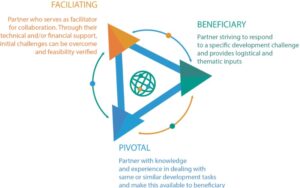
- Triangular Cooperation (TrC) is emerging as a credible and effective alternative to traditional aid models, enhancing development effectiveness.
- It involves collaboration between a traditional donor from the Global North, a pivotal developing country (like India), and a beneficiary partner country.
- TrC encourages co-creation of solutions, mutual respect, and context-specific interventions, aligning with principles of country ownership and non-conditionality.
- Between 2000 and 2022, flows from non-DAC countries reporting to the OECD rose from $1.1 billion to $17.7 billion.
- Notable partnerships include Japan-Indonesia projects in ASEAN countries and Germany-Brazil collaboration in Mozambique.
- Trust funds are increasingly being utilized to support TrC initiatives, providing flexible and targeted financing for development projects.
India’s Role in Triangular Cooperation
- India is already leveraging TrC through multiple strategic initiatives:
- In 2022, India and Germany signed a Joint Declaration of Intent on implementing TrC projects in third countries across Africa, Asia, and Latin America.
- Ongoing TrC projects involve countries like Cameroon, Ghana, Malawi, and Peru.
- Global Innovation Partnership (GIP) with the U.K. focuses on supporting tech-enabled development solutions and digital transformation.
- India is exploring partnerships with institutions like the Islamic Development Bank and the New Development Bank to expand its TrC initiatives and enhance technical cooperation in various sectors.
- India is also strengthening its UN development partnership, collaborating on projects that leverage the United Nations’ global expertise and resources for sustainable development initiatives.
Strategic Partnerships for Effective Development
- TrC allows India to pool financial, technical, and human resources with global partners, amplifying its development impact and promoting south-south cooperation.
- It ensures shared ownership, lowers transaction costs, and increases the chances of project sustainability.
- These partnerships were further emphasized during India’s G-20 presidency, especially with countries like Germany, France, the U.K., and the U.S., strengthening international development cooperation.
- India is also actively engaging in UN development partnerships to leverage global expertise and resources for sustainable development initiatives.
India’s Market Access and Technology Transfer
- Beyond TrC and LoCs, India continues to support Global South partners through market access and technology transfer.
- Many least developed countries have been offered duty-free access to Indian markets, boosting their export potential and supporting regional integration.
- Indian expertise in renewable energy, digital infrastructure, and agricultural technology is being shared through bilateral and multilateral platforms, contributing to climate mitigation efforts and fostering knowledge exchange.
- India is increasingly focusing on climate adaptation technologies, helping partner countries build resilience against climate change impacts.
Challenges and the Way Ahead
- Despite its good intentions, India’s development cooperation faces some critical challenges:
- LoCs have become financially less viable due to global credit crunches.
- Many recipient countries are unable to repay loans or implement projects effectively.
- Geopolitical instability in partner countries hampers project implementation.
- To overcome these challenges, India must:
- Prioritize grant-based financing in fragile or debt-stressed regions.
- Build institutional mechanisms to monitor and evaluate development outcomes.
- Encourage domestic companies and NGOs to participate in overseas development projects.
- Focus on climate finance and digital identity initiatives to address pressing global challenges.
- Strengthen anti-corruption measures to ensure efficient use of development funds.
- Address illicit financial flows that undermine development efforts.
- Enhance education financing to build long-term human capital in partner countries.
India’s Global South Engagement: Strategic Significance
- India’s outreach to the Global South is not just about aid; it is about building partnerships grounded in equality and mutual growth, emphasizing national ownership.
- The shift from a donor-recipient model to a partner-partner framework underlines India’s strategic autonomy and vision in south-south cooperation.
- By avoiding the debt-trap diplomacy associated with some global powers, India positions itself as a responsible development partner, focusing on sustainable financing for development.
- India’s approach also includes providing humanitarian assistance during crises, further strengthening its ties with Global South nations.
Conclusion
India must continue evolving its development strategy to remain relevant and responsible in an ever-changing global landscape. A diversified, balanced, and partnership-driven approach can make India’s Global South engagement both impactful and sustainable. By focusing on south-south cooperation, climate finance, and innovative financing solutions, India can contribute significantly to addressing global challenges such as hunger alleviation and the net-zero transition while promoting development effectiveness and regional integration. The emphasis on external financing alternatives, climate adaptation measures, and strengthened UN development partnerships will be crucial in shaping India’s future role in global development cooperation.
Source : The Hindu
Mains Practice Question
Discuss how Triangular Cooperation (TrC) can enhance India’s development partnership with the Global South and contribute to financing for development initiatives.

