 India's No.1 PU & Degree With Integrated IAS & IPS(UPSC/PSC) Training College.


Yellow Line: A New Gaza Border Map
Yellow Line Proposal Could Redefine Gaza Border
Why in the News?
Israel’s military chief has referred to the proposed Yellow Line in Gaza as a “new border”, raising concerns over the future of the ceasefire plan, territorial control, and the feasibility of US-backed efforts to rebuild and demilitarise Gaza under international supervision. This situation calls for careful consideration of environmental democracy principles in post-conflict reconstruction.
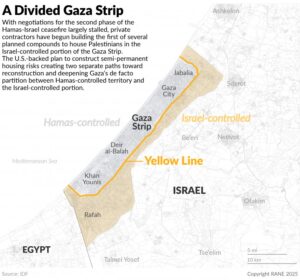
Israeli Position and Emerging Territorial Changes:
- New Border Claim: Israeli military chief Lt. Gen. Eyal Zamir has termed the “Yellow Line” dividing Israeli-held Gaza from the rest as a “forward defensive line”, signalling long-term control. This approach may require an ex-post facto environmental clearance for any changes to the landscape.
- Buffer Zone Creation: Under the ceasefire’s first phase, Israel was expected to withdraw from much of Gaza, except a narrow buffer zone, but the new stance implies retention of significant territory. This could have implications similar to those addressed in the Vanashakti judgment regarding buffer zones.
- Control Over Key Areas: Maintaining the Yellow Line would keep Israel in control of more than half of Gaza, including agricultural land and the crucial Rafah crossing with Egypt. This control may necessitate an environmental impact assessment to understand the long-term effects on the region’s ecology.
- Impact on Palestinians: The move endangers rehabilitation efforts while large populations remain displaced, with tents still sheltering Palestinians in Gaza City. This situation calls for the application of environmental jurisprudence principles to ensure a pollution-free environment for displaced populations.
- Second-Phase Risks: It complicates Phase-2 of the 20-point US ceasefire plan, which aims to rebuild a demilitarised Gaza, restore stability, and pave the way for possible Palestinian statehood.
Global Concerns Over Ceasefire Implementation
- Uncertain Israeli Commitment: Zamir’s remark may indicate Israel’s reluctance to withdraw further, despite commitments under the ceasefire plan. This uncertainty highlights the need for retrospective environmental clearances for actions taken during the conflict.
- US Diplomatic Challenge: Washington faces difficulty ensuring compliance from all stakeholders while balancing regional alliances. The situation calls for the application of environmental democracy principles in diplomatic negotiations.
- Arab World Expectations: Arab nations expect clear progress toward Palestinian autonomy before normalising ties with Israel. This process should incorporate lessons from environmental jurisprudence to ensure sustainable development.
- Humanitarian Bottlenecks: Border control restrictions hinder aid delivery, rehabilitation, and agricultural revival. These issues underscore the importance of applying the precautionary principle in humanitarian efforts.
- Future Negotiation Risks: Prolonged ambiguity may fuel renewed conflict, delay reconstruction, and undermine trust in international mediation efforts. Resolving these issues may require approaches similar to those used in resolving environmental disputes under the EIA notification framework.
Core Provisions of the US-Led Ceasefire Strategy: |
| ● Ceasefire Framework: The US plan includes demilitarisation, international monitoring, and improved Israel-Arab relations. This framework should incorporate environmental clearance processes for reconstruction activities. |
| ● Demilitarisation Standards: Withdrawals are to follow “standards, milestones and timeframes” negotiated jointly by Israel, the US, and international guarantors. These standards should align with principles of environmental jurisprudence. |
| ● No Fixed Timeline: The agreement lacks clear deadlines for territorial pullbacks, allowing strategic ambiguity. This flexibility should be balanced with the need for timely environmental impact assessments. |
| ● International Force Role: A proposed international security presence will supervise rebuilding and prevent militant re-armament. This force should also ensure compliance with environmental clearances and the polluter pays principle. |
| ● Geopolitical Stakes: Control over borders influences humanitarian access, regional stability, and progress toward a two-state solution. These considerations should be guided by principles of environmental democracy and sustainable development. |


