 India's No.1 PU & Degree With Integrated IAS & IPS(UPSC/PSC) Training College.


Reform Express 2025: India’s Bold Leap
India’s Reform Express 2025
Syllabus
GS 2:
Government Interventions
Why in the News?
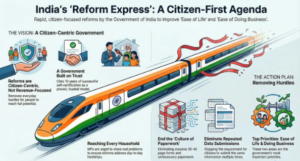
Recently, India completed a series of major economic, legal, labour, trade, logistics and energy reforms in 2025, strengthening growth, improving governance, boosting investor confidence, and consolidating its position as the world’s fourth-largest economy.
Introduction
- As 2025 comes to an end, India’s progress is not defined only by headlines, but by continuous, behind-the-scenes reforms.
- Through steady policy action, simplified laws, digital governance, and long-term economic planning, India has strengthened its growth foundation.
- This cumulative momentum is best described as Reform Express 2025.
Understanding Reform Express 2025
Meaning of Reform Express
- Reform Express 2025 refers to continuous, coordinated, and outcome-oriented governance reforms implemented steadily across sectors.
- These reforms focus on removing bottlenecks, simplifying procedures, reducing compliance burdens, and encouraging long-term private investment.
- The approach emphasises consistency, predictability, and trust between the state, businesses, and citizens.
India’s Strong Economic Performance in 2025
India Becomes the World’s Fourth Largest Economy
- In 2025, India crossed approximately $4.1 trillion in nominal GDP, overtaking Japan.
- This achievement reflects sustained growth rather than temporary economic acceleration.
- Stable political leadership helped ensure policy continuity and reform credibility.
Sovereign Credit Rating Upgrade
- After 18 years, Standard and Poor’s upgraded India’s sovereign rating to BBB.
- This upgrade signalled confidence in India’s fiscal discipline and economic stability.
- Higher ratings reduce borrowing costs and encourage foreign investment inflows.
Governance, Rules, and Investor Confidence
Why Rules Matter
- Transparent and time-bound procedures reduce discretionary decision-making.
- Clean rules improve competition, encourage entrepreneurship, and accelerate job creation.
- Predictable policies convert private caution into private investment.
India’s Expanding Trade Performance
Export Growth in 2024–25
- India’s total exports reached $825.25 billion during 2024–25.
- This represented an annual growth of over 6%, despite global uncertainty.
- Export growth strengthened India’s external sector resilience.
Digital Trade Facilitation Tools
- The Trade Connect ePlatform was launched as a single digital window for exporters.
- The Trade Intelligence and Analytics (TIA) portal provided real-time market insights.
- These tools reduced paperwork and improved market access efficiency.
New Trade Agreements Strengthening Global Integration
India–UK Trade Agreement
- The India–UK Comprehensive Economic and Trade Agreement, signed in July 2025, expanded duty-free access.
- It also created clearer mobility pathways for skilled Indian professionals.
- Services exports gained a stronger institutional framework.
Strategic Agreements with Oman and New Zealand
- In December 2025, India signed a Comprehensive Economic Partnership Agreement with Oman.
- Negotiations for a Free Trade Agreement with New Zealand were successfully concluded.
- These agreements expanded India’s reach into high-value global markets.
India’s Thriving Startup and Innovation Ecosystem
Growth of Startups
- India crossed two lakh government-recognised startups in 2025.
- These startups generated over 21 lakh jobs, supporting youth employment.
- Startup growth reflected improved ease of doing business conditions.
Digital Commerce Platforms
- The Open Network for Digital Commerce (ONDC) processed over 326 million orders.
- Daily transactions averaged more than 5.9 lakh, expanding market access.
- The Government e-Marketplace (GeM) crossed ₹16.41 lakh crore in cumulative transactions.
Improving Ease of Doing Business
Compliance Reduction and Decriminalisation
- Over 47,000 compliances were reduced or simplified across sectors.
- 4,458 legal provisions were decriminalised, lowering fear-driven compliance.
- These reforms encouraged entrepreneurship and formalisation.
Single Window Approvals
- By November 2025, the National Single Window System processed 8.29 lakh approvals.
- Faster approvals reduced project delays and cost overruns.
Infrastructure Planning and Project Monitoring
PM GatiShakti National Master Plan
- The PM GatiShakti platform was opened to private sector participation.
- It enabled integrated infrastructure planning across ministries and states.
- The platform also incorporated environmental clearance processes to streamline project approvals.
Project Monitoring Group (PMG)
- The PMG portal onboarded over 3,000 projects worth ₹76 lakh crore.
- This improved coordination and timely resolution of infrastructure bottlenecks.
- The PMG also facilitated ex post facto environmental clearances for certain projects to ensure compliance with regulations.
Legislative Reforms for Trust-Based Governance
Repealing Obsolete Laws
- Parliament passed the Repealing and Amending Bill, 2025.
- This removed 71 outdated and redundant Acts from the statute book.
- Legal clarity reduced confusion for businesses and citizens.
District-Level Business Reforms
- The District Business Reform Action Plan 2025 strengthened local governance.
- District administrations became more responsive, predictable, and accountable.
- The plan included measures to improve local-level implementation of the Forest Conservation Act and Coastal Regulation Zone norms.
Modern Labour Laws for a New Economy
Implementation of Four Labour Codes
- From November 21, 2025, four labour codes came into force.
- These replaced 29 central labour laws, simplifying compliance.
- The codes cover wages, industrial relations, social security, and workplace safety.
Strengthening Financial and Capital Market Governance
Securities Markets Code Bill
- The Securities Markets Code Bill modernised securities regulation.
- It strengthened SEBI’s investigative and enforcement powers.
- Provisions included specialised market courts and faster grievance redressal.
Logistics and Maritime Reforms
Why Maritime Reforms Matter
- Nearly 95% of India’s trade by volume and 70% by value moves by sea.
- Efficient ports and shipping directly impact trade competitiveness.
Key Maritime Laws of 2025
- The Indian Ports Act, 2025 replaced colonial-era legislation.
- The Merchant Shipping Act, 2025 modernised shipping governance.
- The Carriage of Goods by Sea Act, 2025 updated liability frameworks.
Boosting Shipbuilding and Maritime Industry
Major Financial Package
- The Cabinet approved ₹69,725 crore to strengthen shipbuilding.
- A ₹25,000 crore Maritime Development Fund was established.
- The goal was to reduce dependence and retain freight value domestically.
Energy Reforms for Long-Term Security
Oil and Gas Sector Reforms
- The Oilfields Amendment Act, 2025 improved contractual stability.
- New Petroleum and Natural Gas Rules, 2025 simplified approvals.
- The Open Acreage Licensing Policy Round X offered 25 exploration blocks.
- These reforms incorporated the polluter pays principle and precautionary principle to ensure environmental protection.
Nuclear Energy as a Strategic Pillar
Nuclear Energy Mission
- Budget 2025 launched a ₹20,000 crore Nuclear Energy Mission.
- The target is 100 GW nuclear capacity by 2047.
- Five indigenous Small Modular Reactors are planned by 2033.
- The mission aims to contribute to a pollution free environment through clean energy production.
SHANTI Bill, 2025
- The SHANTI Bill modernised India’s civil nuclear framework.
- It enabled carefully regulated private participation.
- Nuclear energy provides stable, low-carbon base-load power.
- The bill included provisions for rigorous environmental impact assessment and adherence to the EIA notification guidelines.
Strategic Meaning of Reform Express 2025
- Reforms focused on simplifying laws, de-risking investment, and digitising governance.
- Long-cycle sectors like energy, logistics, and infrastructure received policy certainty.
- Productivity gains and private investment form the backbone of future growth.
Conclusion
Reform Express 2025 reflects India’s steady governance approach, combining economic stability, legal clarity, digital efficiency and long-term energy security. These cumulative reforms quietly prepare India for sustained growth, competitiveness, and global leadership in coming decades. The reforms also demonstrate a commitment to balancing development with environmental protection, as evidenced by the integration of environmental clearance processes and the emphasis on sustainable practices across sectors.
Source: The Hindu
Mains Practice Question
Discuss how Reform Express 2025 reflects India’s shift from episodic reforms to continuous governance-led economic transformation.

