 India's No.1 PU & Degree With Integrated IAS & IPS(UPSC/PSC) Training College.


Price of Water: A Justice, Not Just Economy Issue
Price of Water: Not Merely an Economic Issue but a Question of Justice
Syllabus:
- GS – 3 – Water management, Sustainable Development
Focus :
The editorial focuses on the need for rational water pricing in India to address growing water scarcity, promote water conservation, and encourage wastewater recycling. It highlights the mismatch between the actual cost of water supply and existing tariffs, the inefficiencies of urban water management, and the inequitable burden on poorer households. The article argues that water pricing is ultimately a matter of social justice and sustainability.
Introduction
- Water is one of the most critical natural resources for human survival, economic development, and environmental sustainability.
- However, increasing urbanisation, population growth, climate variability, and inefficient water management have intensified water stress across the world.
- India, despite being home to nearly 18% of the global population, possesses only about 4% of the world’s freshwater resources.
- This imbalance has made water security one of the most pressing developmental challenges facing the country.
- The recent water management ratings published by Moody’s have placed India in the highest water-risk category.
- Simultaneously, the Ministry of Jal Shakti has highlighted a steady decline in India’s per capita freshwater availability.
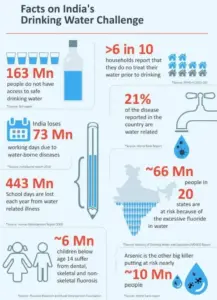
India’s Growing Water Crisis
1.Declining Availability of Freshwater
- India’s freshwater resources are under severe stress due to rapid population growth and increasing demand.
- Per capita freshwater availability has declined significantly over the decades.
- Rising urbanisation has increased the demand for domestic, industrial, and commercial water consumption.
- Climate change has further aggravated water scarcity through irregular rainfall patterns and extreme weather events.
2.Urban Demand Outpacing Supply
- Cities are expanding rapidly, leading to increased pressure on existing water infrastructure.
- Commercial establishments, industries, and changing lifestyles have raised per capita water consumption.
- Urban local bodies (ULBs) often struggle to meet the growing demand due to inadequate infrastructure and financial constraints.
- As a result, many Indian cities experience periodic water shortages despite substantial investments in water supply systems.
Water Tariffs: An Underutilised Policy Instrument
1.Importance of Water Pricing
- Water tariffs represent one of the most effective mechanisms for influencing consumer behaviour and promoting efficient water use.
- Appropriate pricing can encourage conservation, reduce wastage, and incentivise recycling.
- Tariffs can also help recover operational and maintenance costs, ensuring financial sustainability of water utilities.
2.Current Situation in India
- Water in most Indian cities is priced significantly below its actual cost of supply.
- Water pricing is generally determined by political considerations rather than economic realities.
- Consequently, water utilities remain financially weak and unable to improve service quality.
Findings of the Jal Mulya Project
Objectives of the Study
- The Jal Mulya Project, conducted by the Centre for Sustainable Development in collaboration with the Pune International Centre and Pune Knowledge Cluster, sought to examine:
- The economics of urban water supply.
- Actual costs involved in delivering water.
- Consumer willingness to pay for quality drinking water.
- The role of tariffs in regulating urban water consumption.
The Grey Water Paradox
- Grey water refers to domestic wastewater generated from Washing clothes, Bathing, Kitchen activities, Household cleaning activities.
- It excludes sewage from toilets and can be treated relatively easily for reuse.
- Potential Uses of Treated Grey Water-Toilet flushing, Gardening, Construction activities, Landscaping, Industrial cooling, Other non-potable purposes.
Political Economy of Water Pricing
1.Tariffs Based on Political Acceptability
- The study confirmed that water tariffs are usually determined by what is politically acceptable rather than what is economically necessary.
- Several factors contribute to this situation: Fear of public backlash, Electoral considerations, Perception of water as a free public good, Lack of awareness regarding the actual costs of water supply.
2.Consequences
- Utilities face chronic revenue shortages.
- Infrastructure deteriorates.
- Water losses increase.
- Service quality remains poor.
- Long-term sustainability is compromised.
Lack of Full-Cost Accounting by Urban Local Bodies
- Most urban local bodies do not undertake comprehensive cost accounting
- As a consequence: Actual subsidies remain hidden, Inefficiencies are not identified, Financial planning becomes difficult , Decision-making lacks transparency.
The Problem of Non-Revenue Water (NRW)
- Non-Revenue Water refers to treated water that is produced but does not generate revenue because it is lost before reaching paying consumers.
- Sources include: Pipeline leakages, Illegal connections, Metering inaccuracies, Theft of water.
- In many Indian cities, NRW exceeds 30% of total water supplied.
- This represents a substantial loss of valuable resources.
Water Inequality and Social Justice
- Unequal Distribution of Costs-The burden of poor water management is not distributed equally across society
- Impact on Low-Income Households-Poor households often face two difficult choices: Consume potentially unsafe tap water and risk health problems and spend a large share of income purchasing safe water.
- Impact on Wealthier Households-Higher-income groups can afford advanced purification systems, Purchase bottled water and install private storage facilities.Thus, they are better insulated from deficiencies in public services.
Inequality in Water Consumption
The study also observed that:
- Higher-income households consume substantially more water.
- Lower-income households often consume less due to affordability constraints.
- This creates concerns regarding: Resource allocation, Environmental sustainability, Social equity.
Towards a Circular Urban Water Economy
- A circular water economy seeks to maximise water efficiency by Reusing wastewater, Recycling grey water, Minimising waste, Reducing dependence on freshwater sources.
- Urban India converts nearly 80% of daily water use into sewage.
- This presents a major opportunity for: Resource recovery, Water conservation, Environmental protection.
Role of Grey Water
- Grey water should be viewed as an asset rather than waste.
- Key measures include: Separate collection systems, Appropriate treatment infrastructure, Reuse for non-potable purposes, Creation of viable markets for treated water.
- A circular approach can:
- Reduce freshwater demand.
- Lower sewage generation.
- Improve environmental outcomes.
- Enhance urban water security.
Policy Recommendations
- Full-Cost Accounting-Calculate and disclose the actual cost of water supply.
- Reduction of Non-Revenue Water-Governments should improve leak detection systems and strengthen metering mechanisms.
- Progressive Tariff Structures-Water pricing should follow the principle of equity.
- Lifeline Water Supply-Basic minimum quantities necessary for survival should remain subsidised. This ensures affordability for all citizens.
- Increasing Block Tariffs-Higher levels of consumption should attract progressively higher charges. This discourages wasteful and excessive use.
- Promotion of Water Reuse-Encourage grey-water recycling systems.
Conclusion
- India’s water crisis demands urgent and comprehensive policy responses.
- While technological solutions and infrastructure investments are essential, the role of water pricing cannot be overlooked.
- Current water tariffs fail to reflect the true cost of supply and discourage conservation and recycling.
- The resulting inefficiencies contribute to financial stress for utilities, excessive freshwater consumption, and environmental degradation.
- In a water-scarce nation like India, treating water as a valuable resource is essential.
- The price of water is therefore not simply a question of economics; it is fundamentally a question of justice, sustainability, and the responsible stewardship of a vital common resource.Top of Form
Mains UPSC Question GS 3
- Discuss the role of water pricing in promoting sustainable urban water management in India. How can rational tariff structures contribute to water conservation, wastewater reuse, and social justice? (250 words, 15 marks)

