 India's No.1 PU & Degree With Integrated IAS & IPS(UPSC/PSC) Training College.


Minor Planet Centre Announces New Moons
Minor Planet Centre Tracks Newly Discovered Planetary Moons
Why in the News ?
The Minor Planet Centre (MPC) recently confirmed the discovery of 15 new moons—four orbiting Jupiter and eleven around Saturn—highlighting its critical role in verifying celestial discoveries, tracking small solar system bodies, and supporting global astronomical research coordination.
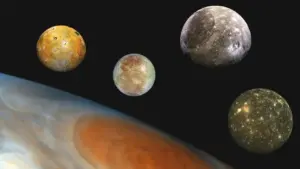
Discovery of New Moons and Role of MPC:
- The Minor Planet Centre (MPC) announced the discovery of 15 new moons in the solar system.
- Four moons were identified around Jupiter, discovered by astronomers Scott Sheppard and David Tholen.
- Eleven moons orbiting Saturn were discovered by a research team led by Edward Ashton.
- The MPC acts as the global authority for verifying such discoveries and assigning official recognition.
- These findings enhance scientific understanding of planetary systems and their evolution.
Functions and Scientific Importance of MPC
- The MPC is the primary global repository for observations of minor celestial bodies like asteroids, comets, and outer planet moons.
- It operates under the International Astronomical Union (IAU) at the Smithsonian Astrophysical Observatory in Massachusetts.
- Astronomers submit observational data to MPC, where experts verify findings and compute orbital paths.
- Once validated, the MPC assigns a unique designation, ensuring systematic cataloguing of celestial objects.
- It plays a key role in tracking Near-Earth Objects (NEOs), helping predict potential threats to Earth.
- Supported by NASA’s Planetary Defense Coordination Office, MPC maintains a database for planetary defense monitoring.
- It also publishes electronic circulars, enabling global coordination among observatories.
Key points : MPC & Space Tracking● Established under the International Astronomical Union (IAU) as the official body for minor planet data. ● Located in Cambridge, Massachusetts, at the Smithsonian Astrophysical Observatory. ● Deals with asteroids, comets, dwarf planets, and irregular moons of outer planets. ● Near-Earth Objects (NEOs): Celestial bodies whose orbits bring them close to Earth; crucial for planetary defense. ● Planetary Defense Coordination Office (NASA): Works with MPC to detect and monitor potential impact threats. ● Ensures global scientific collaboration by sharing timely updates on discoveries and celestial events. |


