 India's No.1 PU & Degree With Integrated IAS & IPS(UPSC/PSC) Training College.


Impartiality of Nominated Governor Explained
IMPARTIALITY OF A NOMINATED GOVERNOR
Syllabus:
GS-2:
- Constitutional posts, powers and functions
- Transparency and Accountability
Why in the News?
The recent Supreme Court judgment on gubernatorial powers and the advisory in the 16th Presidential Reference have reignited discussions on the constitutional intent behind the Governor’s role. With multiple conflicts emerging between Governors and elected State governments, questions regarding impartiality, discretion, and constitutional morality have returned to the forefront of democratic debate.
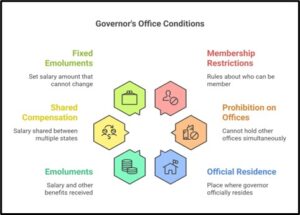
GOVERNOR’S CONSTITUTIONAL POSITION● Formal Head: The Governor is the nominal executive head of a State under Articles 153–161, functioning similarly to the President at the Union level within India’s parliamentary system. ● Advice Bound: Under Article 163, the Governor acts on the aid and advice of the Council of Ministers except in matters where the Constitution expressly provides discretionary powers. ● Discretion Areas: Discretion applies in specific cases like appointing a Chief Minister, recommending President’s Rule under Article 356, or reserving certain Bills for Presidential consideration. ● Legislative Role: The Governor summons, prorogues, and dissolves the State Legislature, addresses the first session each year, and grants assent, withholding, or reservation of Bills within constitutional limits. ● Emergency Functions: During constitutional breakdown, the Governor becomes a key channel for reporting to the President on Article 356 matters, though still expected to act impartially within the constitutional framework. |
CONSTITUTIONAL VISION OF GOVERNOR’S ROLE
- Founders’ Intent: The Constituent Assembly envisioned the Governor as a neutral constitutional head bound by ministerial advice, ensuring smooth parliamentary governance without exercising personal authority that undermines the elected executive.
- Ambedkar’s Clarification: Ambedkar stressed that a Governor is a “purely constitutional” figure meant to make the parliamentary system work, not to rival the elected Ministry or act as New Delhi’s agent.
- Fear Addressed: Assembly members feared Governors would become remote-controlled authorities like colonial-era provincial heads, but Ambedkar assured their powers were limited, not overriding like the 1935 Act.
- Neutral Authority: The Governor was structured as an impartial referee, stepping in only in rare constitutional situations, not as an interfering force in routine political disagreements.
- Limited Role: The founders placed Governors within a framework where discretion is rare, advice-binding is mandatory, and impartiality is central to the office.
DEBATE ON DISCRETIONARY POWERS
- Discretion Defined: Ambedkar clarified that discretion applies only in explicitly stated areas—mainly choosing a Chief Minister when no clear majority exists or in similarly narrow situations.
- Not Interfering: The Governor’s role was never intended as an interventionist authority, and they cannot act independently in matters requiring ministerial advice.
- Not 1935 Revival: Critics compared the powers to the colonial 1935 Act, but Ambedkar asserted no general overriding powers exist under the Indian Constitution.
- Misreading Prevented: Ambedkar cautioned that no power of discretion should be inferred, only used when expressly provided, ensuring strict constitutional boundaries.
- Contemporary Misuse: Today, Governors in several States appear to stretch this limited discretion, often in ways contradicting the framers’ clear intent.
BILL ASSENT AND LEGISLATURE’S AUTHORITY
- Assembly Concerns: Members feared Bills passed by elected legislatures could be stalled by Governors, undermining democratic supremacy and enabling indirect central influence.
- Discretion Misunderstood: Ambedkar clarified reservation of Bills for the President is not discretionary, but a procedural safeguard for limited cases affecting national interests or constitutional provisions.
- Not a Veto: The Governor cannot sit in judgment over Bills or use assent power to obstruct legislative functioning; their role is largely formal.
- Modern Issues: Recent withholding or delaying of assent contradicts Ambedkar’s intent that decisions must be made “as soon as possible,” not indefinitely delayed.
- Legislature’s Primacy: The framers clearly prioritised the elected legislature, ensuring Governors cannot become parallel political power centres.
EMERGENCY POWERS AND GOVERNOR’S POSITION
- No Special Power: According to Ambedkar, Governors hold no extraordinary authority even during emergencies; they remain bound by ministerial advice.
- Ornamental Role: Ambedkar famously called the Governor’s position “ornamental”, suggesting few would contest an election if the post were elective due to its limited powers.
- No Rival Authority: The Constitution does not permit Governors to overshadow elected governments or influence governance except where explicitly mandated.
- Limited Expectations: The role is symbolic of federal balance, not active governance, making impartiality its core requirement.
- Emergency Misinterpretations: Contemporary claims of enhanced gubernatorial power during crises contradict the framers’ restrictive and cautious
CONTEMPORARY MISALIGNMENTS WITH CONSTITUTIONAL SPIRIT
- Judicial Gaps: Courts sometimes fail to enforce constitutional morality strongly enough, enabling Governors to push boundaries of delay and discretion.
- Ambiguity Exploited: Phrases like “as soon as possible” in Bill assent have been interpreted in practice as “as late as possible,” distorting democratic intent.
- Political Interference: Several Governors increasingly appear aligned with the Union government, creating friction in Opposition-ruled States and weakening federal trust.
- Ambedkar’s Warning: Ambedkar warned that constitutional failure often reflects human “vileness,” not structural weakness—highlighting misuse rather than design flaws.
- Narayanan’s Question: Former President K.R. Narayanan’s query—whether we failed the Constitution—remains relevant as misuse of the office challenges democratic federal balance.
IMPACT ON FEDERALISM AND DEMOCRACY
- Federal Tension: Excessive gubernatorial interference strains Centre-State relations, creating political instability and eroding cooperative federalism.
- Democratic Erosion: Delayed assent, withheld Bills, or interventions in legislative processes weaken democratic mandates and undermine public will.
- Governance Blockage: When Governors obstruct legislation, States face delays in implementing essential policy decisions, affecting welfare and administration.
- Political Polarisation: The perceived bias of Governors contributes to heightened political confrontation, making constitutional coordination difficult.
- Institutional Credibility: Overreach diminishes the credibility of the gubernatorial office, once envisioned as a neutral and dignified
WAY FORWARD FOR A NEUTRAL GOVERNORSHIP
- Clear Guidelines: Codifying timelines and procedures for Bill assent can prevent arbitrary delays, ensuring smoother legislative processes.
- Judicial Oversight: Stronger judicial intervention when Governors exceed constitutional boundaries can reinforce accountability and constitutional morality.
- Federal Restraint: The Union must exercise political neutrality in appointments, ensuring Governors are individuals of integrity and non-partisanship.
- Strengthening Conventions: Restoring the primacy of constitutional conventions, like acting on ministerial advice, can revive the original spirit of governance.
- Training and Orientation: Governors should undergo structured orientation on constitutional roles to avoid misinterpretations and ensure functional impartiality.
CONCLUSION
The framers envisioned the Governor as a neutral, constitutional guardian—not a political actor. Dr. Ambedkar’s assurances emphasised limited discretion, democratic supremacy, and federal balance. Contemporary deviations from this vision weaken constitutional morality. Restoring impartiality, clarity, and accountability is essential to preserve India’s cooperative federalism and strengthen its democratic foundations.
SOURCE:TH
MAINS PRACTICE QUESTION
“Critically examine the constitutional role of the Governor in India in light of recent controversies. How far does contemporary practice diverge from the framers’ original intent?”

