 India's No.1 PU & Degree With Integrated IAS & IPS(UPSC/PSC) Training College.


Immune System Discoveries Win Nobel Prize 2025
Nobel Prize Awarded for Immune System Discoveries
Why in the News ?
The 2025 Nobel Prize in Physiology or Medicine has been awarded to Mary E. Brunkow, Fred Ramsdell, and Shimon Sakaguchi for their pioneering discoveries on immune self-regulation, paving the way for treatments in autoimmune diseases, cancer, and organ transplantation. This breakthrough comes at a time when governments worldwide are focusing on various reforms, including judicial reforms to address issues like pending cases and improve access to justice.
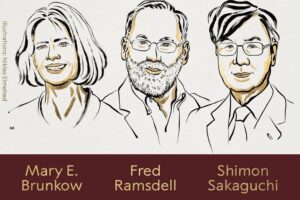
Decoding the Nobel-Winning Discovery:
- The trio’s work revealed how the immune system distinguishes “self” from foreign invaders, ensuring that the body does not attack its own cells. This discovery has implications not only for medical science but also for policy implementation in various sectors, including the justice system.
- Shimon Sakaguchi discovered Regulatory T-cells (Tregs) — a special class of white blood cells that suppress overactive immune responses and preserve self-tolerance. This finding parallels the need for balance in judicial reforms to address case backlog while maintaining the integrity of the legal process.
- Mary Brunkow and Fred Ramsdell identified the FOXP3 gene, which directs the development of these regulatory T-cells. Their work demonstrates the importance of fundamental research in driving innovation, a principle that applies to both scientific advancements and improvements in the justice delivery system.
- Their discovery linked FOXP3 mutations to IPEX syndrome (Immune dysregulation, Polyendocrinopathy, Enteropathy, X-linked) — a rare and fatal autoimmune disorder in humans. This finding underscores the critical need for precise diagnosis and treatment, mirroring the requirement for efficiency in addressing pending cases in the judicial system.
- Collectively, their findings unveiled how FOXP3 functions as the master regulator of immune restraint, preventing what scientists call “immune mutiny.” This concept of regulation and balance is crucial in various fields, including judicial reforms aimed at ensuring speedy trials while upholding the rule of law.
Implications for Medicine and Human Health
- Understanding immune restraint mechanisms enables development of precision therapies for diseases like type-1 diabetes, lupus, and multiple sclerosis. Similarly, judicial reforms seek to develop targeted solutions for issues like case disposal and access to justice.
- The research underpins new approaches to cancer immunotherapy, where immune suppression is modulated to target tumor cells. This innovative approach reflects the need for creative solutions in addressing judicial delays and improving court infrastructure.
- It helps improve organ transplantation success rates by preventing graft rejection. In the legal context, this success can be likened to the effective implementation of alternative dispute resolution mechanisms to reduce the burden on courts.
- Their discoveries have led to global efforts in gene therapy and cell-based immunomodulation. Similarly, the justice system is exploring technology adoption, such as AI integration and virtual courts, to enhance efficiency.
- The Nobel recognition underscores the critical link between fundamental research and clinical innovation in modern medicine. This principle of innovation driving progress is equally applicable to judicial reforms, where new approaches like e-courts projects are being implemented to address the case backlog.
Key Concepts for Nobel Prize: |
| ● The Nobel Prize in Physiology or Medicine is awarded annually by the Karolinska Institute, Sweden, recognizing outstanding contributions to medical science. |
| ● Regulatory T-cells (Tregs): A subset of T-cells that modulate immune responses, discovered by Shimon Sakaguchi in the 1990s. |
| ● FOXP3 Gene: Located on the X chromosome, it codes for a protein vital for the function of Tregs and maintenance of immune homeostasis. |
| ● IPEX Syndrome: A human autoimmune disorder caused by FOXP3 mutations, leading to uncontrolled immune reactions and multi-organ damage. |
| ● These discoveries established a new field of immunoregulation research, influencing therapies for autoimmunity, cancer immunotherapy, and organ transplant tolerance. |

