 India's No.1 PU & Degree With Integrated IAS & IPS(UPSC/PSC) Training College.


Global Corruption: India’s Lessons
Deepening Global Corruption: Lessons and Imperatives for India
Syllabus:
- GS – 2 – Corruption , Good Governance
Focus :
The Transparency International Corruption Perceptions Index 2025 highlights rising global corruption and India’s stagnant performance. It underscores the need to strengthen transparency, institutional accountability, and regulatory simplification. Corruption is not just a governance issue but an economic constraint affecting investment, growth, and public trust, making reforms essential for India’s developmental ambitions and ensuring a pollution free environment through better governance.
Introduction
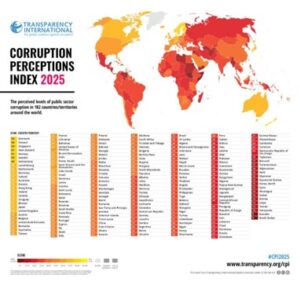
- The Corruption Perceptions Index 2025 (CPI) presents a concerning global trend of increasing corruption.
- The global average score has declined, indicating weakening institutional integrity worldwide.
- Corruption today is not merely an ethical issue but a systemic challenge affecting governance and economic growth.
- For India, which aspires to become a developed nation by 2047, this trend carries important lessons.
Global Trends in Corruption
- The CPI 2025 shows that corruption is deepening rather than declining globally.
- The global average score has fallen to 42 out of 100, reflecting worsening perceptions.
- Around 122 out of 182 countries score below 50, indicating widespread governance challenges.
- Only a few countries score above 80, highlighting that high integrity governance is becoming rare.
- The trend suggests that:
- Weak oversight mechanisms
- Declining civic freedoms and environmental democracy
- Reduced institutional accountability
contribute to higher corruption levels.
India’s Position in the Global Context
- India has a CPI score of 39 and ranks 91 out of 182 countries.
- Over the last decade, India’s score has remained largely stagnant between 38 and 41.
- Despite becoming one of the world’s largest economies, governance perception has not improved proportionately.
- Compared to other countries:
- India performs better than some neighbours like Pakistan and Bangladesh.
- However, it lags behind many East Asian and European economies that have undertaken sustained reforms.
- This indicates a gap between economic growth and governance quality.
Why CPI Score Matters for India
- Indicator of Governance Quality
- The CPI measures perceived public sector corruption, not just reported cases.
- It evaluates factors such as:
- Public procurement transparency
- Regulatory enforcement including environmental clearances
- Judicial effectiveness
- A low score reflects institutional weaknesses and lack of accountability.
- Impact on Investment and Economy
- Corruption perceptions influence:
- Foreign investment decisions
- Sovereign risk ratings
- Long-term capital flows
- Governance credibility has become a competitive economic variable in the global economy.
Economic Costs of Corruption
- Corruption imposes significant economic costs at both global and national levels.
- Globally, it is estimated to cost around 5% of GDP annually, amounting to trillions of dollars.
- For India:
- Direct losses are estimated at around 0.5% of GDP.
- Total impact, including indirect effects, may reach 1–1.5% of GDP.
- These losses result in:
- Reduced public investment
- Inefficient allocation of resources
- Lower productivity and growth
Structural Challenges in India
- Complex Compliance Architecture
- India’s regulatory system is highly complex and fragmented.
- Businesses face:
- Over 26,000 imprisonment-related provisions across laws.
- A single pharmaceutical startup may need to comply with:
- Nearly 1,000 regulatory requirements
- Almost half carrying criminal liability
- Similarly, environmental clearance processes involve multiple agencies, with requirements under the EIA Notification, Forest Conservation Act, and Coastal Regulation Zone regulations creating overlapping jurisdictions and discretionary powers.
- Impact of Over-Regulation
- Excessive regulation:
- Increases cost of doing business
- Expands discretionary power of officials
- This creates opportunities for:
- Rent-seeking behaviour
- Informal payments and corruption
- The practice of granting ex post facto or retrospective environmental clearances, as highlighted in environmental jurisprudence including the Vanashakti judgment, exemplifies how regulatory gaps enable corruption and undermine the precautionary principle and polluter pays principle.
Positive Developments in India
- Digital Public Infrastructure
- India has made significant progress in reducing corruption through technology.
- Initiatives include:
- Direct Benefit Transfer (DBT) systems
- Digital identity frameworks
- Online portals for environmental impact assessment and environmental clearances
- These have helped:
- Reduce leakages in welfare schemes
- Improve targeting and efficiency
- Financial and Tax Reforms
- The Goods and Services Tax (GST) has:
- Increased transparency in taxation
- Improved compliance and traceability
- The Reserve Bank of India Digital Payments Index shows rapid growth in digital transactions.
- E-Governance Initiatives
- E-procurement and digital payments:
- Reduce human discretion
- Limit opportunities for bribery
- These reforms demonstrate that institutional design can effectively reduce corruption.
Corruption as a Strategic Challenge
- Corruption is not only a governance issue but also a strategic economic constraint.
- It leads to:
- Reduced fiscal efficiency
- Lower investor confidence
- Weak regulatory credibility
- It also undermines:
- Social trust
- Democratic legitimacy
- For a country targeting a multi-trillion-dollar economy, governance quality becomes critical.
Need for Institutional Reforms
- Enhancing Transparency
- Greater openness in:
- Public procurement
- Government decision-making
- Adoption of:
- Open data platforms
- Transparent environmental clearance procedures eliminating ex-post approvals
- Strengthening Accountability
- Independent oversight bodies must be empowered.
- Mechanisms for:
- Whistleblower protection
- Anti-corruption enforcement
should be strengthened.
- Strengthening environmental democracy through participatory decision-making in environmental clearances can reduce discretionary corruption.
- Simplifying Regulations
- Reduce:
- Compliance burden
- Criminal provisions in business laws
- Promote:
- Ease of doing business
- Predictability in regulations
- Improving Judicial Efficiency
- Address:
- Case pendency
- Delays in enforcement
- Ensure:
- Swift and fair justice delivery
Lessons from Global Experience
- Countries that improved CPI rankings followed:
- Gradual and consistent reforms
- Strengthening of institutions
- Reduction of discretionary powers
- Key takeaway:
- Sustainable progress requires systemic change, not short-term actions.
Way Forward for India
- India must align its governance reforms with its economic ambitions.
- Focus areas should include:
- Institutional independence
- Regulatory clarity
- Transparency in governance
- Leveraging technology should continue to:
- Reduce discretion
- Increase accountability
- Public awareness and civic participation must also be strengthened.
Conclusion
- India’s economic rise has been significant, but governance reforms have not kept pace.
- The CPI 2025 should be viewed as a benchmark for improvement rather than a criticism.
- Strengthening transparency and accountability will:
- Enhance public trust
- Improve investment climate
- Support sustainable growth
- A corruption-resilient governance system is essential for achieving India’s long-term developmental goals.
Mains UPSC Question GS 2
- “Corruption is not only a governance deficit but also an economic constraint. In light of global trends and India’s experience, discuss the structural reforms required to improve transparency and accountability in India.” (250 words)


