 India's No.1 PU & Degree With Integrated IAS & IPS(UPSC/PSC) Training College.


Debunking the Job Creation Myth
Debunking the Myth of Job Creation
Syllabus:
GS 3
- Employment generation
- Economic development
Why in the News?
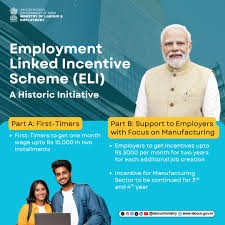
On July 1, 2025, the government approved the Employment Linked Incentive (ELI) Scheme to support employment generation, with an outlay of ₹99,446 crore. However, this raises serious concerns about the target population in a labour market where capital–labour asymmetries, the formal–informal sector divide, and the persistent mismatch between employment opportunities and employability continue to marginalise large sections of the workforce, particularly low-skilled and informal workers.
Introduction
- The Employment Linked Incentive (ELI) Scheme aims to generate jobs through fiscal incentives to employers, primarily in manufacturing. However, it risks excluding the informal sector, worsening capital–labour asymmetries, and ignoring skill–job mismatches. Sustainable employment policy must focus on skilling, social security, and equitable job creation rather than short-term employer subsidies.
Employer-Centric Approach
- The ELI reflects an employer-centric approach by providing fiscal incentives to employers for creating jobs, particularly in the manufacturing sector. This overlooks the persistent skill–job mismatch and risks mimicking capital subsidies, which may worsen capital–labour asymmetries.
- Impact: Strengthens employers’ bargaining power over workers.
- Consequence: High wage gaps could widen, hurting informal and low-skilled workers excluded from the scheme.
Severe Skill Mismatch
At the heart of India’s labour market crisis lies not just job scarcity, but poor skills alignment.
- Only 25% of graduates are in roles matching their qualifications (Economic Survey 2024–25).
- Over 53% of graduates are underemployed in unskilled jobs.
- Top earners in high-skill roles: ₹4–₹8 lakh per annum.
- Nearly 46% in low-skill jobs earn < ₹1 lakh.
- Formal vocational training among youth (15–29 years): 9%.
Exclusion of the Informal Sector
The scheme prioritises sectors/firms registered with the Employees’ Provident Fund Organisation (EPFO).
- Result: Excludes 90% of the labour force in the informal sector.
- Informal workers: Lack social security, formal contracts, and job stability.
- Public funds are channelled to well-off enterprises, leaving low-wage, unregistered workers further behind
Sectoral Blind Spots
The scheme’s manufacturing focus ignores declining employment elasticity in this sector.
- Manufacturing employment share: < 13% of total jobs.
- Services + Agriculture: ~70% of workforce.
- Automation & capital intensity in manufacturing reduce labour absorption.
- Women, rural youth, and informal workers—dominant in low-skill services/agriculture—are overlooked.
Long-Term Policy Needs
The ELI Scheme risks deepening structural inequalities without addressing:
- Skill development
- Job quality
- Social security for informal sector workers
Policy Recommendations:
- Invest in skilling & education reform to support low-skilled workers.
- Shift from short-term job creation to long-term sustained employment
- Ensure labour rights and minimum wage protection.
- Build a dignified and equitable labour market for all.
MAINS PRACTICE QUESTION
“Critically examine the Employment Linked Incentive (ELI) Scheme in light of India’s labour market challenges. How can policy be redesigned to ensure inclusive and sustainable employment generation? (250 words)

