 India's No.1 PU & Degree With Integrated IAS & IPS(UPSC/PSC) Training College.

GS-3

El Niño, La Niña and “Godzilla El Niño”
Understanding the World’s Powerful Climate Cycle
UPSC CSE | GS Paper 1: Physical Geography | GS Paper 3: Environment, Agriculture, Disaster Management
How to use this articleFirst understand the mechanism: normal Pacific conditions, trade winds, Walker Circulation, El Niño and La Niña. Revise tables for Prelims: ENSO phases, indices, organisations, famous events and India-specific impacts. Use Mains sections for answer-writing: monsoon, agriculture, food security, disaster management and climate change linkages. |
- Syllabus Linkage
| Paper/Area | Relevance |
| GS Paper 1 – Physical Geography | Ocean-atmosphere interaction, monsoon mechanism, climatic regions and global climate variability. |
| GS Paper 3 – Environment | Climate change, extreme weather, coral bleaching, heatwaves and ecological impacts. |
| GS Paper 3 – Agriculture | Monsoon dependence, Kharif output, food inflation, drought management and crop planning. |
| GS Paper 3 – Disaster Management | Droughts, floods, cyclones, heatwaves, early warning systems and climate-risk governance. |
| Essay / Interview | Climate uncertainty, resilience, scientific forecasting and human security. |
-
Introduction
El Niño and La Niña are two of the most important natural climate phenomena influencing weather patterns across the world. They affect rainfall, temperature, heatwaves, droughts, floods, cyclones, agriculture, water supply and food prices. Both are part of a larger climate system called ENSO – El Niño-Southern Oscillation.
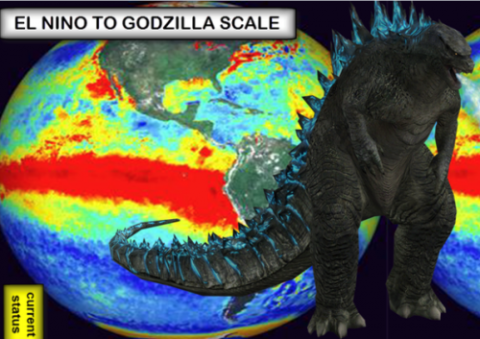
Recently, the phrase “Godzilla El Niño” has become popular in media discussions. It is used to describe an extremely powerful El Niño event that can create serious global climate disturbances. However, it is not an official scientific term. For UPSC, it is essential to separate media language from scientific classification.
-
Normal Pacific Conditions: The Base for Understanding ENSO
Under normal conditions, the equatorial Pacific Ocean has a strong east-west contrast. Trade winds blow from east to west, pushing warm surface water towards the western Pacific near Indonesia and Australia. As warm water piles up in the west, cold nutrient-rich water rises in the eastern Pacific near Peru and Ecuador. This process is called upwelling.
3.1 Trade Winds
Trade winds are persistent surface winds blowing from east to west across the tropical Pacific. They are crucial because they maintain the normal warm pool in the western Pacific and cold upwelling in the eastern Pacific. Any weakening or strengthening of these winds changes the ocean-atmosphere balance.
3.2 Walker Circulation
The Walker Circulation is an east-west atmospheric circulation loop over the tropical Pacific. Warm water in the western Pacific heats the air above it, causing convection and rainfall. Air then moves eastward at higher levels, sinks over the cooler eastern Pacific, and returns westward at the surface as trade winds.
| Region | Normal Condition | Effect |
| Western Pacific | Warm sea surface temperature and low pressure | Rising moist air and heavy rainfall over Indonesia, Australia and nearby regions. |
| Eastern Pacific | Cool sea surface temperature and high pressure | Descending dry air, coastal upwelling and productive fisheries near Peru. |
| Surface winds | Trade winds blow east to west | Warm water is pushed westward and cold upwelling occurs in the east. |
- What is ENSO?
ENSO stands for El Niño-Southern Oscillation. It is a natural climate cycle linked with changes in sea surface temperature, atmospheric pressure and wind circulation over the tropical Pacific Ocean. ENSO is one of the strongest drivers of year-to-year climate variability across the globe.
| ENSO Phase | Ocean Condition | Atmospheric Signal | Simple Meaning |
| El Niño | Central/eastern equatorial Pacific becomes warmer than normal | Trade winds weaken; Walker Circulation weakens | Warm phase of ENSO |
| La Niña | Central/eastern equatorial Pacific becomes cooler than normal | Trade winds strengthen; Walker Circulation strengthens | Cool phase of ENSO |
| ENSO-neutral | Sea surface temperatures remain near long-term average | Normal or near-normal pressure and wind pattern | Neutral phase |
These phases influence weather not only in the Pacific region but also in Asia, Africa, Australia, North America, South America and many other parts of the world. Such long-distance climate effects are called teleconnections.
-
How ENSO is Measured
5.1 Southern Oscillation Index (SOI)
The Southern Oscillation Index measures the atmospheric pressure difference between Tahiti in the eastern Pacific and Darwin in Australia. Negative SOI is generally associated with El Niño, while positive SOI is generally associated with La Niña.
5.2 Oceanic Niño Index (ONI)
The Oceanic Niño Index is widely used by NOAA for ENSO classification. It measures the three-month running average of sea surface temperature anomalies in the Niño 3.4 region of the equatorial Pacific. A sustained anomaly of +0.5°C or above indicates El Niño conditions; -0.5°C or below indicates La Niña conditions.
| ONI Anomaly | Classification |
| +0.5°C to +0.9°C | Weak El Niño |
| +1.0°C to +1.4°C | Moderate El Niño |
| +1.5°C to +1.9°C | Strong El Niño |
| +2.0°C or above | Very strong El Niño – popularly called a super or “Godzilla” type event by media |
| -0.5°C to -0.9°C | Weak La Niña |
| -1.0°C to -1.4°C | Moderate La Niña |
| -1.5°C or below | Strong La Niña |
-
What is El Niño?
El Niño is the warm phase of ENSO. It occurs when the surface waters of the central and eastern equatorial Pacific Ocean become warmer than normal. This abnormal warming changes wind movement and rainfall patterns across the world.
6.1 Mechanism of El Niño
- Trade winds over the equatorial Pacific weaken.
- Warm water accumulated in the western Pacific shifts eastward towards the central and eastern Pacific.
- Upwelling of cold water near Peru and Ecuador weakens, reducing nutrient supply to fisheries.
- Convection and rainfall shift from the western Pacific towards the central/eastern Pacific.
- The Walker Circulation weakens, disturbing rainfall patterns over South Asia, Australia, Indonesia and other regions.
6.2 Global Impacts of El Niño
| Region | Common El Niño Impact |
| India / South Asia | Weak or deficient Southwest Monsoon, drought risk, heat stress and lower Kharif output. |
| Australia / Indonesia | Drought, bushfire risk and reduced rainfall. |
| Peru / Ecuador | Heavy rainfall, flooding and collapse of cold-water fisheries due to reduced upwelling. |
| East Africa | Increased rainfall and flood risk in some equatorial regions. |
| Southern Africa | Drought and food-security stress. |
| Atlantic Ocean | Higher vertical wind shear and usually fewer Atlantic hurricanes. |
| Global climate | Higher global average temperatures and increased heatwave intensity. |
-
El Niño and the Indian Monsoon
For India, El Niño is especially important because it is often linked with a weaker Southwest Monsoon. Since the monsoon provides most of India’s annual rainfall and supports the Kharif crop season, any monsoon weakening can affect agriculture, drinking water supply, reservoirs, hydropower generation, rural income and food prices.
- Monsoon onset may be delayed or its advance may become weak.
- Rainfall may become spatially uneven; some areas may receive normal rain while others face severe deficit.
- Kharif crops such as paddy, pulses, oilseeds, cotton and sugarcane may suffer.
- Reservoir storage and groundwater recharge may decline, affecting drinking water and irrigation.
- Food inflation can increase if crop output falls and supply chains are stressed.
| UPSC Caveat: El Niño does not always mean drought
The El Niño-monsoon relationship is probabilistic, not deterministic. Other factors such as the Indian Ocean Dipole, Madden-Julian Oscillation, snow cover, land heating and intra-seasonal monsoon dynamics can modify the outcome. A positive Indian Ocean Dipole may partly counter the negative influence of El Niño on India. |
-
What is “Godzilla El Niño”?
“Godzilla El Niño” is a media nickname used for an extremely strong El Niño event. It is not an official scientific name. The word Godzilla is used because it represents something very large, powerful and destructive. When an El Niño event becomes unusually intense, journalists and climate commentators sometimes use dramatic language to attract public attention.
The term became especially popular during the 2015-16 El Niño, which was one of the strongest El Niño events on record. Therefore, “Godzilla El Niño” means a very strong or super El Niño, but the scientifically correct expression is strong El Niño or very strong El Niño.
Prelims Trap: Media Term vs Scientific TermGodzilla El Niño = popular media expression, not official classification. Official terminology = El Niño, La Niña, ENSO-neutral, weak, moderate, strong and very strong. WMO, NOAA and IMD do not normally use dramatic names like Godzilla in scientific classification. |
-
Do WMO, NOAA and IMD Give Names Like “Godzilla El Niño”?
No. Scientific agencies such as the World Meteorological Organization, NOAA and the India Meteorological Department do not usually give dramatic names like “Godzilla El Niño”. Their aim is to provide accurate climate monitoring, forecasts, warnings and impact assessment, not media-style naming.
These organisations study sea surface temperature, wind patterns, atmospheric pressure and rainfall signals before declaring an ENSO phase. They issue scientific updates and probability-based forecasts rather than popular names. Therefore, “Godzilla El Niño” is a popular media expression, while “strong El Niño” or “very strong El Niño” is the scientific expression.
-
Important Organisations
| Organisation | Full Form / Country | Role in ENSO and Climate Monitoring |
| WMO | World Meteorological Organization; UN specialised agency; headquarters at Geneva, Switzerland | Coordinates global weather, climate, water and atmospheric monitoring; issues international climate updates and guidance. |
| NOAA | National Oceanic and Atmospheric Administration; United States; under the U.S. Department of Commerce | Monitors ocean and atmosphere conditions, publishes ENSO updates, uses ONI and operates climate prediction systems. |
| IMD | India Meteorological Department; India; under the Ministry of Earth Sciences | Issues weather forecasts, cyclone warnings, monsoon updates, heatwave alerts and seasonal climate information for India. |
| IITM Pune | Indian Institute of Tropical Meteorology; India | Researches monsoon dynamics, climate variability, ENSO-monsoon relationship and climate modelling. |
| INCOIS | Indian National Centre for Ocean Information Services; India | Monitors ocean conditions and supports ocean-state forecasts relevant to climate and disaster management. |
-
Famous El Niño and La Niña Events
| Event | Phase / Strength | Significance |
| 1982-83 | Very strong El Niño | Major global weather disturbances, floods in South America, droughts in Australia/Indonesia and large economic losses. |
| 1997-98 | Very strong El Niño | One of the strongest on record; linked with floods, droughts, forest fires, coral bleaching and agricultural damage. |
| 2010-12 | Strong/multi-year La Niña | Associated with heavy rainfall and flooding in Australia and strong monsoon conditions in parts of South Asia. |
| 2015-16 | Very strong El Niño; popularly called “Godzilla El Niño” | Contributed to high global temperatures, drought stress, coral bleaching and extreme weather events. |
| 2020-22 | Multi-year La Niña | Linked with active Atlantic hurricane seasons, flooding in Australia and above-normal rainfall in several monsoon regions. |
| 2023-24 | Strong El Niño | Contributed to exceptional global heat and extreme weather in several parts of the world. |
-
What is La Niña?
La Niña is the cool phase of ENSO. It occurs when the surface waters of the central and eastern equatorial Pacific Ocean become cooler than normal. It is often described as the opposite of El Niño, but it is not simply a harmless opposite. La Niña also reorganises global rainfall, temperature, storm and cyclone patterns.
12.1 Mechanism of La Niña
- Trade winds become stronger than normal.
- Warm surface water is pushed even more strongly towards the western Pacific.
- Cold upwelling intensifies in the eastern Pacific near Peru and Ecuador.
- The Walker Circulation strengthens.
- Convection and rainfall increase over the western Pacific and nearby monsoon regions.
12.2 Global Impacts of La Niña
| Region | Common La Niña Impact |
| India / South Asia | Generally stronger Southwest Monsoon, higher rainfall, flood risk and landslides. |
| Australia / Indonesia | Above-normal rainfall and flooding. |
| East Africa | Drought risk in several regions. |
| Southern Africa | Often better rainfall and improved crop prospects. |
| Peru / Ecuador | Cooler waters and stronger upwelling; better fisheries but drier conditions. |
| Atlantic Ocean | Lower wind shear and usually more active hurricane seasons. |
| Bay of Bengal | Higher probability of active post-monsoon cyclone conditions. |
-
Impact of La Niña on India
La Niña generally supports a stronger Indian monsoon. In many years, it brings better rainfall to India and helps agriculture, groundwater recharge, reservoir storage and the rural economy. However, La Niña is not always completely beneficial.
- Positive effects: stronger monsoon, better Kharif sowing, improved reservoir levels and groundwater recharge.
- Negative effects: excess rainfall, floods, landslides, waterlogging, crop damage and infrastructure loss.
- Disaster risk: more intense rainfall events can affect Assam, Bihar, Himalayan states, Western Ghats and urban centres.
- Cyclone risk: La Niña conditions can support more active cyclone seasons in the Bay of Bengal.
- Northeast Monsoon: Tamil Nadu and parts of peninsular India may receive excess rainfall in some La Niña years.
-
Indian Ocean Dipole (IOD): The India-Specific Modifier
The Indian Ocean Dipole is a climate pattern in the Indian Ocean based on the temperature difference between the western Indian Ocean and the eastern Indian Ocean near Indonesia. It is important because it can either reduce or intensify the impact of ENSO on the Indian monsoon.
| IOD Phase | Condition | Likely Impact on Indian Monsoon |
| Positive IOD | Western Indian Ocean warmer than eastern Indian Ocean | Generally favourable; can enhance monsoon rainfall and partly counter El Niño. |
| Negative IOD | Eastern Indian Ocean warmer than western Indian Ocean | Generally unfavourable; can weaken monsoon and worsen El Niño impact. |
| Neutral IOD | No major east-west temperature contrast | ENSO and other factors dominate monsoon behaviour. |
Thus, a complete monsoon forecast for India cannot depend only on El Niño or La Niña. It must also examine IOD, intra-seasonal monsoon oscillations, land-sea thermal contrast, snow cover and regional circulation patterns.
-
ENSO, Agriculture and Food Security
India’s agricultural economy remains highly dependent on monsoon rainfall. Therefore, ENSO can influence crop output, rural employment, food prices, reservoir management and inflation. El Niño creates drought risk, while La Niña may create both crop benefit and flood damage.
| Sector | El Niño Risk | La Niña Risk / Benefit |
| Kharif agriculture | Lower rainfall can reduce paddy, pulses, oilseeds and cotton output. | Better rainfall may improve sowing, but excess rain can damage crops. |
| Water resources | Reservoir storage and groundwater recharge may decline. | Reservoirs may fill, but flood-control stress increases. |
| Food prices | Crop failure can increase food inflation. | Good rainfall may reduce price pressure, but flood damage can disrupt supply. |
| Rural economy | Agricultural labour demand and rural income may fall. | Good monsoon supports income, but floods damage assets and infrastructure. |
| Government response | Drought relief, crop insurance, irrigation planning and buffer stocks become important. | Flood relief, evacuation, drainage, crop-loss compensation and disease control become important. |
-
ENSO and Disaster Management
ENSO turns climate variability into governance challenges. It affects drought management, flood control, cyclone preparedness, heatwave planning, urban drainage, public health and food-security policy. A good disaster management response should be anticipatory rather than reactive.
16.1 Measures for El Niño Years
- Early monsoon forecast communication to farmers and state governments.
- Contingency crop planning, drought-resistant varieties and advisories on sowing dates.
- Reservoir operation planning and drinking-water security for vulnerable districts.
- Activation of heatwave action plans in urban and rural areas.
- Use of crop insurance, MGNREGA support and food buffer stocks to reduce rural distress.
16.2 Measures for La Niña Years
- Flood forecasting by river-basin authorities and timely dam-release coordination.
- Urban drainage preparedness and landslide risk mapping in hilly areas.
- Cyclone preparedness in Bay of Bengal coastal states.
- Disease surveillance for water-borne and vector-borne diseases after floods.
- Relief, rehabilitation and resilient infrastructure planning in flood-prone districts.
-
ENSO and Climate Change
Climate change is warming the background ocean and atmosphere. This can make the impacts of ENSO more damaging even when the event itself is not historically extreme. A warmer atmosphere holds more moisture, increasing the chance of intense rainfall events, while higher baseline temperatures worsen heatwaves during El Niño years.
- El Niño years can combine with global warming to produce record heat.
- Extreme rainfall during La Niña can become more damaging in a warmer climate system.
- ENSO-monsoon prediction may become more complex due to changing ocean-atmosphere linkages.
- Developing countries require adaptation finance, climate-resilient agriculture and stronger early warning systems.
-
Key Terms Glossary
| Term | Meaning |
| ENSO | El Niño-Southern Oscillation; natural ocean-atmosphere climate cycle in the tropical Pacific. |
| El Niño | Warm phase of ENSO; central/eastern equatorial Pacific becomes warmer than normal. |
| La Niña | Cool phase of ENSO; central/eastern equatorial Pacific becomes cooler than normal. |
| ENSO-neutral | Phase when Pacific conditions remain normal or near normal. |
| Trade winds | Persistent east-to-west winds over the tropical Pacific. |
| Walker Circulation | East-west atmospheric circulation loop over the tropical Pacific. |
| SOI | Southern Oscillation Index; pressure difference between Tahiti and Darwin. |
| ONI | Oceanic Niño Index; three-month running SST anomaly in Niño 3.4 region. |
| Niño 3.4 region | Central-eastern equatorial Pacific region used for ENSO monitoring. |
| Upwelling | Rise of cold, nutrient-rich deep water to the ocean surface. |
| Teleconnection | Climate impact in a distant region caused by ocean-atmosphere changes elsewhere. |
| IOD | Indian Ocean Dipole; east-west SST contrast in the Indian Ocean. |
| Godzilla El Niño | Media nickname for a very strong El Niño; not an official scientific term. |
-
UPSC Prelims Quick Revision Points
- ENSO has three phases: El Niño, La Niña and ENSO-neutral.
- El Niño is the warm phase; La Niña is the cool phase.
- El Niño: central/eastern Pacific warmer than normal; trade winds weaken.
- La Niña: central/eastern Pacific cooler than normal; trade winds strengthen.
- Walker Circulation is an east-west atmospheric circulation over the tropical Pacific.
- SOI measures pressure difference between Tahiti and Darwin.
- ONI is based on SST anomaly in the Niño 3.4 region.
- El Niño is generally associated with weak Indian Southwest Monsoon and drought risk.
- La Niña generally supports stronger Indian monsoon but increases flood risk.
- Positive IOD may counteract the negative impact of El Niño on India.
- Godzilla El Niño is a media nickname, not an official scientific term.
- WMO headquarters: Geneva, Switzerland.
- NOAA belongs to the United States and works under the U.S. Department of Commerce.
- IMD works under the Ministry of Earth Sciences, Government of India.
- The 2015-16 El Niño was popularly called Godzilla El Niño.
- ENSO affects agriculture, food prices, water resources, cyclones, floods and heatwaves.
-
Previous-Year UPSC Linkages: What to Prepare
UPSC may not always ask a direct question on El Niño. It usually links ENSO with monsoon, agriculture, disaster management, climate change and ocean-atmosphere interaction. Aspirants should prepare the following dimensions:
- Mechanism of El Niño and La Niña with trade winds and Walker Circulation.
- Impact of El Niño on Indian monsoon and food security.
- Role of IOD in modifying ENSO-monsoon relationship.
- Drought and flood management during ENSO years.
- Heatwaves, coral bleaching and climate change linkage.
- Scientific organisations: WMO, NOAA and IMD.
- Difference between scientific terminology and media expressions such as Godzilla El Niño.
-
Practice Questions – Prelims MCQs
Instructions: Choose the most appropriate option. Answers with explanations are provided below each question.
Q1. With reference to ENSO, which of the following statements is/are correct?
1. El Niño is the warm phase of ENSO.
2. La Niña is the cool phase of ENSO.
3. ENSO-neutral refers to near-normal conditions in the tropical Pacific.
(A) 1 only
(B) 1 and 2 only
(C) 2 and 3 only
(D) 1, 2 and 3
Answer: D. ENSO has three phases: El Niño, La Niña and ENSO-neutral. El Niño is warm, La Niña is cool and neutral means near-normal conditions.
Q2. During El Niño, which one of the following changes generally occurs in the equatorial Pacific?
(A) Trade winds strengthen and cold upwelling increases
(B) Trade winds weaken and central/eastern Pacific warms
(C) Eastern Pacific cools abnormally and monsoon strengthens everywhere
(D) Atmospheric pressure becomes uniform across the Pacific
Answer: B. El Niño develops when trade winds weaken, allowing warm surface water to shift eastward and warm the central/eastern equatorial Pacific.
Q3. The Oceanic Niño Index (ONI) is primarily based on:
(A) Rainfall anomaly over India
(B) Sea surface temperature anomaly in the Niño 3.4 region
(C) Snow cover over Eurasia
(D) Pressure difference between Mumbai and Chennai
Answer: B. ONI measures the three-month running mean sea surface temperature anomaly in the Niño 3.4 region.
Q4. The Southern Oscillation Index (SOI) is associated with pressure difference between:
(A) Delhi and Chennai
(B) Tahiti and Darwin
(C) Peru and Mumbai
(D) Tokyo and Jakarta
Answer: B. SOI measures atmospheric pressure difference between Tahiti in the eastern Pacific and Darwin in Australia.
Q5. “Godzilla El Niño” is best described as:
(A) An official WMO classification of cyclones
(B) An official IMD term for Indian drought years
(C) A media nickname for a very strong El Niño event
(D) A new phase of ENSO identified after 2020
Answer: C. Godzilla El Niño is a popular media expression used for an extremely strong El Niño. It is not an official scientific term.
Q6. Which of the following agencies is correctly matched with its country/organisation?
(A) NOAA – United States
(B) IMD – United Nations
(C) WMO – United States Department of Commerce
(D) IITM – World Bank
Answer: A. NOAA is a scientific agency of the United States under the U.S. Department of Commerce. IMD is India’s agency and WMO is a UN specialised agency.
Q7. WMO headquarters is located in:
(A) New York
(B) Geneva
(C) Paris
(D) Washington D.C.
Answer: B. The World Meteorological Organization is headquartered in Geneva, Switzerland.
Q8. IMD functions under which ministry of the Government of India?
(A) Ministry of Environment, Forest and Climate Change
(B) Ministry of Science and Technology
(C) Ministry of Earth Sciences
(D) Ministry of Agriculture and Farmers Welfare
Answer: C. India Meteorological Department functions under the Ministry of Earth Sciences.
Q9. Which of the following is generally associated with El Niño in India?
(A) Stronger Southwest Monsoon
(B) Weaker Southwest Monsoon and drought risk
(C) Complete absence of cyclones
(D) Permanent increase in groundwater recharge
Answer: B. El Niño is often linked with a weaker Indian Southwest Monsoon, although the relationship is probabilistic and may be modified by IOD and other factors.
Q10. Which of the following is generally associated with La Niña in India?
(A) Stronger monsoon but higher flood risk
(B) Permanent drought in all states
(C) Warmer central/eastern Pacific
(D) Weakening of trade winds
Answer: A. La Niña generally supports stronger monsoon rainfall in India, but excess rainfall may cause floods, landslides and crop damage.
Q11. Positive Indian Ocean Dipole is generally favourable for Indian monsoon because:
(A) It warms the western Indian Ocean relative to the eastern Indian Ocean
(B) It completely stops El Niño formation
(C) It cools the Arabian Sea permanently
(D) It removes all intra-seasonal monsoon breaks
Answer: A. In positive IOD, the western Indian Ocean becomes warmer than the eastern Indian Ocean, which can support rainfall over India and sometimes counter El Niño.
Q12. Which of the following pairs is incorrectly matched?
(A) El Niño – Warm phase of ENSO
(B) La Niña – Cool phase of ENSO
(C) Walker Circulation – East-west Pacific atmospheric loop
(D) Godzilla El Niño – Official IMD category
Answer: D. Godzilla El Niño is not an official IMD category. It is a media nickname for a very strong El Niño.
Q13. The 2015-16 ENSO event became widely known in media as:
(A) Arctic El Niño
(B) Godzilla El Niño
(C) Monsoon La Niña
(D) Indian Ocean Cyclone Index
Answer: B. The 2015-16 very strong El Niño was popularly called Godzilla El Niño in media discussions.
Q14. Under normal Pacific conditions, trade winds blow:
(A) West to east
(B) East to west
(C) North to south only
(D) From poles to equator
Answer: B. Under normal conditions, trade winds blow from east to west across the equatorial Pacific.
Q15. Which of the following can be an impact of El Niño?
(A) Suppression of upwelling near Peru
(B) Strengthening of upwelling near Peru
(C) Cooling of central/eastern Pacific
(D) Guaranteed above-normal rainfall in India
Answer: A. El Niño suppresses cold upwelling near Peru and Ecuador because warm water spreads into the eastern Pacific.
Q16. La Niña conditions in the Atlantic hurricane basin are generally linked with:
(A) More wind shear and fewer hurricanes
(B) Lower wind shear and more active hurricane seasons
(C) No effect on hurricanes
(D) Only snowfall in the Sahara
Answer: B. La Niña often reduces vertical wind shear over the Atlantic, making hurricane seasons more active.
Q17. Which of the following statements is correct?
(A) El Niño and La Niña are man-made phenomena only
(B) ENSO affects only the Pacific and has no global impact
(C) ENSO teleconnections affect distant regions across the world
(D) ENSO is the same as Indian Ocean Dipole
Answer: C. ENSO teleconnections are climate impacts in distant parts of the world caused by tropical Pacific ocean-atmosphere changes.
Q18. The term upwelling means:
(A) Sinking of warm water into the ocean floor
(B) Rise of cold, nutrient-rich water to the surface
(C) Evaporation of ocean water into clouds
(D) Formation of glaciers over the sea
Answer: B. Upwelling is the rise of cold, nutrient-rich deep water to the surface, important for fisheries near Peru.
Q19. Which of the following is NOT a usual impact area of ENSO?
(A) Agriculture
(B) Food prices
(C) Cyclones
(D) Plate tectonic earthquake generation
Answer: D. ENSO affects weather and climate-related sectors, but it does not generate plate tectonic earthquakes.
Q20. Which statement best captures the India-specific ENSO lesson?
(A) El Niño always causes drought in India
(B) La Niña always causes disaster in India
(C) ENSO influences the monsoon, but IOD and other factors also matter
(D) ENSO has no relation with Indian agriculture
Answer: C. The ENSO-monsoon relationship is important but not deterministic. IOD and other atmospheric-oceanic factors must also be considered.
- Practice Questions – Mains
Instructions: Write answers in a structured format – Introduction, Body and Conclusion. Use examples, diagrams and India-specific dimensions wherever possible.
Q1. [GS1 – Physical Geography | 15 Marks | 250 Words] Explain the mechanism of ENSO. How do El Niño and La Niña alter global weather patterns?
Key points to cover:
- Define ENSO and its three phases.
- Explain normal Pacific conditions, trade winds and Walker Circulation.
- Discuss El Niño mechanism: weaker trade winds, eastward shift of warm water and weak upwelling.
- Discuss La Niña mechanism: stronger trade winds, stronger upwelling and stronger Walker Circulation.
- Mention teleconnections: droughts, floods, cyclones, heatwaves and fisheries.
- Conclude with importance of monitoring by WMO, NOAA and IMD.
Q2. [GS1/GS3 – Indian Monsoon & Agriculture | 15 Marks | 250 Words] El Niño is often considered a threat to the Indian monsoon and food security. Critically examine.
Key points to cover:
- Define El Niño and link it with central/eastern Pacific warming.
- Explain weak monsoon pathway: weakened Walker Circulation and shifted convection.
- Discuss effects on Kharif crops, reservoirs, drinking water, hydropower and food inflation.
- Add caveat: El Niño does not always cause drought; IOD and other factors matter.
- Mention policy tools: IMD forecasts, contingency crop planning, PMFBY, irrigation and buffer stocks.
- Conclude with climate-resilient agriculture and anticipatory governance.
Q3. [GS3 – Disaster Management | 10 Marks | 150 Words] La Niña is beneficial for India, but it also increases disaster risk. Discuss.
Key points to cover:
- Start with positive impact: stronger monsoon, better agriculture and groundwater recharge.
- Explain risks: floods, landslides, waterlogging, crop damage and urban flooding.
- Mention Bay of Bengal cyclone risk and northeast monsoon excess rainfall.
- Add disaster-management measures: flood forecasting, dam coordination, cyclone preparedness and urban drainage.
- Conclude that La Niña is not purely beneficial; it requires risk-sensitive planning.
Q4. [GS1 – Physical Geography | 10 Marks | 150 Words] What is the Indian Ocean Dipole? Explain how it modifies the impact of ENSO on the Indian monsoon.
Key points to cover:
- Define IOD as east-west temperature contrast in the Indian Ocean.
- Explain positive IOD and negative IOD.
- Show how positive IOD can counter El Niño, while negative IOD can worsen monsoon deficit.
- Mention why monsoon prediction cannot depend only on ENSO.
- Conclude with need for integrated ocean-atmosphere forecasting.
Q5. [GS3 – Environment & Climate Change | 15 Marks | 250 Words] Climate change can intensify the impacts of ENSO events. Examine with special reference to India.
Key points to cover:
- Discuss warming ocean and atmospheric baseline.
- Explain how El Niño plus global warming can intensify heatwaves and drought stress.
- Explain how La Niña rainfall extremes can become more damaging in a warmer atmosphere.
- Discuss India’s vulnerability: monsoon dependence, rainfed agriculture, floods, cyclones and food prices.
- Mention adaptation: early warning, climate-resilient agriculture, urban flood planning and water conservation.
- Conclude with climate finance, technology and disaster-risk reduction.
Q6. [Essay / GS3 – Governance | 10 Marks | 150 Words] Distinguish between media terminology and scientific terminology using “Godzilla El Niño” as an example.
Key points to cover:
- Define Godzilla El Niño as a media nickname.
- Explain scientific terminology: weak, moderate, strong, very strong El Niño based on indices.
- Mention WMO, NOAA and IMD do not normally use dramatic labels.
- Explain why accurate terminology matters: public trust, risk communication and policy response.
- Conclude that popular language can create awareness but scientific classification must guide governance.
