 India's No.1 PU & Degree With Integrated IAS & IPS(UPSC/PSC) Training College.


Cabinet Approves ₹14,500-Crore Energy Storage Plan
CABINET APPROVES ₹14,500-CRORE ENERGY STORAGE SCHEME
WHY IN THE NEWS ?
The Union Cabinet approved a ₹14,500-crore Viability Gap Funding (VGF) Scheme for grid-scale energy storage during 2026-27 to 2030-31. It aims to support 92 GWh of new storage capacity and strengthen India’s renewable energy integration and grid stability.
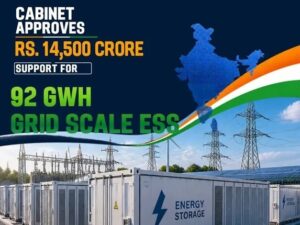
VGF SCHEME: KEY FEATURES AND TARGETS
- Financial Support: The scheme has a total outlay of ₹14,500 crore to promote large-scale energy storage infrastructure across India.
- Implementation Period: It will operate for five years, covering 2026-27 to 2030-31.
- Capacity Creation: The initiative aims to support 92 GWh of new, yet-to-be-commissioned energy storage capacity.
- Project Composition: The planned capacity includes:
- 60 GWh through hydro pumped storage plants (PSPs).
- 30 GWh through battery energy storage systems (BESS).
- 2 GWh through alternative energy storage technologies.
- Investment Requirement: The supported projects are expected to attract an estimated total investment of approximately ₹97,600 crore.
- Selection Process: Energy storage projects will be allocated through a tariff-based competitive bidding process.
- Eligible Participants: Both public and private sector electricity distribution companies (DISCOMs) will be eligible for VGF support for BESS and pumped storage projects.
- Capacity Contribution: The proposed 92 GWh capacity is equivalent to approximately 170% of India’s existing grid-scale storage capacity, according to the government.
SIGNIFICANCE FOR INDIA’S ENERGY TRANSITION
- Grid Stability: Energy storage helps balance electricity demand and supply, reducing fluctuations caused by renewable energy generation.
- Renewable Integration: It enables surplus solar and wind electricity to be stored and used when generation is low or demand is high.
- Investment Promotion: VGF improves the financial viability of capital-intensive storage projects and encourages private-sector participation.
- Manufacturing Boost: The scheme is expected to provide an impetus to domestic BESS manufacturing, supporting India’s clean-energy industrial ecosystem.
- Energy Security: Large-scale storage can reduce dependence on conventional power sources and improve electricity supply reliability.
- Long-Term Target: The initiative supports India’s requirement of approximately 411 GWh of grid-scale energy storage by 2031-32.
ABOUT ENERGY STORAGE TECHNOLOGIES:● Energy Storage System (ESS): Technologies that store electricity or energy for later use, helping balance the power grid. ● Battery Energy Storage System (BESS): Stores electricity in rechargeable batteries, commonly lithium-ion batteries, and releases it when required. ● Pumped Storage Plant (PSP): Uses surplus electricity to pump water to an upper reservoir and generates electricity by releasing it through turbines. ● Viability Gap Funding: Government financial assistance provided to economically desirable but financially unviable infrastructure projects to improve their commercial feasibility. |

