India's No.1 PU & Degree With Integrated IAS & IPS(UPSC/PSC) Training College.


C-Section Rates Surge in Birth Industry
Relevance
- GS Paper 2 Issues Relating to Development and Management of Social Sector/Services relating to Health, Education, Human Resources.
- Tags: #CaesareanSection #NFHS #Liveminteditorial #UPSCMains2024.
Why in the News?
The rising rate of C-sections in India, especially in private hospitals, raises concerns about medical necessity versus profit incentives, compromising women’s autonomy and healthcare resources.
Caesarean Sections: Beyond Julius Caesar
- The term ‘Caesarean section’ isn’t directly linked to Julius Caesar, despite his rumored birth.
- The ancient general may be surprised at the variety of reasons for modern C-sections.
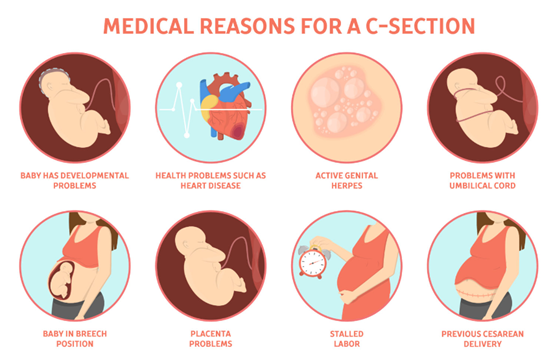
- They fall into three categories: medically necessary, elective, and potentially profit-driven.
- Medically necessary C-sections prioritize the safety of the mother and baby when vaginal birth poses risks.
- Elective C-sections are chosen by the mother for non-medical reasons, like personal comfort or scheduling.
- Profit-driven C-sections, though not directly stated, may involve financial incentives and are subject to ethical debates.
Rising Concerns: India’s Alarming C-Section Rates
- In India, the surge in C-section deliveries, particularly in private hospitals, sparks concern over potential financial-driven advice by some doctors, which are costlier than natural births.
- In India, these rates have surged, raising concerns about
- According to the National Family Health Survey, C-section deliveries increased from 17.2% in 2015-16 to an alarming 21.5% in 2019-21.
- Private hospitals exhibit even higher rates, with 48% of deliveries being C-sections, a significant increase from 41% in 2015-16.
- The World Health Organization recommends a C-section rate of 10-15% for optimal maternal and neonatal health.
Regional Disparities in C-Sections and Hysterectomies in India
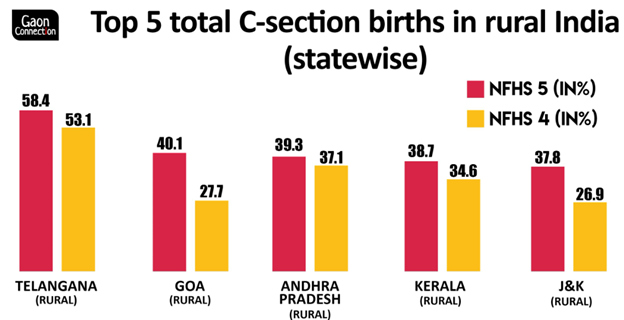
- NFHS-5 data reveals significant regional variations in C-section and hysterectomy rates.
- States like Telangana, Tamil Nadu, and Andhra Pradesh exhibit high C-section rates, with Telangana topping at 60.70%, while Nagaland reports a low 5.2%.
- Elevated hysterectomy figures are seen in Andhra Pradesh, Telangana, Bihar, and Ladakh.
- These disparities raise concerns about potential non-medical factors influencing the prevalence of such procedures, particularly in private hospitals.
Compromised Autonomy in C-Section Choices
- The majority of the time, a woman’s autonomy is undermined.
- Although medically recommended C-sections usually are unavoidable, it can be difficult to distinguish between recommendations that are voluntary and those that are driven by profit.
- Without receiving all the information from healthcare professionals, women can feel under pressure to select a single one, undermining their right to choose how to give birth.
C-Section Implications on Health
- C-sections have short- and long-term health implications.
- A Lancet study reveals increased risks for women, including uterine rupture, placental issues, stillbirths, and pre-term births, with higher risks in subsequent C-sections.
- Compared to vaginally born babies, these babies are exposed to distinct hormonal, physical, and microbiological settings.
- This can lead to a reduction in gut microbiome diversity, allergies, asthma, and immunity-related issues in short term.
- Long-term consequences, less studied, link C-sections to childhood obesity and asthma.
High Costs of C-Sections in India
- C-sections in India are costly, with an estimated annual excess expenditure of approximately ₹5,000 crore.
- This cost calculation, based on data from the National Sample Survey 75th round (2017-18), assumes that only 17% of C-sections are medically necessary.
- It reveals a substantial price difference, with C-sections being ₹16,475 more expensive in rural areas and ₹19,548 in urban settings compared to natural childbirth.
- Private hospitals charge significantly more, often 6-7 times the cost, further contributing to the economic burden of unnecessary C-sections.
Institutional Deliveries and C-Sections: The Insurance Factor
- The rise in institutional deliveries across India coincides with an increase in C-sections, raising concerns about underlying motivations.
- The expansion of private and government-backed insurance schemes provides financial security for patients but unintentionally incentivizes doctors to recommend costlier procedures.
- Assurance of insurance coverage may reduce barriers to opting for C-sections, even when medically unnecessary.
- This not only poses potential health risks but also strains healthcare resources unnecessarily.
Addressing High C-Section Rates: State and Union Government Efforts
- In India, the responsibility to address escalating C-section rates lies with state authorities due to health being a State subject.
- The Union government has initiated measures to counter this surge. It issued advisories aligning with WHO guidelines to health officials and professional bodies, fostering judicious C-section practices.
- The LaQshya audit in public hospitals aims to regulate C-section use, complemented by monitoring C-section rates in public and private facilities via the Health Management Information System. High rates are flagged for state review.
Excessive C-sections not only disregard women’s well-being and choices but strain healthcare resources. This trend erodes trust in healthcare, fostering a transactional approach unfit for childbirth. States must take active roles in rectifying this concerning trend for improved maternal care and healthcare integrity.
|
National Family Health Survey (NFHS)
Objectives of the NFHS
Major findings of the NFHS-5
|
Source: Livemint
Mains Questions
What are the factors contributing to the rising rate of Caesarean section (C-section) deliveries in India, describe the measures taken by the government, to address the high C-section rate?