 India's No.1 PU & Degree With Integrated IAS & IPS(UPSC/PSC) Training College.


INCOIS Warns of Marine Heat Waves, Swell Surges
INCOIS WARNS OF MARINE HEAT WAVES AND SWELL SURGES
WHY IN THE NEWS ?
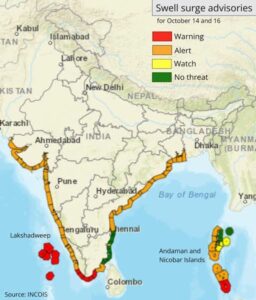
The Indian National Centre for Ocean Information Services (INCOIS) issued marine heat wave warnings across the Arabian Sea, Indian Ocean and Bay of Bengal. It also issued swell surge alerts for India’s eastern and western coasts, warning of potentially hazardous coastal waves.
MARINE HEAT WAVE: WARNING AND ENVIRONMENTAL IMPACT
- Issuing Authority: The warning was issued by INCOIS, a research organisation functioning under the Ministry of Earth Sciences (MoES).
- Affected Regions: Marine heat wave conditions have been reported across the Arabian Sea, Indian Ocean and Bay of Bengal.
- Intensity Classification: Most affected areas fall under the ‘Watch’ and ‘Alert’ categories, indicating sea surface temperature anomalies of up to 1°C above normal.
- Monitoring Framework: INCOIS monitors six ocean basins, including the Persian Gulf, Red Sea, Southern Indian Ocean and South China Sea.
- Coastal Assessment: The Indian coastline is divided into 14 sectors to facilitate detailed regional monitoring and impact assessment.
- Coral Reef Threat: Elevated ocean temperatures can cause coral bleaching, damage reef ecosystems and weaken marine biodiversity.
- Fisheries Impact: Marine heat waves can alter fish distribution, breeding patterns and marine productivity, affecting fisheries and coastal livelihoods.
- Ecological Consequences: Prolonged warming can increase the risk of biodiversity loss and disturb marine food chains.
SWELL SURGE ALERT: COASTAL RISK AND PREPAREDNESS
- Warning Period: INCOIS issued a swell surge warning for both eastern and western coastlines for the following two days.
- Expected Wave Height: Waves measuring one metre or higher are likely to affect several coastal regions.
- Affected States and Territories: The warning covers Gujarat, Goa, Maharashtra, Karnataka, Kerala, Odisha, Andhra Pradesh, Tamil Nadu, West Bengal, Puducherry, Lakshadweep and Andaman and Nicobar Islands.
- High-Risk Location: A specific danger alert was issued for Car Nicobar Island.
- Coastal Vulnerability: Strong swells can cause coastal inundation, erosion and hazardous conditions for fishing communities and coastal infrastructure.
- Preparedness Measures: Timely warnings, fishing advisories, coastal monitoring and public awareness are essential to minimise risks.
ABOUT MARINE HEAT WAVES AND OCEANOGRAPHY:● Marine Heat Wave: A prolonged period of unusually high sea surface temperatures compared with the local historical average. ● Swell Waves: Long-period ocean waves generally generated by distant weather systems and capable of travelling across large distances. ● Coral Bleaching: Occurs when stressed corals expel their symbiotic algae, often due to elevated sea temperatures. ● INCOIS: Established in 1999, it provides ocean information and advisory services, including tsunami warnings, ocean-state forecasts and potential fishing zone advisories. |

