 India's No.1 PU & Degree With Integrated IAS & IPS(UPSC/PSC) Training College.


Daily Current Affairs Digest | 21st May 2026
Daily Current Affairs Digest | 21st May 2026
1. India Semiconductor Mission 2.0: India’s Push for Chip Sovereignty
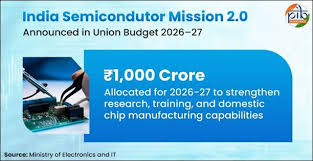
India Semiconductor Mission 2.0 marks the next phase of India’s effort to build a strong domestic semiconductor ecosystem. The Union Budget 2026-27 announced ISM 2.0 with focus on semiconductor equipment, materials, full-stack Indian intellectual property, industry-led research, training centres and supply-chain resilience. A provision of ₹1,000 crore has been made for FY 2026-27.
 Semiconductors are critical for mobile phones, automobiles, telecom networks, defence systems, satellites, artificial intelligence, medical devices and power electronics. The global chip shortage showed that excessive dependence on a few countries can create serious economic and national security risks.
For India, ISM 2.0 is not only an industrial policy initiative but also a strategic technology mission. It supports Atmanirbhar Bharat, Make in India, electronics manufacturing, defence self-reliance and supply-chain security.
Exam Relevance
Prelims Points:
India Semiconductor Mission comes under the Ministry of Electronics and Information Technology.
ATMP stands for Assembly, Testing, Marking and Packaging.
OSAT stands for Outsourced Semiconductor Assembly and Test.
RISC-V is an open-standard instruction set architecture useful for indigenous processor development.
Mains Linkage:
GS Paper III — Science and Technology, indigenisation of technology, industrial policy, infrastructure and supply-chain security.
2. India–Italy Special Strategic Partnership: IMEEC, Defence and Europe Outreach
India and Italy have elevated their bilateral relationship to a Special Strategic Partnership. During Prime Minister Narendra Modi’s visit to Rome on 20 May 2026, both sides reviewed the Joint Strategic Action Plan 2025-2029 and agreed to deepen cooperation in trade, investment, defence, maritime security, science and technology, education, culture and multilateral cooperation.
The partnership is especially important because Italy is a major European Union economy and a key Mediterranean power. Italy’s geographical location gives it significance in the India-Middle East-Europe Economic Corridor, which seeks to improve connectivity between India, West Asia and Europe through ports, shipping, rail, energy and digital links. The India–Italy Joint Declaration also highlighted cooperation under the Joint Strategic Action Plan 2025-2029 and strategic guidance for the Special Strategic Partnership.
This development strengthens India’s wider Europe outreach. It also supports India’s interest in resilient supply chains, defence industrial collaboration, critical minerals, clean technology, maritime transport and India-EU engagement.
 Exam Relevance
 Exam Relevance
Prelims Points:
Italy is a member of the European Union, G7 and NATO.
Rome is the capital of Italy.
IMEEC was announced during the G20 Summit in New Delhi in 2023.
The Mediterranean region is important for Europe-West Asia-North Africa trade routes.
Mains Linkage:
GS Paper II — Bilateral relations and India-Europe relations.
GS Paper III — Infrastructure, defence indigenisation and critical mineral supply chains.
3. 99.6% Railway Electrification: India’s Green Transport Milestone
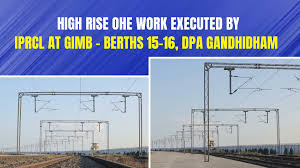
India has achieved 99.6% electrification of its broad-gauge railway network. As of March 2026, 69,873 route kilometres of broad-gauge railway lines were electrified. PIB described this as a major transformation in the environmental character of Indian Railways.
Railway electrification reduces dependence on diesel traction, improves energy efficiency and supports better freight and passenger movement. It is also linked with India’s climate commitments because electrified railways can become cleaner as the electricity grid includes a higher share of renewable energy.
 However, electrification does not automatically make railways carbon-neutral. The climate benefit depends on the source of electricity. If electricity is generated from renewable sources, the environmental gains become much stronger.
Exam Relevance
Prelims Points:
Railway electrification means use of electric traction instead of diesel traction.
Broad gauge is the dominant railway gauge in India.
Electrification reduces diesel dependence but does not automatically mean zero emissions.
Dedicated Freight Corridors and railway electrification together improve freight efficiency.
Mains Linkage:
GS Paper III — Infrastructure, energy security, logistics, environment and climate change mitigation.
4. Sanghmitra NGOPV: Indigenous Shipbuilding and Maritime Security
Yard 3039, named Sanghmitra, a Next Generation Offshore Patrol Vessel, was launched at Garden Reach Shipbuilders and Engineers, Kolkata, on 20 May 2026. The vessel was launched in the presence of senior Indian Navy, Ministry of Defence and GRSE officials.
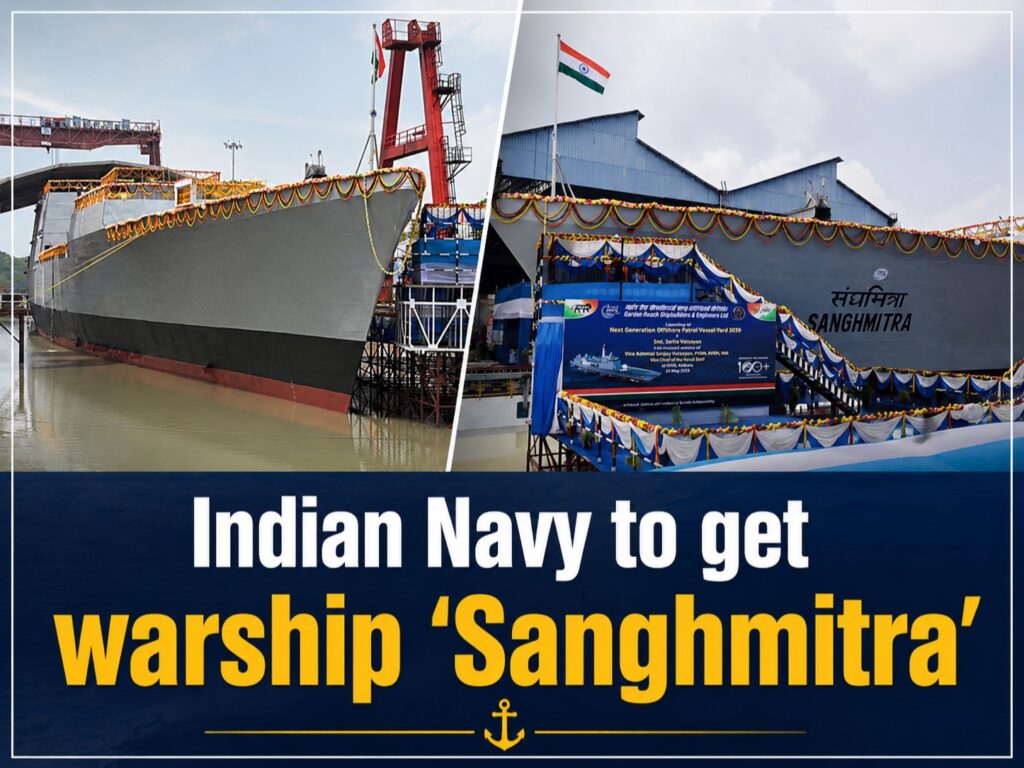 Sanghmitra is part of a larger programme under which 11 NGOPVs are being constructed concurrently at Goa Shipyard Limited and Garden Reach Shipbuilders and Engineers. These indigenously designed and built ships will support surveillance, search and rescue, protection of offshore assets, humanitarian assistance and disaster relief, and anti-piracy missions.
The launch is important for India’s maritime security architecture. The Indian Ocean Region is central to global trade, energy routes, undersea cables and strategic competition. Offshore patrol vessels help India maintain maritime domain awareness and respond to non-traditional maritime threats.
Exam Relevance
Prelims Points:
Sanghmitra is a Next Generation Offshore Patrol Vessel.
It was launched at GRSE, Kolkata.
GRSE stands for Garden Reach Shipbuilders and Engineers.
GSL stands for Goa Shipyard Limited.
HADR stands for Humanitarian Assistance and Disaster Relief.
Mains Linkage:
GS Paper III — Defence indigenisation, maritime security, coastal security and protection of offshore assets.
GS Paper II — Indian Ocean Region and India’s maritime diplomacy.
5. FAO Agricola Medal 2026: Recognition of India’s Food Security Model
Prime Minister Narendra Modi received the FAO Agricola Medal 2026 from the Food and Agriculture Organization of the United Nations at FAO Headquarters in Rome. The honour recognised leadership in food security, sustainable agriculture and rural development.
The development highlights India’s shift from production-centric agriculture to climate-resilient and technology-enabled agriculture. India has focused on micro-irrigation, Per Drop More Crop, precision farming, digital agriculture, AI-based advisories, drones, remote sensing and climate-resilient crop varieties.
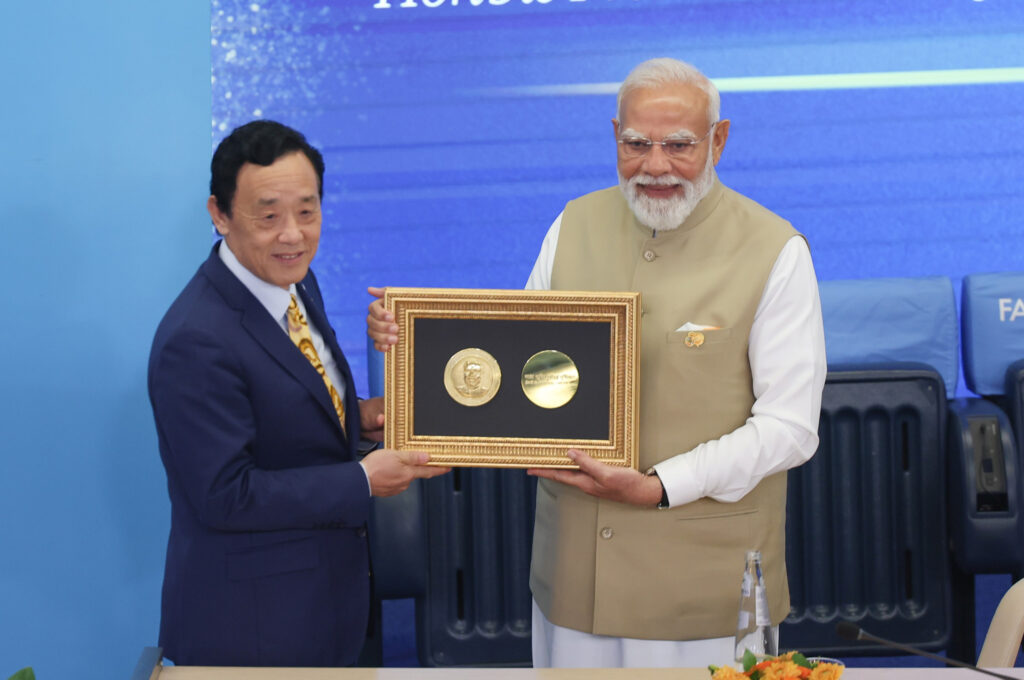
PM conferred with the Food and Agriculture Organizations highest honour – The FAO Agricola Medal 2026 during the conferment ceremony held at FAO Headquarters in Rome, Italy on May 20, 2026.
This is important at a time when agriculture faces challenges such as water stress, erratic monsoon, heatwaves, pest attacks, post-harvest losses and fragmented landholdings. India’s agricultural model is also relevant for Global South cooperation, especially through millets, digital agriculture and affordable climate-resilient farming practices.




