 India's No.1 PU & Degree With Integrated IAS & IPS(UPSC/PSC) Training College.



Daily Current Affairs Digest | 20th May 2026
Daily Current Affairs Digest | 20th May 2026
1. RBI Removes Investment Fluctuation Reserve Rule: Impact on Banks and Financial Stability
The Reserve Bank of India (RBI) has discontinued the Investment Fluctuation Reserve (IFR) requirement for banks effective May 18, 2026. Previously, banks maintained this reserve to absorb losses from fluctuations in the value of their investment portfolios, particularly government and corporate bonds.
 Key Highlights:
- The IFR served as a prudential buffer for interest-rate and market-price risks.
- RBI now considers existing capital charges and revised investment portfolio norms sufficient to manage market risks.
- Outstanding IFR balances as of May 17, 2026, will be treated as Tier 1 capital and transferred to appropriate reserves like Statutory Reserve or General Reserve.
Implications:
- Greater flexibility in bank capital management.
- Supports credit growth while maintaining regulatory oversight.
- Risk management now relies on broader capital adequacy and market-risk frameworks rather than rule-based reserves.
2. BCCI Not Under RTI: Transparency and Governance
The Central Information Commission (CIC) clarified that the Board of Control for Cricket in India (BCCI) is not a public authority under the Right to Information Act (RTI), 2005. Although BCCI performs functions of national importance, such as team selection and tournament organisation, it remains a private body.
 Key Points:
- RTI Section 2(h) defines a public authority as an entity owned, controlled, or substantially financed by the government.
- BCCI does not receive substantial government funding; tax exemptions or concessions alone do not classify it under RTI.
- CIC stressed voluntary transparency and governance reforms in sports administration remain crucial.
Implications:
- Upholds the autonomy of sports bodies while emphasizing accountability.
- Highlights the need for clearer statutory frameworks for sports governance.
- Encourages voluntary disclosure of finances, selection processes, and conflict-of-interest policies.
3. Operation Antim Prahar in Gadchiroli: LWE and Security-Development Strategy
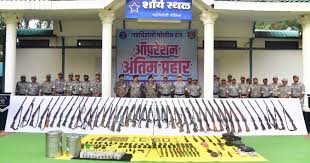
Following Operation Antim Prahar, Gadchiroli in Maharashtra has reportedly become free from active Naxalite presence. The district, a historic Maoist stronghold, saw arrests, surrenders, and seizures that significantly weakened extremist networks.
 Key Highlights:
- Security operations were complemented by development initiatives targeting tribal areas.
- Gadchiroli’s location, dense forests, and tribal population made it a strategic focus for Left-Wing Extremism (LWE) management.
- Rehabilitation and rights-sensitive development are integral to sustaining security gains.
Implications:
- Effective anti-LWE strategy requires both security and socio-economic interventions.
- Strengthened tribal governance, forest rights enforcement, and local police capacity are essential.
- Serves as a case study for the security-development continuum in India.
4. Made-in-India Airbus C-295: Boost to Defence Manufacturing
India’s first domestically assembled Airbus C-295 military transport aircraft is now ready for flight testing at the Tata-Airbus facility in Vadodara. This marks a milestone in India’s defence manufacturing and the Atmanirbhar Bharat initiative.
 Key Highlights:
- The C-295 will replace the ageing Avro-748 fleet of the Indian Air Force.
- 56 aircraft contracted: 16 fly-away and 40 manufactured in India.
- Project involves private-sector manufacturing, technology transfer, and supplier development.
Implications:
- Enhances defence indigenisation and strategic autonomy.
- Creates aerospace manufacturing ecosystems and skilled employment.
- Supports Make in India, export readiness, and long-term industrial capability.
5. Mount Dukono Eruption in Indonesia: Volcanic Activity and Disaster Preparedness
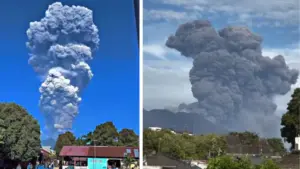
The Dukono volcano in North Maluku, Indonesia, erupted in May 2026, sending ash high into the atmosphere. Authorities have issued safety advisories for surrounding areas.
 Key Highlights:
- Indonesia lies along the Pacific Ring of Fire, making it volcanically active.
- Dukono’s eruption affects aviation, agriculture, and local health.
- Continuous monitoring, hazard zonation, and community drills are vital for disaster management.
Implications:
- Highlights the importance of early warning systems and emergency preparedness.
- Volcanic activity provides learning for disaster management frameworks in India and globally.
- Reinforces the connection between plate tectonics, volcanic hazards, and human safety.




