 India's No.1 PU & Degree With Integrated IAS & IPS(UPSC/PSC) Training College.


5 Years of NEP 2020: Achievements & Challenges
FIVE YEARS OF NEP 2020: POLICY, MISREADINGS, AND MISSED OPPORTUNITIES
Syllabus:
GS-2:
- Government Policies and intervention
- Social Sectors : Education
Why in the News?
The National Education Policy (NEP) 2020 marks its fifth anniversary this year. As a transformative blueprint for India’s education system, its implementation has remained partial, misunderstood, or politically misrepresented. While the pandemic delayed progress, some of the policy’s foundational shifts in school education are underway—but public discourse remains clouded by misinterpretation and indifference.
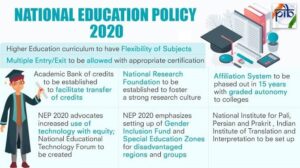
PUBLIC MISREADING OF NEP 2020
A significant challenge has been misrepresentation of NEP provisions by states, institutions, and political actors.
- Widespread Ignorance: Many institutions claim alignment with NEP while implementing ideas completely absent from the policy. This reflects either ignorance or deliberate distortion.
- Contradictory Behaviour: States that oppose the NEP often follow its key suggestions, and some states claim full implementation despite doing very little.
- Language Formula Confusion: The three-language formula, present since 1968 and made more flexible in NEP, triggered political backlash based on misunderstood assumptions.
- Privatization Claims: Critics allege that the NEP promotes privatization, despite the policy’s strong emphasis on public education strengthening.
- Superficial Engagement: Many critiques stem from not reading the NEP thoroughly, leading to projection of anxieties not grounded in its actual text.
EARLY CHILDHOOD EDUCATION PUSH
The NEP has catalyzed a long-overdue system-wide focus on early childhood education (ECE).
- Foundational Focus: Ages 3 to 8 are vital for physical, cognitive, and emotional development—yet they were neglected until NEP initiated reforms.
- Anganwadi Integration: The policy empowers anganwadi centres with curricular upgrades and teacher training to integrate them into mainstream education.
- Curricular Overhaul: New curricula and pedagogy aligned with ECE are being developed and deployed, tailored to young children’s needs.
- Equity Enhancement: By reaching children from disadvantaged backgrounds early, the NEP paves the way for educational equity.
- Momentum Risk: While momentum is building, sustaining it requires continued investment and monitoring to prevent policy fatigue.
MOTHER TONGUE INSTRUCTION INITIATIVE
The NEP’s recommendation to use the mother tongue in early learning is a key pedagogical reform.
- Evidence-Backed: Studies confirm children learn best in familiar languages, making early literacy stronger and long-lasting.
- Multilingual Accommodation: The NEP recognizes India’s linguistic diversity, allowing states to craft policies reflecting local realities.
- English Balance: The policy does not oppose English learning but aims for sequential acquisition, beginning with the mother tongue.
- Literacy-Numeracy Synergy: This change is being aligned with efforts to improve foundational literacy and numeracy (FLN).
- Positive Impact: As states adopt mother tongue-based instruction, basic learning outcomes are expected to rise substantially.
REFORMS IN TEACHER EDUCATION
One of the most transformative yet under-acknowledged NEP reforms lies in revamping teacher education.
- Chronic Weakness: India’s teacher education has long suffered from corruption, poor quality, and lack of standardization.
- Integrated Programs: NEP introduces four-year integrated B.Ed. programs in leading universities to make teacher training rigorous and holistic.
- Quality Benchmarking: These programs are envisioned to become the standard qualification, replacing the fragmented and often unregulated system.
- Regulatory Reforms: Bodies like the National Council for Teacher Education (NCTE) are being reshaped to uphold higher standards.
- Systemic Change: If implemented faithfully, this reform could redefine teaching as a profession, boosting both quality and prestige.
NEP’S TRANSFORMATIVE POTENTIAL
Despite obstacles, the NEP holds deep transformative potential akin to India’s Constitution.
- Visionary Scope: The NEP sets a 20-year roadmap, blending immediate milestones with long-term goals for structural change.
- Inclusivity Focus: It aims to democratize education by improving access, particularly for the marginalized and disadvantaged.
- Flexibility Emphasis: The policy encourages choice-based systems, skill-building, and a learner-centric model of schooling.
- Curricular Innovation: There is emphasis on critical thinking, experiential learning, and reducing rote memorization.
- People’s Participation: Like the Constitution, the NEP requires citizen engagement, political will, and stakeholder collaboration to succeed.
IMPLEMENTATION GAPS AND CONCERNS
Several on-ground realities still hinder NEP’s widespread implementation and acceptance.
- Pandemic Disruption: COVID-19 derailed educational progress for two critical years, delaying foundational reforms.
- Lack of Clarity: Many state governments are yet to articulate a roadmap for phased NEP implementation.
- Uneven Rollout: Progress has been non-uniform—some regions advance rapidly, others remain inactive or resistant.
- Political Polarization: The policy has been mired in ideological debates, diluting attention from its core educational principles.
- Monitoring Mechanisms: Absence of robust progress tracking systems impedes evaluation of real-time impact.
WHAT NEEDS TO BE DONE
To ensure NEP fulfills its transformative promise, decisive and coordinated action is essential across all levels.
- Awareness Campaigns: Launch widespread efforts to educate stakeholders—teachers, parents, administrators—on NEP’s actual provisions.
- Capacity Building: Invest in teacher training, curriculum design, and institutional readiness for implementing structural shifts.
- State Collaboration: Strengthen Centre-State coordination, allowing for contextual adaptation of NEP principles.
- Assessment Frameworks: Create transparent evaluation metrics to monitor milestones and ensure accountability.
- Public Financing: Increase public investment in education to match policy ambition with real resources, especially for infrastructure and equity.
CONCLUSION
Five years on, the National Education Policy 2020 remains a powerful yet underutilized framework for systemic change. While the pandemic slowed initial implementation, public misunderstanding and political misrepresentation pose greater threats. For NEP to achieve its potential, it must be understood in letter and spirit, acted upon systematically, and shielded from ideological distortions. We owe this to the generations who will inherit its outcomes.
SOURCE: Mint
MAINS PRACTICE QUESTION
Despite its visionary proposals, the National Education Policy 2020 has struggled with effective implementation and public understanding. Critically examine the key challenges in NEP’s rollout and suggest ways to overcome them.

