India's No.1 PU & Degree With Integrated IAS & IPS(UPSC/PSC) Training College.


10th January 2026 – Current Affairs Highlights
10 January 2026 – Current Affairs Overview
1. Pravasi Bharatiya Divas 2026: Celebrating India’s Global Diaspora
Pravasi Bharatiya Divas 2026 celebrates India’s 35-million-strong diaspora, recognising overseas Indians as cultural ambassadors, investors, innovators, and strategic connectors. Observed on 9 January, the day marks Mahatma Gandhi’s return to India in 1915, symbolising the historic role of the diaspora in India’s freedom movement.
Beyond symbolism, the event strengthens cultural identity, promotes diaspora investment, enables knowledge transfer, and reinforces India’s global soft power. Today, overseas Indians play a decisive role in sectors ranging from technology and healthcare to geopolitics and development finance.
2. Poland Backs India on Russian Oil Amid Global Energy Realignments
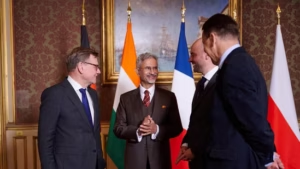 In a notable diplomatic development, Poland backed India amid US pressure over Russian oil imports. This support emerged during the first-ever Weimar Triangle dialogue involving India, held in Paris.
Warsaw acknowledged India’s reduced oil imports and recognised New Delhi’s energy security compulsions. The move reflects growing European pragmatism as the Ukraine war, energy disruptions, and geopolitical fragmentation reshape global diplomacy. It also highlights Europe’s willingness to engage India as a strategic partner rather than a rule-taker.
3. CDS on Operation Sindoor: Strategic Pressure on Pakistan Continues
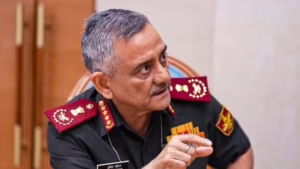 India’s Chief of Defence Staff General Anil Chauhan stated that Pakistan’s hasty military and constitutional responses following Operation Sindoor exposed deep institutional weaknesses. Speaking in Pune, he clarified that the operation is paused, not concluded.
The statement signals a shift in India’s national security doctrine—from episodic retaliation to sustained strategic pressure, reinforcing deterrence while maintaining escalation control. It underlines India’s intent to keep the initiative firmly in its hands.
4. Parliament’s Budget Session 2026: Key Dates and Significance
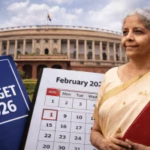 India’s Parliament Budget Session will run from 28 January to 2 April 2026. The Union Budget will be presented on 1 February, despite it being a Sunday, while the Economic Survey will be tabled on 29 January.
The session has been approved by Droupadi Murmu, marking a crucial moment for people-centric governance, fiscal consolidation, welfare spending, and reform-oriented policymaking in a challenging global economic environment.
5. Madhav Gadgil Report: Environmental Warnings Vindicated
The Madhav Gadgil Committee Report (2011) warned that unregulated development in the Western Ghats would trigger ecological disasters. Its recommendations—zoning, local governance, and sustainability—were largely ignored, highlighting the need for stringent environmental clearances and adherence to the Forest Conservation Act.
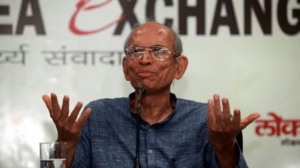 Today, recurring floods, landslides, and climate-induced stress across the Ghats have vindicated the report’s science-based approach. The episode underscores the importance of proper environmental impact assessments and the risks of granting ex post facto or retrospective environmental clearances.
The report’s emphasis on preserving the Coastal Regulation Zone has gained renewed relevance in light of recent natural disasters. This situation exemplifies the need for robust environmental jurisprudence and the application of the precautionary principle in development projects.
The recent Vanashakti judgment further reinforces the Gadgil Report’s recommendations, stressing the importance of the EIA notification process. This episode highlights the cost of sidelining ecological wisdom in favour of short-term economic gains, emphasizing the need for a balance between development and environmental conservation.
6. India Rejects China’s Infrastructure Push in Shaksgam Valley
 India has firmly rejected China’s infrastructure development in the Shaksgam Valley, reiterating that the territory is an integral part of India. New Delhi also dismissed the 1963 China–Pakistan ‘Boundary Agreement’, under which Pakistan illegally ceded 5,180 sq km of Indian territory.
India has made it clear that it will take all necessary measures to safeguard its sovereignty, reinforcing its consistent position on territorial integrity and international law.
7. Harvest Festivals 2026: Unity Through Cultural Diversity
 As January unfolds, India celebrates major harvest festivals—Lohri, Makara Sankranti, Pongal, and Magh Bihu. Rooted in solar transition and agrarian cycles, these festivals blend folk traditions, rituals, and community life.
Bonfires of Lohri, kolam and Pongal pot offerings in Tamil Nadu, kite-flying during Sankranti, and energetic Bihu dances together reflect India’s cultural unity expressed through regional diversity—a living civilisational tradition.
Conclusion
The current affairs of 10 January 2026 capture India’s evolving role—globally engaged, strategically assertive, culturally rooted, and environmentally challenged. From diaspora diplomacy and defence strategy to parliamentary governance and ecological lessons, these developments offer critical insights for competitive examinations and informed citizenship alike.
The Madhav Gadgil Report controversy underscores the ongoing struggle to balance development with environmental protection, highlighting the need for stronger environmental democracy and the application of the polluter pays principle. As India moves forward, the challenge lies in fostering economic growth while ensuring a pollution-free environment for future generations.